

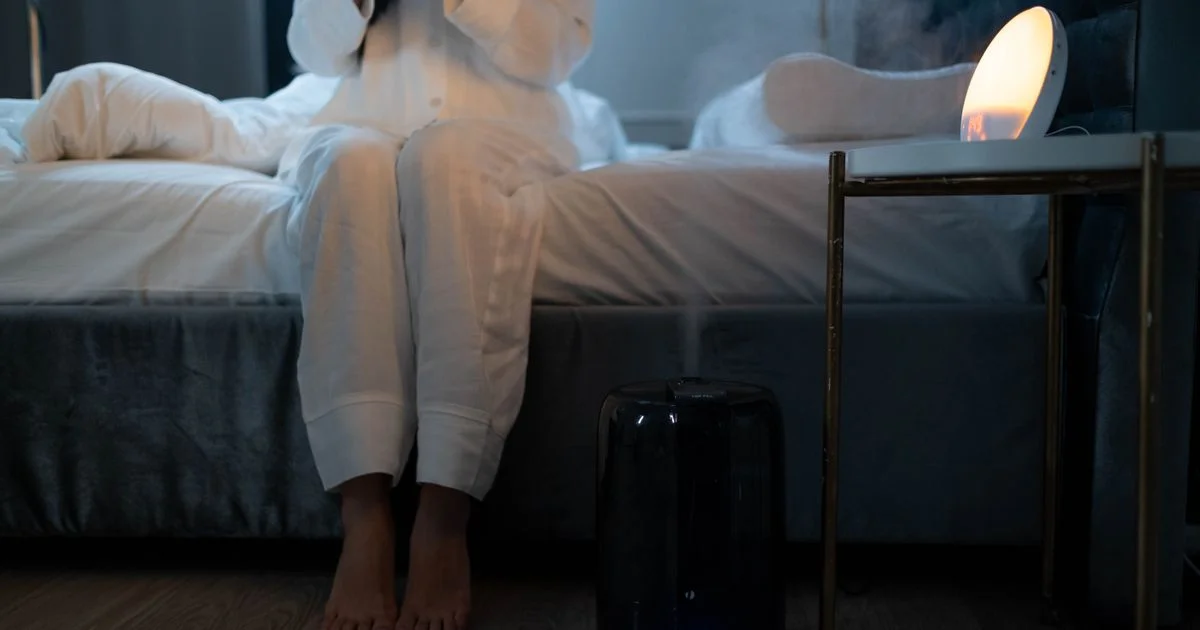
The furnace comes on in October. By the second week of November the doorknobs are shocking people, lips are cracking, and somebody in the house is scrolling through listings at eleven at night. That chain of small irritations is how a humidifier for bedrooms usually gets bought — which is a shame, because the decision that matters is not which machine you pick but which number you are aiming at, and almost nobody sets that number before the box arrives.
A humidifier puts water into the air you breathe, and a steam vaporizer boils that water. The EPA and MedlinePlus guidance summarized below is general information about indoor air, not medical advice; a cough, a rash or a breathing problem that persists belongs with a clinician rather than with an appliance.
Use case 1: a humidifier for bedrooms starts with a target, not a model
Every useful decision downstream depends on one figure. The EPA’s guidance on biological contaminants indoors is to keep relative humidity “below 60 percent indoors, and ideally between 30-50 percent,” and its asthma guidance repeats the same window — “maintain low indoor humidity, ideally between 30-50% relative humidity.” MedlinePlus narrows it further for a running humidifier: “set the unit to 40% to 50% humidity.” The EPA’s own humidifier fact sheet states the ceiling as an instruction rather than a suggestion: “do not humidify to indoor relative humidity levels exceeding 50 percent.”
That range is the whole product brief. Below it, the dry-air complaints start. Above it, a different and worse set of problems starts, because damp air condenses on cold surfaces and feeds things you do not want in a bedroom. The EPA describes the mechanism plainly: “when humid air contacts a cold surface, water vapor can condense, much like when moisture condenses on the outside of a cold glass of water.”
Which means the first purchase for a bedroom is not the humidifier. It is something that reads the room, so you know whether you have a problem, and later, whether you have overcorrected.
Use case 2: a humidifier for winter in an older house
Winter dryness indoors is a side effect of heating cold outside air, and older houses with single-pane windows and drafty frames run drier and colder at the glass than newer ones. That combination is exactly where the ceiling gets breached. Add moisture to a room whose windows sit near freezing and the water does not stay in the air — it collects on the glass, runs down onto the sill, and sits there.
A humidifier for winter in that kind of house needs a shorter leash than one in a tight, modern bedroom. The check takes ten seconds and costs nothing:
- Look at the windows first thing in the morning. A fogged pane or beads of water on the frame means the room went past its ceiling overnight.
- Touch the wall behind furniture on an exterior wall. MedlinePlus puts it directly: “if room surfaces are constantly damp or wet to the touch, mold and mildew can grow.”
- Turn the output down before you turn it off. The goal is the 30 to 50 percent window, not the absence of the machine.
Bedroom comfort in winter is a temperature problem as often as a moisture one, and the two get confused constantly — our guide to a cooling mattress pad for hot sleepers covers the other half of that argument.

Use case 3: a humidifier for babies, and the rule that is not negotiable
A nursery is the situation where the type of machine stops being a preference. The EPA’s fact sheet describes several kinds — console and portable units, ultrasonic, impeller, evaporative, and steam vaporizer — and attaches one warning to the last of them: “keep steam vaporizer humidifiers out of the reach of children. Steam and boiling water may cause burns.” MedlinePlus says the same thing from the other direction: “warm mist humidifiers can cause burns if a person gets too close,” which is why cool-mist models are the standard advice for a child’s room.
Anyone shopping for a humidifier for babies can treat that as a filter applied before any other feature. Beyond it, the placement rules are the ordinary ones for a nursery: the unit on a hard surface the mist will not soak, well away from the crib, and the cord run so it cannot be pulled or reached. And the honest caveat is that added moisture is a comfort measure for a stuffy room; a persistent cough in an infant is a reason to call a pediatrician, not to buy a larger tank.
Use case 4: a humidifier for dry skin, and what it cannot do
This is the claim that sells the most units and survives the least scrutiny. A machine raises the relative humidity of a room. It does not apply anything to a person, and it works only while you are in that room with the door closed. A humidifier for dry skin is doing something real — it stops the air pulling moisture out of everything in the room quite so fast — but it is doing it indirectly, and only inside the 30 to 50 percent window that the rest of the room’s health also depends on.
Pushing past that window to chase a skin result makes things worse rather than better. The EPA lists the consequences of damp indoor air in blunt terms: mold and allergens producing “asthma symptoms (including coughing, chest tightness, wheezing and trouble breathing)” and allergic reactions, and Legionella bacteria causing “Legionnaires’ disease, a serious type of pneumonia, and Pontiac fever, a mild respiratory illness.” A bedroom held at 60 percent to soothe dry skin is trading one discomfort for a list of worse ones.
Use case 5: a bedroom you sleep in every night, where the cleaning schedule is the product
The EPA is unambiguous about what a tank of standing water becomes: “microorganisms often grow in humidifiers which are equipped with tanks containing standing water.” It is equally unambiguous about the cadence that prevents it, and the cadence is more demanding than anyone expects at the checkout:
- Every day: “empty the tank, wipe all surfaces dry, and refill the water in portable humidifiers daily.” MedlinePlus states the same requirement — humidifiers “must be drained and cleaned daily, because bacteria can grow in standing water.”
- Every third day: “clean portable humidifiers every third day,” following the manufacturer’s instructions for the model you own.
- Every refill: water choice. The EPA notes that ultrasonic and impeller units “are very efficient at dispersing minerals in tap water into the air,” producing the white dust that shows up on nearby surfaces. Its recommendation is bottled water labeled “distilled,” or a demineralization cartridge — and it flags that spring, artesian and mineral waters have not had that treatment. MedlinePlus adds that those minerals can be “released into the air as white dust and cause breathing problems.”
For a machine that runs next to your head for eight hours a night, that schedule is not optional maintenance — it is the difference between adding moisture to a room and aerosolizing whatever has been growing in the tank since Tuesday. Anyone who knows they will not keep to it should treat that as the real buying signal, and a smaller tank emptied daily beats a large one that never is.
Side-by-side by situation
| Your situation | What it actually needs | What to skip |
|---|---|---|
| You have never measured the room | A humidity reading before anything else | Buying to a symptom rather than a number |
| Old house, cold single-pane windows | Lower output, a morning window check | Running it unattended all night at full |
| Nursery or a child’s room | Cool mist, placed out of reach, cord secured | Steam vaporizers anywhere a child can reach |
| Dry skin is the whole reason | The 30 to 50 percent window, and nothing above it | Chasing a skin result past the ceiling |
| You know you will not clean it daily | A small tank you will actually empty | A large-capacity unit as a labor saver |
| Hard tap water, white dust on surfaces | Distilled water or a demineralization cartridge | Spring, artesian or mineral water as a substitute |
Related Articles
- Top 5 Air Purifiers for Allergies Under 150: A Buyer’s Guide
- Best Smart Thermostat for Energy Savings: Rental or Old House
- Best Smart Plug for Home Automation: A Buyer’s Guide
Frequently Asked Questions
These are the questions that decide whether a unit helps or quietly creates a second problem. The answers come from published EPA and MedlinePlus guidance rather than from product descriptions.
What humidity level should a bedroom sit at?
The EPA’s window is 30 to 50 percent, with an instruction not to humidify past 50 percent, and MedlinePlus suggests setting a unit to 40 to 50 percent. Anything approaching 60 percent indoors is the point at which condensation and mold become the bigger risk.
Cool mist or warm mist for a child’s room?
Cool mist. The EPA tells owners to keep steam vaporizers out of the reach of children because steam and boiling water may cause burns, and MedlinePlus notes that warm mist units can burn anyone who gets too close.
Is tap water really a problem?
In ultrasonic and impeller units it can be. The EPA describes them as very efficient at dispersing the minerals in tap water into the room, which is the white dust people find on furniture; MedlinePlus links that dust to breathing problems. Distilled water or a demineralization cartridge is the published fix.
How often does it genuinely need cleaning?
The tank gets emptied, wiped dry and refilled daily, and the unit itself cleaned every third day, per the EPA. That is the schedule the health guidance assumes you are keeping, and skipping it is what turns a humidifier into a source of the problems it was bought to relieve.
Conclusion
Buy the reading before the machine, aim at 30 to 50 percent, and pick the size of tank you will genuinely empty every morning. A modest unit that is cleaned on schedule does more for a bedroom than a large one that runs unattended past its ceiling.


