

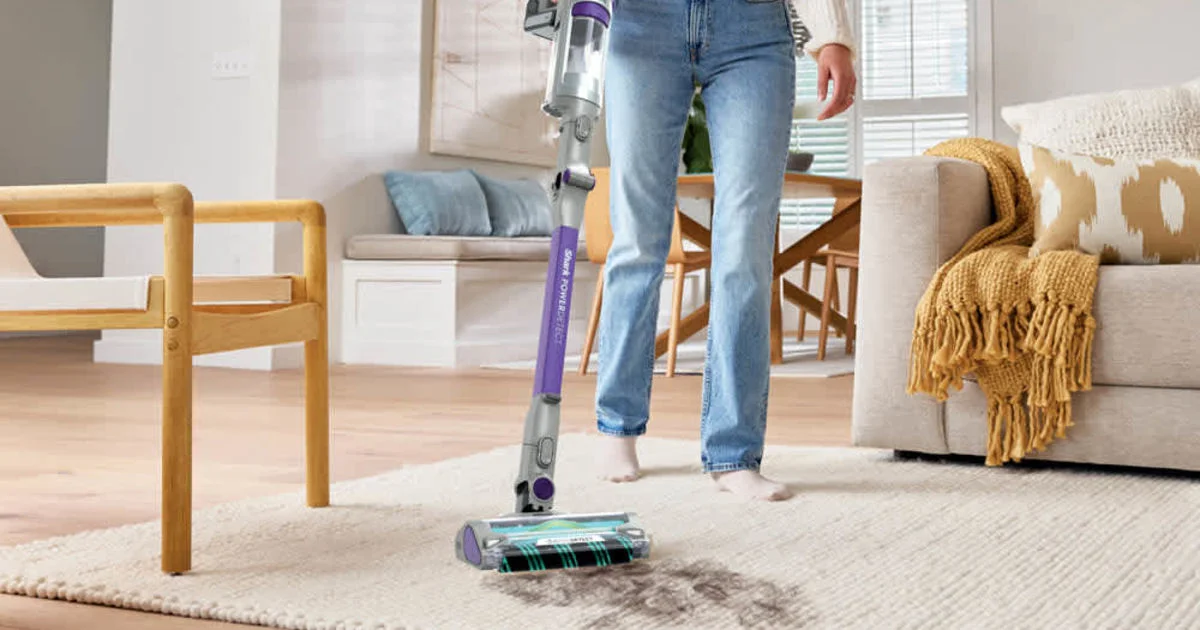
A vacuum that lives in a closet gets used on Saturdays. One that lives where you can reach it gets used on Tuesdays too, and with animals in the house that difference is the whole argument. Choosing a cordless stick vacuum cleaner for pet hair from Shark’s range is less about which model claims more and more about which of four situations you are actually in: daily shedding, hard floors with rugs between them, an apartment with nowhere to put anything, and stairs.
This is an independent editorial review. Shark did not review or approve this article.
Every cordless vacuum here runs on a lithium-ion battery pack charged indoors. Charge it the way your own model’s manual says, and stop using a pack that is swollen, cracked or unusually hot rather than continuing to charge it.
You can see Shark’s current lineup on its official site: Visit Shark
Use case 1: A cordless stick vacuum cleaner for pet hair in a house that sheds every day
Daily shedding is a scheduling problem before it is a suction problem. The machine has to be quick enough to pick up without ceremony, and it has to deal with hair that wraps rather than lifts.
Shark builds its answer into the brushroll rather than the settings. On its PowerPro Pet model, the company lists a “Self-cleaning brushroll for powerful pet hair pickup with no hair wrap”, alongside “LED HEADLIGHTS: For illumination of dark areas to easily spot dust & small debris” and an “Anti-Allergen Complete Seal” that it says “Captures and traps over 99.97% of dust and allergens”. Higher up the range, Shark describes its Stratos cordless line as “Shark’s most advanced deep-cleaning cordless vacuums”, with “Clean Sense IQ finds the dirt & dander you can’t see” and “Odor Neutralizer Technology for a fresh-smelling home”. The odor feature is the one aimed squarely at animals rather than at dust.
If anyone in the house has asthma, the Environmental Protection Agency’s own guidance changes when you clean rather than what you buy. It states that “Proteins in your pet’s skin flakes, urine, feces, saliva and hair can trigger asthma”, advises keeping pets out of the bedroom of the person with asthma and off the furniture, and adds the instruction people usually miss: “Vacuum carpets and furniture when the person with asthma is not around.” It also recommends using “a vacuum with a HEPA filter on carpet and fabric-covered furniture to reduce dust build-up”. A sealed, filtered cordless machine is only half of that advice; the other half is the timing, and it costs nothing.
Use case 2: A cordless stick vacuum cleaner for hardwood floors with rugs in between
An open-plan floor is rarely one surface. It is boards, then a rug, then boards again, and hair behaves differently on each. A cordless stick vacuum cleaner for hardwood floors has to stop flinging debris on the bare sections and still agitate the pile when it crosses onto the rug.
Shark automates that transition rather than leaving it to a switch. On the PowerPro it lists “FLOORDETECT TECHNOLOGY: Detects floor type and automatically adjusts brushroll speed for maximized performance on all surfaces”. On its PowerDetect cordless model it describes a “DuoClean Detect nozzle” that “has forward AND reverse debris pickup for faster cleaning”, along with edge, floor and dirt sensing built into the same head. In a room where you cross a floor boundary every few steps, an automatic adjustment is worth more than a better manual setting you will forget to use.
Two habits do the rest on wood, whatever machine you own:
- Work along the boards rather than across them, because the gaps between planks run that way and so does the hair that settles in them.
- Do the rug last. Carpet releases fine dust into the air, and vacuuming it before the hard floor puts that dust straight back down where you have just cleaned.
Use case 3: A cordless stick vacuum cleaner for small apartments, and where it lives between cleans
In a small home the decision is storage, not cleaning. A cordless stick vacuum cleaner for small apartments is competing for a closet that already has a coat rail in it, and in a rental you may not be allowed to put a mounting bracket on the wall at all.
That makes the folding designs genuinely relevant rather than a gimmick. Shark says its “MultiFLEX technology allows you to bend the wand to clean under furniture, or fold it over for compact, flex storage”, which turns a full-length stick into something that stands in a cupboard without a bracket. The removable battery matters in the same way: Shark lists a “Removable quick-charge battery” on its PowerPro, which means the pack can charge on a shelf near an outlet while the vacuum itself stands somewhere with no socket at all. In a studio with three outlets, that is the difference between a machine that is always charged and one that lives permanently plugged into the only free socket in the room.
Work through storage in this order before you choose a model:
- Measure the place it will actually stand, not the place you imagine it standing. Behind a door counts.
- Check whether that spot has an outlet. If it does not, a removable battery is the feature that makes the spot usable.
- Confirm what your lease allows before planning on a wall mount, because a bracket is a hole in someone else’s wall.
- Try folding it once in the store or on day one. A storage feature you find fiddly is a storage feature you stop using.

Use case 4: A cordless stick vacuum cleaner for stairs and everything above the floor
Stairs are where full-size vacuums lose, because the machine has to be carried rather than pushed, and it has to be held at an angle for several minutes. A cordless stick vacuum cleaner for stairs earns its place by not being a stick at all for that part of the job.
Shark’s cordless models detach into a handheld. It describes the PowerDetect as one that “Converts to a lightweight hand vac for easier abovefloor cleaning”, and lists a “Removable hand vac” on the PowerPro. The attachments are what decide how useful that is: the PowerDetect ships with an 8″ Duster Crevice Tool and a Pet Multi-Tool, while the PowerPro comes with a Crevice Tool and an Anti-Allergen Brush. For a staircase, the crevice tool does the tread edges where hair gathers against the riser, and the motorized or bristled pet tool does the carpet itself.
The same detached mode is what handles the places pet hair really accumulates: the couch cushion seams, the car seats, the top of a cat tree, and the strip of carpet right against the baseboard. None of those are floor jobs, and a machine that cannot become small enough to do them leaves the hair exactly where the animal put it.
Side-by-side by situation
| Your situation | What that situation needs | Shark feature that answers it |
|---|---|---|
| Long-haired pet, daily shedding | A brushroll that does not wrap, and odor control | Self-cleaning brushroll; Odor Neutralizer Technology on the Stratos line |
| Someone in the house with asthma | Sealed filtration, plus cleaning while they are out of the room | Anti-Allergen Complete Seal, with the EPA’s timing advice doing the rest |
| Hardwood with rugs in between | Automatic adjustment at every floor boundary | FloorDetect brushroll speed; DuoClean Detect nozzle |
| Small apartment or rental | Somewhere to stand it with no bracket and no dedicated socket | MultiFLEX fold-over storage; removable quick-charge battery |
| Stairs, upholstery and the car | A machine light enough to hold at an angle, with the right nozzle | Hand vac conversion; crevice tool and pet tool attachments |
Related Articles
- Robot Vacuum for Pet Hair: What Actually Picks It Up
- Steam Mop for Hardwood Floors: What Your Floor Actually Is
- Top 5 Air Purifiers for Allergies Under 150: A Buyer’s Guide
Frequently Asked Questions
These come up once the machine is in the house and the first week of using it has changed a few assumptions.
Does a self-cleaning brushroll mean I never have to cut hair off it?
It means far less of it. Shark describes the design as giving pet hair pickup “with no hair wrap”, and on long hair that is a real difference rather than a marketing one. It does not remove the need to look at the nozzle occasionally, particularly if anyone in the house has very long hair or the floor collects thread and string.
Is a cordless machine enough for a whole house with two animals?
For a daily pass, yes, and that is the job it is best at. For an occasional deep clean of wall-to-wall carpet across several rooms in one session, plan to clean in stages rather than expecting one uninterrupted run, and keep the charging point somewhere you pass.
Which attachment actually helps most with pet hair?
The one with a brush or a driven roller, used on fabric. Shark supplies a Pet Multi-Tool with its PowerDetect and an Anti-Allergen Brush with the PowerPro. A plain crevice tool is for edges and seams; it will not lift hair that is woven into upholstery.
Do I need the model with sensing features?
It depends on how many floor changes your home has. In a house of mostly one surface, the automatic adjustment has little to do. In an open-plan room with rugs scattered across boards, it is doing something on nearly every pass, and that is where it earns its place.
Conclusion
Pick by the situation rather than the feature list: daily shedding wants a brushroll that resists wrapping, mixed floors want automatic adjustment, a small apartment wants a machine that folds and a battery that charges apart from it, and stairs want a handheld. Shark’s range splits along those lines closely enough that the right question is which of the four describes your week.
You can see Shark’s current lineup on its official site: Visit Shark


