

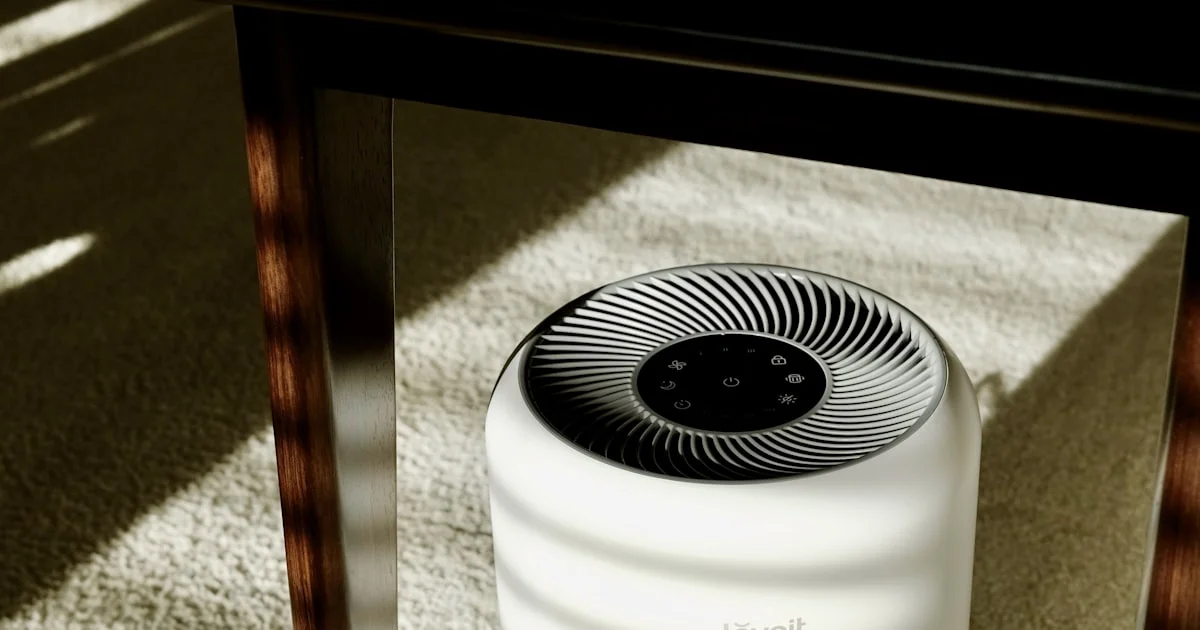
Allergy season never really ends anymore. Between spring pollen, summer dust, and a cat that sheds all year, plenty of people end up shopping for relief they can plug into a wall. The good news is that the top 5 air purifiers for allergies under 150 dollars now do the one job that matters — pulling a lot of air through a real HEPA filter — nearly as well as machines that cost three times more.
This guide skips the marketing language and looks at the numbers that decide whether a purifier actually helps you breathe easier: clean air delivery rate, room size, noise, and what replacement filters cost every year.
Key Takeaways
- CADR is the number that matters. The EPA suggests at least 65 CFM for a 100-square-foot room, 130 CFM for 200 square feet, and 195 CFM for 300 square feet.
- True HEPA captures at least 99.97% of particles 0.3 microns and larger, which covers pollen, dust mite debris, and pet dander.
- Filters are the real cost. A $90 purifier with $60 of filters a year is not cheaper than a $140 one with a washable pre-filter.
- Skip anything that intentionally produces ozone. The EPA warns against ozone generators because ozone irritates the lungs.
- Expect improvement, not a cure. Studies show gains in some allergy symptoms, not all of them.
What Makes the Top 5 Air Purifiers for Allergies Under 150 Worth Buying
The short answer: buy for clean air delivery rate and room size, then check the filter bill before you check anything else. Every machine on this list uses true HEPA media, so the filter itself is not the difference. What separates them is how much air they move per minute, how loud they get doing it, and how often you have to open your wallet.
Clean air delivery rate, or CADR, measures how much filtered air a machine delivers each minute, in cubic feet. A higher CADR cleans a bigger room, or cleans a small room more times per hour. That second part is the one shoppers miss.
Size the Machine to the Room, Not to the Box
Manufacturers love to print a big square-footage number on the packaging. That figure is usually based on cleaning the air just once per hour, which is not enough for a room with an open window or a shedding dog. Independent reviewers rate coverage at five air changes per hour instead.
The gap is dramatic. A machine advertised for 1,000 square feet at one air change per hour is really a 200-square-foot machine if you want the air scrubbed five times an hour. Here is how to size one properly:
- Measure the room’s length and width, then multiply them to get square feet.
- Match that figure against the EPA’s minimum CADR guidance — roughly 0.65 CFM per square foot.
- Add headroom if your ceilings are above 8 feet or the space opens into another room.
- Check the CADR the manufacturer publishes, not the square footage claim.
- Plan to run the machine continuously on a low or medium speed rather than blasting it for an hour a day.
The 5 Picks, and Who Each One Suits
The best affordable HEPA air purifier for you depends almost entirely on room size. These five cover the range most homes need.
1. Levoit Core 300S — the default bedroom pick
The Core 300S is rated at 141 CFM CADR and covers about 219 square feet at 4.8 air changes per hour. It draws a maximum of 26 watts, runs from roughly 41 dBA in sleep mode up to about 65 dBA at full speed, and uses a three-stage pre-filter, true HEPA, and activated carbon stack. Filters last around six to eight months. It has been selling near $134, which leaves room in a $150 budget.
2. Levoit Core 300 — the same machine for less
The non-smart Core 300 posts the same 141 CFM CADR and the same 219-square-foot coverage. It gives up app control and typically sells closer to $85. If you were never going to open the app, this is the better value of the two.
3. Winix 5500-2 — the one for bigger rooms
At 232 CFM, the Winix covers roughly 360 square feet at the same strict 4.8 air changes per hour standard. It pairs a washable pre-filter and a washable carbon filter with true HEPA, so you replace less often — about once a year. It draws more power at 70 watts and runs a little louder at the top end, around 66 dBA.
4. Coway Airmega 100 — the quiet, efficient one
The Airmega 100 delivers 148 CFM and covers about 222 square feet at five air changes per hour. Its standout number is power draw: between 3.5 and 23.2 watts depending on speed, with a noise range of roughly 36 to 57 dBA. If the purifier lives in a bedroom and runs all night, that low end matters.
5. Honeywell HPA120W — the small-room specialist
Consumer Reports lists the HPA120W among its picks for rooms of 150 square feet or less, with annual running costs around $65 including filters and electricity. It is the pick for a nursery, a home office, or a small bedroom where a larger machine would be overkill.

How These Five Compare
| Model | Best for | Main trade-off |
|---|---|---|
| Levoit Core 300S | Standard bedrooms with app control and scheduling | Costs more than the identical non-smart version |
| Levoit Core 300 | Lowest price per unit of clean air | No app, no air quality sensor |
| Winix 5500-2 | Living rooms and open spaces up to about 360 sq ft | Louder and thirstier at 70 watts |
| Coway Airmega 100 | Overnight running and low electricity use | Coverage tops out near a mid-size bedroom |
| Honeywell HPA120W | Nurseries, offices, and rooms under 150 sq ft | Not enough air movement for a large room |
What Filters Actually Cost You
Shopping for budget air filters for bedroom use is where a cheap purifier turns expensive. The machine is a one-time cost. Filters are forever.
Most manufacturers recommend replacing filters every 60 to 90 days in heavy use, and the EPA is blunt about why: a dirty, overloaded filter does not work well. Some machines stretch that interval considerably. The Levoit units want new filters roughly every six to eight months. The Winix, thanks to its washable pre-filter and washable carbon layer, generally goes about a year between HEPA changes.
So do the math before you buy: a $60 annual filter bill turns an $85 purifier into a $145 first-year purchase.
Pet Allergies Need More Air, Not Fancier Filters
Hunting for a cheap room air cleaner for pet allergies tends to send shoppers toward machines advertising special pet filters. That is usually the wrong instinct. Dander is a particle, and true HEPA already captures particles down to 0.3 microns at 99.97% efficiency. What a home with pets actually needs is more air changes per hour, because the source never stops producing.
Practically, that means sizing up. If your living room measures 300 square feet and a dog sleeps in it, treat it like a 400-square-foot room and pick a purifier with the CADR to match. A washable pre-filter is also worth real money here, since fur clogs the first stage fast.
What an Air Purifier Cannot Do
Set expectations honestly. The EPA’s own review of the research found that studies show improvements in one or more allergy or asthma symptoms, but not improvements in all of them. Benefits to breathing and heart health tend to be small.
Filtration also cannot replace what works better. The EPA is direct: the most effective way to improve indoor air is to remove the source of the pollutant, then ventilate with clean outdoor air. Wash bedding, vacuum with a sealed machine, and let the purifier handle what is left floating.
One firm rule: avoid any device that intentionally produces ozone. Ionizers, electrostatic precipitators, some UV lamps, and plasma units can emit ozone as a byproduct, and ozone irritates the lungs — the opposite of what an allergy sufferer needs.
Related Articles
- Best Smart Plug for Home Automation: A Buyer’s Guide
- Best Smart Garage Door Opener: A Complete Buyer’s Guide
- Portable Neck Fan for Summer: A Practical Buying Guide
Frequently Asked Questions
A few questions come up over and over from readers shopping in this price range. Here are straight answers.
Should I run my air purifier all day?
Yes, if you can. Longer run times and higher fan speeds both increase the amount of air filtered. Most budget machines draw between 25 and 70 watts at full tilt, and far less on low, so continuous running on a medium setting is usually cheap.
Is a smart air purifier worth the extra money?
Only if you will use the features. App control and scheduling are handy, but the Levoit Core 300 and Core 300S move identical amounts of air, and the plain model costs meaningfully less.
Do I need an activated carbon filter?
For pollen, dust, and dander, no — HEPA does that work. Carbon targets odors and volatile organic compounds, which is why it helps in kitchens, homes with pets, or rooms where someone smokes. Most machines in this price range include a thin carbon layer anyway.
How do I know when to change the filter?
Follow the manufacturer’s interval as a floor, then look at the filter. If it is visibly gray and packed, replace it early. Many machines have indicator lights, but those usually count run hours rather than measure actual loading.
The Bottom Line
Under $150 buys a genuinely capable allergy machine in 2026, as long as you shop by CADR and room size instead of by the square-footage claim on the carton. Match the number to your room, budget for a year of filters up front, and run the thing continuously.
Do that and the difference between a $90 purifier and a $500 one shrinks to features you may never touch.


1 Comment
Comments are closed.