

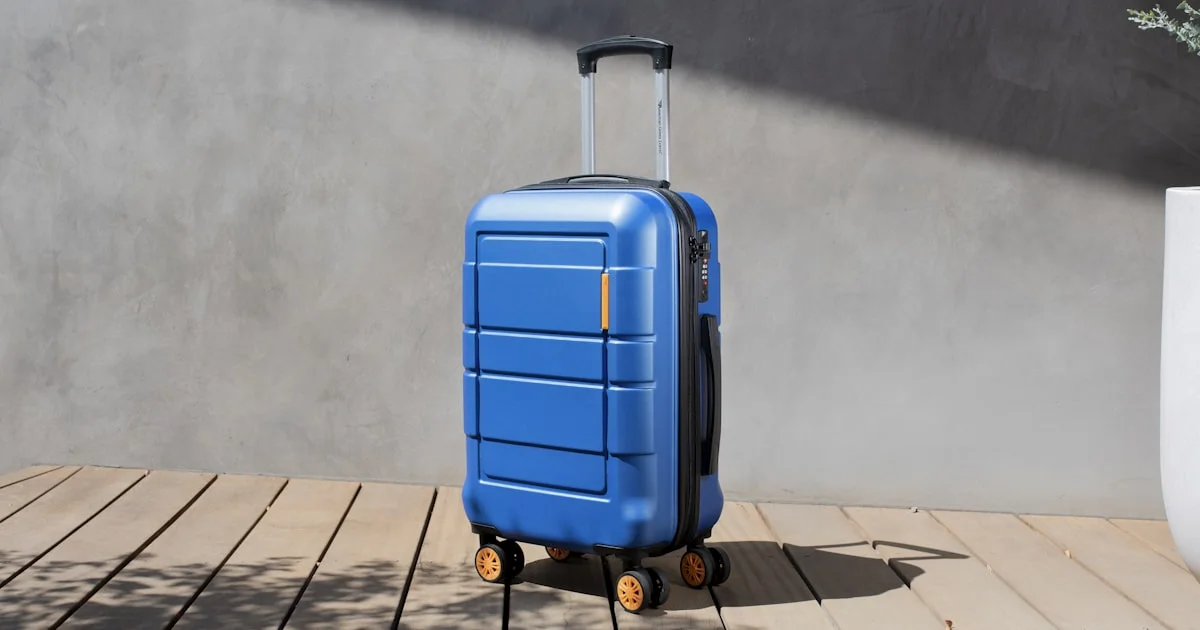
Smart suitcases had a rough start. Airlines banned a whole generation of them in 2018, and the survivors had to be redesigned around one rule. That rule still decides everything. The cheapest smart luggage for international travel is worth buying only if its battery pops out in a few seconds, because a bag whose battery is sealed inside can be refused at the counter no matter how much you paid for it.
Key Takeaways
- The battery must be removable. This is the single non-negotiable feature, and it rules out many cheap listings.
- Lithium batteries and power banks fly in the cabin only — never in checked baggage, on any airline.
- Batteries up to 100 watt-hours are generally fine in carry-on; 100 to 160 Wh needs airline approval; above 160 Wh is not allowed on passenger flights.
- “TSA approved” refers to the lock, not the bag, and it means very little outside the United States.
- The features worth paying for are the boring ones: good wheels, a removable charger, and a tracker you can move between bags.
What the Cheapest Smart Luggage for International Travel Really Means
The short answer: a well-built hard-shell carry-on with a battery pod you can pull out, plus one or two genuinely useful electronics — and nothing sealed permanently into the shell.
“Smart luggage” is a marketing category, not a technical one. It covers four features in different combinations: a USB charging port fed by an internal power bank, a Bluetooth or GPS tracker, an electronic or fingerprint lock, and a weight scale in the handle. Cheap bags have one or two. Expensive bags have all four.
The electronics are the least durable part of any smart bag. The shell, wheels and handle decide whether it survives ten trips, so a cheap bag with good wheels and one removable charger beats a cheap bag with four gadgets.
The Battery Rule That Decides Everything
This is the part that gets people turned away at check-in, so it is worth being precise about.
Lithium batteries must travel in the cabin. Every major airline requires it, and the reason is straightforward: if a battery overheats in the cabin, someone can deal with it. If it overheats in the cargo hold, nobody can. That rule applies to loose power banks and to the batteries inside smart bags equally.
For smart luggage specifically, that produces two outcomes. If your battery is removable and your bag gets checked, you take the battery out and carry it on with you. If your battery is not removable, the bag may be refused as both checked and cabin baggage, depending on the airline. American, Delta, United and Southwest all require removable batteries. So does most of the international market.
The capacity limits are set by watt-hours, not milliamp-hours, and most reputable bags print the Wh figure on the battery. Up to 100 Wh is generally allowed in carry-on with no paperwork. Between 100 and 160 Wh you need airline approval in advance, and you are usually limited to two spares. Above 160 Wh is not permitted on passenger aircraft at all. Almost every smart bag battery sits comfortably under 100 Wh, but it is worth reading the number rather than assuming.
What a Budget Carry On With USB Port Should Have
A budget carry on with usb port is the most common shape this category takes, and it is also where corners get cut most often. Three things separate a good one from a frustrating one.
First, the battery pod should come out without tools and without unzipping the main compartment. If you have to dig through your clothes at the gate to reach it, you will eventually forget, and forgetting is what causes the argument at the counter.
Second, the port should be on the outside of the bag and the cable run should be sealed. Some cheap designs route a bare cable through the lining, which snags and eventually tears.
Third, check what the pod actually is. On many discount bags it is an ordinary power bank in a fabric sleeve. That is not a bad thing — it means you can replace it cheaply when it stops holding a charge, and you can use it separately from the bag.

What “Affordable Smart Suitcase TSA Approved” Actually Means
An affordable smart suitcase TSA approved listing is describing the lock, not the suitcase. A TSA-recognized lock has a keyhole that agents in the United States can open with a master key, so they can inspect the bag without cutting the lock off. That is the entire claim.
Two things follow. Outside the United States, most security services do not use those master keys, so the feature travels less well than the phrase suggests. And a lock any agent can open with a common key is not a theft deterrent — it keeps zippers closed and saves you a cut lock.
Electronic and fingerprint locks add a different problem: they need power. If the lock shares the removable battery you just took out for the flight, make sure there is a mechanical key override. Being locked out of your own suitcase in a hotel room is a very specific kind of bad evening.
Which Features Are Worth the Money
Not every smart feature earns its place in a cheap bag. This is roughly how they sort out.
| Feature | Best for | Trade-off |
|---|---|---|
| Removable USB power bank | Long layovers and airports with no free outlets | Must be removed before any checked flight |
| Bluetooth or GPS tracker | Checked bags and connecting flights | A standalone tracker does the same job and moves between bags |
| Built-in handle scale | Travelers who repack and buy things abroad | Less accurate than a separate luggage scale |
| Electronic or fingerprint lock | Convenience over carrying a key | Needs power; useless without a mechanical override |
| App connectivity | People who genuinely use the app | Depends on a company that may stop supporting it |
At the bottom of the market, the tracker is the feature to skip in the bag and buy separately. A standalone Bluetooth tag costs little, works with the phone you own, and moves between bags.
Sizing and Packing for International Flights
International carriers are stricter about carry-on baggage than most US airlines, and the difference catches people out.
- Check your specific airline’s carry-on dimensions before you buy. Many carriers outside the United States allow a smaller bag than US domestic carriers do.
- Check the carry-on weight limit too. Plenty of international airlines weigh hand baggage at the gate; most US carriers do not.
- Remember that a battery pod, an electronic lock and a scale all add weight before you have packed anything.
- Confirm the bag is expandable or not. An expanded bag often exceeds carry-on limits even when the unexpanded one fits.
- Practice removing the battery at home, once, before the trip. It takes thirty seconds and it prevents the only real failure mode in this category.
Where Discount Smart Travel Bags Cut Corners
The savings on discount smart travel bags come out of predictable places, and knowing them makes a listing much easier to read.
- Wheels. The most common failure point on any suitcase. Look for double spinner wheels rather than single ones, and check whether replacements are sold.
- Telescoping handle. Cheap handles wobble immediately and jam eventually. A handle that locks at only one height is a warning sign.
- Zippers. Coil zippers are common at low prices and split under pressure. Chunkier tooth zippers hold up better.
- Battery quality. An unbranded pod with no printed watt-hour rating is a bag you should not check or fly with. If the capacity is not stated, an airline is within its rights to refuse it.
- Warranty. Budget brands often warranty the shell but not the electronics. Read which is covered before buying.
Related Articles
- Best Smart Luggage Scale: What Actually Matters
- Portable Neck Fan for Summer: A Practical Buying Guide
- Best Budget Smartphone 2026: What to Look For
Frequently Asked Questions
These questions come up constantly from people buying their first smart bag, and the answers are more consistent across airlines than most travelers expect.
Can I check a smart suitcase?
Yes, as long as you remove the battery first and carry it with you into the cabin. A bag with a sealed, non-removable battery is the problem case — it may be refused as checked baggage and, depending on the airline, refused in the cabin as well.
What happens if my carry-on gets gate-checked?
This is the situation the removable battery exists for. When a full flight sends your carry-on to the hold, take the battery out at the gate and keep it on you. If you cannot get to it quickly, you are relying on a gate agent’s patience.
Do I need to declare the battery at check-in?
Not for a battery under 100 watt-hours, which covers nearly all smart luggage. Between 100 and 160 Wh you need approval from the airline before you fly. Above 160 Wh it cannot go on a passenger aircraft at all.
Is a built-in tracker better than a separate tag?
Usually not. A separate Bluetooth tag works with your phone, costs little, keeps working if the suitcase’s own electronics fail, and moves to your next bag. A built-in tracker is convenient but ties a replaceable feature to a bag you will eventually retire.
The Bottom Line
Cheap smart luggage is a reasonable buy as long as you treat the battery rule as the first filter and the shell quality as the second. Buy a bag with a pod you can pull out in seconds, add a separate tracker, and ignore the features that only exist to fill out a listing. That combination costs less than most branded smart bags and will not strand you at a check-in counter.


4 Comments
Comments are closed.