

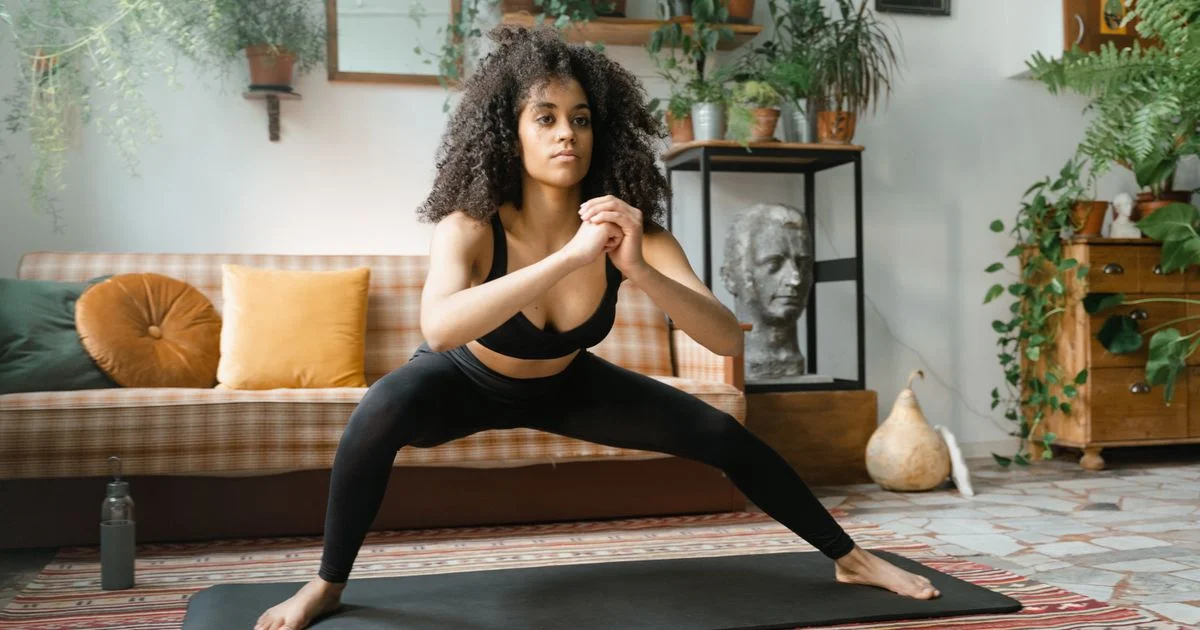
A mat gets unrolled in a spare bedroom, at the foot of a bed, on a rug between a couch and a coffee table, and in whatever corner of a studio apartment is not currently holding furniture. Those four feet of floor are the real product specification, and they are the first thing a smart yoga mat for beginners has to fit — before any question about sensors, apps or scoring comes up at all.
This article draws on the National Center for Complementary and Integrative Health, the Food and Drug Administration and Yoga Alliance. It is general information, not medical advice, and anyone with a joint, back or blood pressure concern should talk to a clinician before starting.
Use case 1: a smart yoga mat for beginners in a room with no floor to spare
Measure the space before reading a single feature list. A pressure-sensing mat only knows what is happening on its own surface, so a mat wedged against a couch — where a lunge sends one foot off the edge and onto carpet — hands the sensors an incomplete picture and hands you a score that reflects the room rather than the pose. The same is true of laying a mat over a thick rug, which softens and smears the pressure readings the whole system depends on.
Two practical constraints follow from a small room, and not one of them appears on a box:
- Clearance on all four sides. Standing poses need room for an arm to swing out and a foot to step back. A mat that fits the floor exactly does not fit the practice.
- A hard, flat surface underneath. Wood, tile or a low-pile carpet. A plush rug or an uneven floor makes the mat’s own readings less trustworthy, which removes the reason you bought it.
If the honest answer is that there is no such space at home, that is useful information rather than a problem to buy around. A studio hour costs less than a sensor mat and comes with a floor.
Use case 2: nobody in the room to tell you the knee is wrong
This is the gap these products are sold into, so it is worth being precise about what a sensor can and cannot see. One manufacturer’s own published description of how its mat works says it reads body position through embedded pressure sensors and reports back with colored light cues — green for correct form, amber for close, red for an adjustment needed — through an app on a phone or tablet connected over Bluetooth, with the mat holding a charge for up to eight hours of use.
Read that carefully and the boundary becomes clear. Pressure sensors under your hands and feet can tell whether your weight is even, whether you are drifting forward, whether one side is carrying more load. They cannot see a rounded lower back, a hyperextended knee, a shoulder creeping toward an ear, or a held breath — and those are the things that hurt people.
The NCCIH is specific about which things: “the most common injuries are sprains and strains, and the parts of the body most commonly injured are the knee or lower leg.” It advises practicing “under the guidance of a qualified instructor,” notes that “older adults may need to be particularly cautious,” and tells newcomers to avoid “extreme practices such as headstands, shoulder stands, the lotus position, and forceful breathing.”
For scale, a teacher registered with Yoga Alliance at the RYT 200 level has completed a 200-hour training program with a registered school. A mat reports a pressure map. Those are not competing versions of the same service, and a beginner who can only have one is better served by a handful of real classes first — the same logic that applies to any device that turns a physical activity into a number, as our guide to a fitness tracker for running works through in detail.

Use case 3: what a smart yoga mat for posture correction is allowed to claim
The phrase does a lot of work in listings, and the regulator has drawn a line around it that shoppers almost never see. The FDA operates a general wellness policy for low-risk products, and its position is stated directly: “For low risk products that promote a healthy lifestyle (general wellness products), FDA does not intend at this time to examine whether they are devices, or if they are devices, whether they comply with device requirements.”
Under that policy, a product either makes claims unrelated to any disease, or it may connect a healthy lifestyle to reducing risk using careful phrasing — “may help to reduce the risk of” or “may help living well with” a chronic condition. What it cannot do is promise to diagnose or treat anything, and what nobody has done is test whether it works.
So a smart yoga mat for posture correction sits in a category the FDA has decided not to examine. That is not an accusation against any product; it is a description of the shelf. The marketing claim on the box has not passed a test that a cheaper mat failed. It has not been put to a test at all.
On the underlying question, the evidence for yoga itself is real but measured. A 2022 review cited by the NCCIH found yoga “slightly better than no exercise, but the small difference may not be important” for low-back pain, while a 2020 report found improvements in pain and function in the short term of one to six months and the intermediate term of six to twelve months. On balance, 11 of 15 studies covering 688 participants showed improvement in at least one balance measure, and a 2020 review of 12 studies found beneficial effects on perceived stress in all of them.
Use case 4: a smart yoga mat for home workouts that are not yoga
Plenty of buyers want the mat for planks, core work and stretching rather than a full practice, and the feedback system behaves differently there. A smart yoga mat for home workouts is calibrated against a library of recognized poses; movements outside that library get no scoring, or worse, get scored against the nearest pose the software thinks you are attempting.
Before buying for general exercise, check three things in the app’s own description rather than the product page:
- How many movements the library actually contains, and whether the ones you do daily are among them.
- Whether the mat scores freeform movement at all, or only guided sessions it is driving.
- What happens offline, since a mat that reports through a phone app is only as available as that app.
For pure strength or stretching work, thickness and grip matter more than any sensor. A thicker mat protects knees and elbows during floor work; a thinner one gives a steadier base for standing poses. No electronics change that trade.
Use case 5: a smart yoga mat for daily practice, and the friction of setup
The failure mode for connected fitness gear is almost never the hardware. It is the third Thursday, when the mat needs charging, the phone needs pairing, and unrolling a plain mat and pressing play on a video is forty seconds faster. A smart yoga mat for daily practice has to survive that comparison every single day, and eight hours of battery means a recharge every week or two for a regular practitioner.
The setup chain is worth counting honestly: charge the mat, unroll it, open the app, wait for Bluetooth, choose a session, prop the phone somewhere visible. A rolled mat and a free video class has two steps. Whether the feedback is worth the other four is a question about your own habits, not about the product, and the answer changes if you are the kind of person who likes a number at the end of a session.
Side-by-side by situation
| Your situation | What it actually needs | What to skip |
|---|---|---|
| Four feet of floor between furniture | Mat size measured first, hard surface underneath | Any mat that does not physically fit with clearance |
| Complete beginner, no teacher nearby | A few real classes, then decide | Treating light cues as supervision |
| Existing knee or back trouble | A clinician, then a qualified instructor | Any posture claim made by a product |
| Core and stretching rather than yoga | Thickness and grip; check the movement library | Paying for pose scoring you will not use |
| Daily habit you are trying to build | The shortest possible setup chain | Anything that adds a charging step |
| Practicing on a plush rug or carpet | A firmer surface, or a plain mat | Sensor feedback you cannot trust |
Related Articles
- Smart Water Bottle Review: Are They Worth Buying?
- Standing Desk Converter: Small Desk, Rental, or Shared Office
Frequently Asked Questions
These come up repeatedly from people weighing a connected mat against a plain one and a video. The answers lean on published guidance from the NCCIH and the FDA rather than on manufacturer claims.
Can a sensor mat actually prevent injuries?
There is no published evidence that it can, and the injuries the NCCIH records — sprains and strains, mostly at the knee or lower leg — tend to come from joint angles and pushing too far, which pressure sensors under the hands and feet cannot see. The NCCIH’s own advice is to work with a qualified instructor.
Does the FDA approve these mats?
No. Under the general wellness policy the FDA states it does not intend to examine whether such low-risk products are devices, or whether they meet device requirements. Nothing about the category has been reviewed for effectiveness.
Is a thicker mat better for a beginner?
It depends on what you do on it. A thicker mat is kinder to knees and elbows during floor work; a thinner one is steadier under standing poses, where a soft surface makes balance harder. Beginners doing a mix usually land in the middle rather than at either extreme.
What would you buy first with a limited budget?
A plain mat that fits the room, and a few classes with a real teacher. That combination addresses what the NCCIH actually flags — form supervision and sensible progression — and it leaves the decision about a connected mat until after you know whether the habit sticks.
Conclusion
A connected mat can tell you where your weight is, and that is a genuinely interesting thing to know once you already have a practice. For a first month, the room, the floor underneath, and a person who can see your knees are worth more than any sensor in the surface.


