

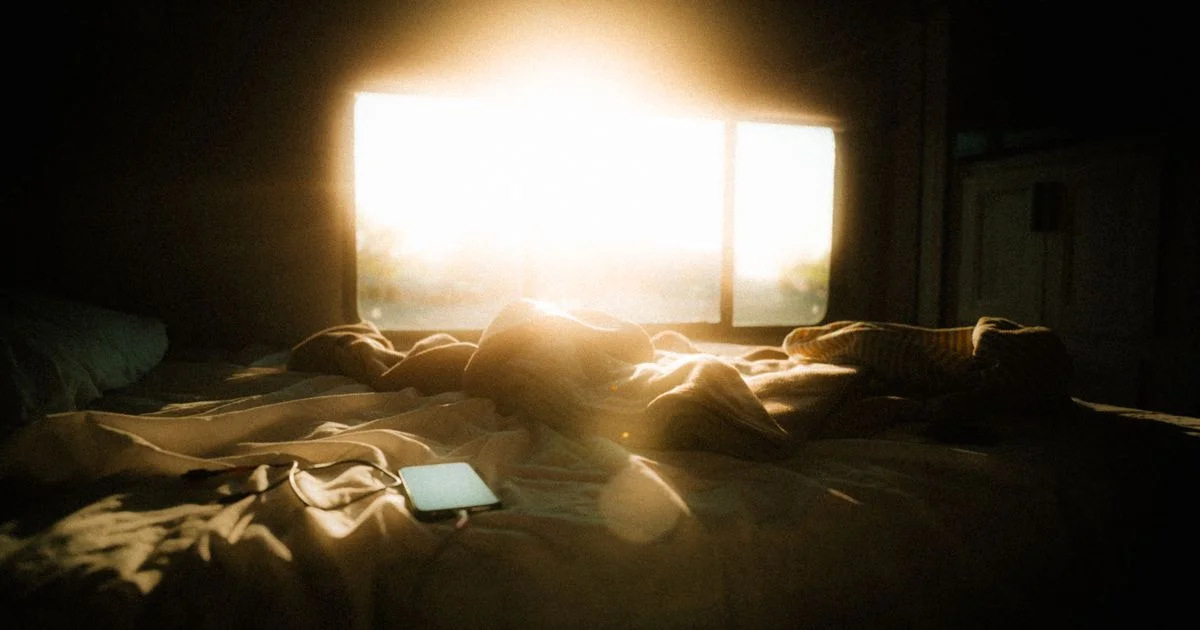
The darkest morning of the year is not the shortest day of the year. A sunrise alarm clock for waking up naturally is bought to solve getting up in the dark, and the dark it is fighting peaks about two weeks after the date almost everyone assumes. Which means the first useful question is not about the clock at all — it is about where you live and what the sky is actually doing outside your window at the hour your alarm goes off.
Sourcing and scope: the light-therapy and sleep figures below come from the National Institute of Mental Health, the Centers for Disease Control and Prevention, the American Academy of Pediatrics and the U.S. Naval Observatory. This is general information, not medical advice.
Use case 1: Whether a sunrise alarm clock for waking up naturally suits your latitude
The U.S. Naval Observatory explains why the darkest wake-up is offset from the solstice: “Our clocks do not keep Sun time,” and around the solstice “the Sun runs slow compared to clock time,” delaying sunrise and sunset by up to half a minute a day. The result is that at 40 degrees north latitude the earliest sunset lands around December 8 and the latest sunrise around January 5 — each roughly two weeks from the solstice. The Observatory adds that “the range of these dates is wider at lower latitudes and narrower at higher latitudes.”
Turn that into a purchase decision by looking up sunrise where you live on the first week of January and comparing it with your alarm. Three outcomes:
- The sun is already up when your alarm goes off, every month of the year. A sunrise clock is a preference, not a fix — open the curtains instead.
- The sun comes up after your alarm for part of the winter. This is the common case, and it is the one the device was designed for.
- The sun comes up after your alarm for months at a stretch, which is normal in the northern states. Expect to lean on the device hard, and read the next section carefully.
Use case 2: A sunrise alarm clock for seasonal depression is not a light box
A sunrise alarm clock for seasonal depression is the search that brings the largest share of readers to this category, and it is the one place where being precise matters most. Seasonal affective disorder is, in the National Institute of Mental Health’s words, “a type of depression characterized by a recurrent seasonal pattern, with symptoms lasting about 4−5 months out of the year.” NIMH notes the geography too: SAD “is more common in people living farther north, where there are shorter daylight hours in the winter,” and gives Alaska and New England against Texas and Florida as the comparison.
The treatment NIMH describes is a specific piece of equipment used a specific way: “the person sits in front of a very bright light box (10,000 lux) every day for about 30−45 minutes, usually first thing in the morning, from fall to spring.” A wake-up light is a different object doing a different job. It is designed to ease you out of sleep over a fade, at a brightness meant to be tolerable with your eyes closed, while you are still lying down and facing the wrong way. It is not a half-hour of deliberate exposure at close range, and buying one as a substitute for clinical light therapy is buying the wrong thing.
There is also a safety note worth repeating exactly as published: NIMH says “people with certain eye diseases or people taking certain medications that increase sensitivity to sunlight may need to use alternative treatments or use light therapy under medical supervision.” If you are considering light therapy for a seasonal mood pattern, that is a conversation with a clinician, not a shopping decision.

Use case 3: A sunrise alarm clock for heavy sleepers, and what it cannot fix
A sunrise alarm clock for heavy sleepers is usually bought after the phone alarm has been snoozed through for a week. It can help, but it is worth being honest about what is underneath the problem, because a lot of heavy sleeping is simply not enough sleeping.
The CDC’s National Center for Health Statistics puts numbers on how common that is. In its 2024 data, 30.5 percent of American adults reported short sleep duration, defined as 0 to 6 hours in a 24-hour period. Another 15.4 percent reported trouble falling asleep and 18.1 percent trouble staying asleep. Short sleep peaked in the 50-to-64 age group at 34.5 percent and was lowest at ages 18 to 34, at 27.2 percent.
If you are in the first group, no device fixes the arithmetic. If you are getting the hours and still surfacing badly, work through it in this order:
- Fix the wake time first. Pick one and hold it on weekends, because a device cannot hit a moving target.
- Move the sound alarm across the room, so that switching it off requires standing up.
- Add the light, set to finish rather than start at your alarm time.
- Give it two weeks before judging it. One bad Monday is not evidence either way.
Keep the sound in the plan throughout. A light that arrives before the noise genuinely helps, but every honest version of this purchase includes a backup that makes a noise, positioned where you have to stand up to reach it, because a light alone will lose to a heavy sleeper on a bad week. The room matters too: if you are waking up hot and thrashing rather than sleeping badly in the dark, the problem is temperature, and our guide to cooling mattress pads for hot sleepers is the more useful read.
Use case 4: A sunrise alarm clock for kids and a shared room
A sunrise alarm clock for kids is doing something slightly different from the adult version — it is less about waking gently and more about giving a small child a signal they can read before they can read a clock. The American Academy of Pediatrics’ guidance lines up with that use surprisingly well. Its healthy-sleep advice calls for “the same waking time (both on weekdays and weekends)” as part of a predictable routine, and says plainly to “expose children to bright light when it’s time to get up to help stimulate wakefulness.”
The same guidance argues against the obvious cheap alternative. The AAP recommends “keeping all screens—TVs, computers, laptops, tablets and phones out of children’s bedrooms, especially at night,” and turning screens off “at least 60 minutes/1 hour before bedtime.” A tablet propped on a nightstand as a wake-up light is the thing that advice exists to prevent.
In a shared room — a child’s bunk, or a partner on a different schedule — the feature that decides everything is whether the display can be dimmed to nothing. A device that glows all night in a room where someone else is sleeping has traded one problem for another.
Side-by-side by situation
| Your situation | What it actually needs | What to watch for |
|---|---|---|
| Northern winter, alarm before sunrise | A light that reaches full brightness before the alarm sounds | Check sunrise in early January, not on the solstice |
| Southern state, sun already up | Curtains and a consistent wake time | The device solves a problem you may not have |
| Diagnosed seasonal mood pattern | A conversation with a clinician about light therapy | A wake-up light is not a 10,000 lux light box |
| Heavy sleeper, enough hours | Light plus a sound backup across the room | Light alone loses on a bad week |
| Heavy sleeper, six hours or fewer | More time asleep | No device changes the arithmetic |
| Young child’s bedroom | A readable signal and no screen | Screens are the thing AAP guidance keeps out of the room |
| Shared bedroom or bunk | A display that dims to nothing overnight | An always-on glow wakes the other person |
Related Articles
- Best Weighted Blanket for Anxiety: Bedtime, Kids, and Shared Beds
- Smart Water Bottle Review: Are They Worth Buying?
Frequently Asked Questions
These come up once someone has decided the idea makes sense and starts looking at what is on the shelf. The answers below stay with what the published guidance says.
Does a wake-up light treat seasonal affective disorder?
It is not the treatment NIMH describes, which is a 10,000 lux light box used for about 30 to 45 minutes, usually first thing in the morning, from fall to spring. A wake-up light is built for a different moment and a different posture. If a seasonal mood pattern is the reason you are shopping, talk to a health care provider first.
Is it safe to use one every morning?
For most healthy adults an ordinary bedside light is unremarkable. The exception NIMH names for light therapy is worth carrying over: people with certain eye diseases, and people taking medications that increase sensitivity to sunlight, should get medical advice before adding deliberate bright-light exposure to a routine.
Can I just use a smart bulb on a timer?
You can, and for a lot of bedrooms it is the sensible first try, since you probably own the lamp already. What you give up is the integrated alarm and the ability to dim the display to nothing overnight. If the bulb approach works for a month, you have saved the money; if you keep sleeping through it, you have learned something before spending.
Will it wake my partner too?
Light spreads and a bedside device cannot aim. In a shared bed the realistic options are accepting that both of you get the light, positioning the unit close on your side and low, or going back to a quiet sound alarm and a pair of earplugs for the other person.
Conclusion
A wake-up light earns its place in a narrow set of situations: dark winter mornings at a northern latitude, a household that wants a signal without a screen, or a sleeper who surfaces badly but is getting enough hours. It is not clinical light therapy and it is not a cure for six hours of sleep. Check your own sunrise time in early January, be honest about which of those situations you are in, and the shopping gets straightforward.


