

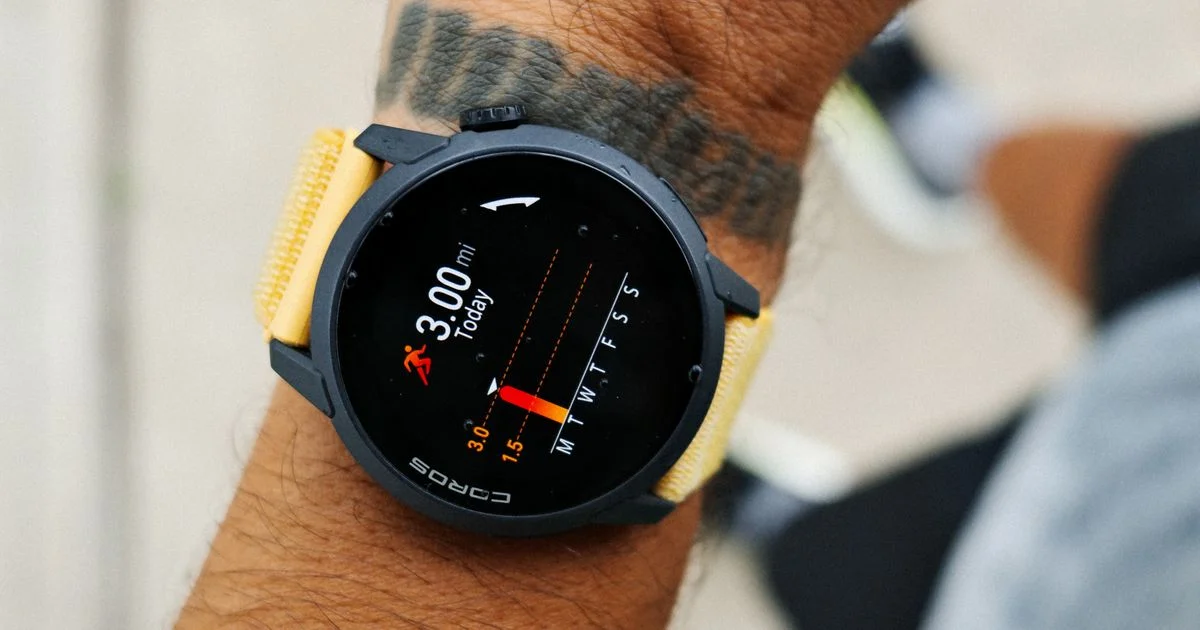
Running gear arguments usually happen on a spec sheet. They get settled somewhere else entirely — on a wet sidewalk at 6 a.m., on a treadmill belt in February, at the shallow end of a lap pool. The best fitness tracker for running is whichever one survives the places you actually run, and those places ask for very different things.
This is an independent editorial comparison. We are not affiliated with Garmin, Coros, Suunto, Polar, Apple, Amazfit or Fitbit, and no brand reviewed or approved this article.
Use case 1: Road running and race day, where the best fitness tracker for running earns its price
Outdoors, distance comes from satellites, and satellites are the one thing every current running watch does competently. Across tested models, GPS accuracy sits within about 1% to 3%. On a 10-mile run that is a spread of roughly a tenth of a mile — real, but not the difference between a good watch and a bad one.
Where the gap opens is difficult terrain. Multi-band, sometimes called dual-frequency, listens on two satellite signals at once and holds a line better where the sky is broken up; the Coros Vertix 2S pulls from all five satellite systems at once and was noticeably steadier in slot canyons and under heavy tree cover. Worth paying for on a wooded river trail or between tall buildings. On a suburban loop with open sky, it mostly costs you battery.
Battery is the other race-day question, and the numbers vary more than anything else on the shelf:
- Coros Vertix 2S — 118 hours in standard GPS mode, which covers a hundred-miler with room to spare
- Coros Apex 4 — 41 hours of GPS use
- Amazfit T-Rex 3 Pro — 38 hours in dual-band GPS
- Polar Grit X2 — 30 hours in its best performance mode
- Garmin Forerunner 970 — 23 hours with all-systems GNSS plus multi-band, and 13 days as a plain smartwatch
- Suunto Run — 20 hours at its highest-accuracy dual-band setting
- Apple Watch Ultra 3 — 14 hours of continuous GPS tracking
For a 5K habit, 14 hours is a non-issue. For a 50-miler where you do not want to think about a charger at an aid station, the gap between 14 hours and 118 hours is the whole decision.
Two smaller things decide comfort. Weight is barely noticeable in the hand and very noticeable on hour four: the Coros Pace 4 is about 1.1 ounces, the Suunto Run about 1.3 ounces, the Forerunner 970 about 2 ounces. And screens split the same way batteries do — a bright AMOLED panel is easier to read at a glance, while the older MIP style trades color for endurance, which is why the Coros Apex 4 lasts longer on navigation-heavy days. Prices ran from about $200 for the Suunto Run to roughly $750 for the Forerunner 970 and $800 for the Apple Watch Ultra 3 and Polar Grit X2 when these models were surveyed, and street prices move.
Use case 2: The treadmill, where satellites cannot help you
Step indoors and the watch loses its best sensor. Distance now comes from an accelerometer estimating your stride length, stride frequency and arm swing, calibrated against how you move outdoors, while the treadmill counts belt revolutions — a mechanical measurement that is hard to argue with.
The two disagree because you do not run the same way indoors. Stride length and cadence shift on a belt, so the watch is fed different inputs than the ones it learned from. A gap past about 15% is where the mismatch stops being noise, and it is worse on interval workouts than easy runs, because every speed change is another chance for the estimate to drift.
There are three practical fixes, in order of effort:
- Use the save-and-calibrate step. After an indoor run, enter the treadmill’s distance. Some watches now learn from each session and tighten the estimate over time.
- Pick one source of truth and stay with it. If you log every treadmill run from the console, keep doing that. Mixing console numbers and watch numbers in the same training log makes the trend line meaningless.
- Add a foot pod if indoor pace genuinely drives your training. It measures at the foot instead of the wrist, which removes the arm-swing guesswork.
Use case 3: A fitness tracker for the gym, where the wrist sensor struggles most
A fitness tracker for the gym runs into the weakness that every optical heart rate sensor shares. Green LEDs flash at the skin hundreds of times a second and read how much light comes back as blood volume changes. It works well at steady effort — errors are usually around 5%, or about 3 beats per minute.
Accuracy falls off exactly where you want it most. Studies show wrist readings degrade as intensity and speed rise, and tend to underestimate heart rate at the hard end. Running is harder on the sensor than cycling because the wrist moves more, cold weather thins the blood flow it depends on, a strap cinched too tight skews the reading, and darker skin tones absorb more light before it can bounce back.
Weights add their own problem: gripping a bar tenses the forearm right where the sensor sits, and the reading drops out for whole sets. If your training is intervals, circuits or heavy lifting, pair the watch with a chest strap and let the wrist sensor handle the rest of the day. The watch is still the right log — it should just not be the sensor for the hardest ten minutes of your week.
Use case 4: A fitness tracker for swimming, and what the waterproof number really says
A fitness tracker for swimming is where marketing labels do the most damage. The ratings look like depths and are not.
ATM describes pressure in a lab, expressed as an equivalent depth: 3 ATM matches the pressure at about 98 feet, 5 ATM about 164 feet, 10 ATM about 328 feet. Nobody is suggesting you take a watch to 328 feet. Those are static pressure estimates, and swimming adds movement, which raises pressure at the seals well above standing still.
IP ratings cover a different question. IP67 means protection from temporary immersion — roughly 3 feet for up to 30 minutes. IP68 means continuous immersion to whatever depth the maker specifies. For lap swimming, look for a device carrying both a 5 ATM rating and an IPX8 figure; one without the other leaves a gap. A 3 ATM device paired with a weak IP number is a rain-and-handwashing watch, not a pool watch.

Open water asks for one more thing. Heart rate through a wetsuit sleeve is unreliable, and GPS does not travel through water, so a swim track is stitched together from the moments your wrist breaks the surface. Expect the distance to be an estimate — usually good enough for triathlon training, and handled best by the multi-band models from the first section.
Use case 5: A fitness tracker for kids, which is a different product entirely
A fitness tracker for kids is not a small running watch. It is a step counter with a parent account attached, and it should be judged on that.
The target it nudges toward is real: the World Health Organization recommends an average of 60 minutes a day of moderate to vigorous activity for children and adolescents ages 5 to 17, and most kids’ trackers build their daily goal around that hour. Four things separate them:
- Age fit. The Garmin vivofit jr. 3 is designed for ages 4 to 7 and leans on chores, coins and task timers. The Fitbit Ace 3 and most third-party trackers aim at ages 5 and up with a plainer activity view.
- Battery, which decides whether it gets worn. The vivofit jr. 3 runs up to a year on a coin cell. The Fitbit Ace 3 runs up to 8 days. A watch that needs charging every few days on a school night quietly stops being worn.
- Water rating, because kids do not take it off. The Ace 3 and the vivofit jr. 3 are both rated WR50. Cheaper models land at IP67 or IP68, which is splash-and-rain territory rather than pool territory.
- What the parent sees. Family accounts let a parent hold the account and view activity, and most kids’ trackers deliberately have no social feed.
One thing to know before you buy: none of the mainstream kids’ activity trackers include GPS. If what you actually want is to know where your child is, that is a different category of device, and an activity tracker will disappoint you. Prices in this group ran roughly $19 to $100, with the Fitbit Ace 3 around $80 and the Garmin vivofit jr. 3 around $90 when surveyed.
Side-by-side by situation
| Your situation | What it actually needs | What you can skip |
|---|---|---|
| Suburban loops, 5K to half marathon | Standard GPS, comfortable band, a screen you can read mid-run | Multi-band, 100-hour battery, titanium anything |
| Trail, canyon or dense-city running | Multi-band or multi-system GPS, long GPS battery | The lightest model; endurance beats grams here |
| Ultra distance or multi-day | 40-plus hours of GPS, MIP-style screen, charge-on-the-go support | AMOLED brightness, smartwatch apps |
| Mostly treadmill through winter | Calibration that learns, or a foot pod | Any GPS feature at all, for these months |
| Intervals, circuits, heavy lifting | A chest strap paired to the watch | Trusting wrist heart rate on the hard sets |
| Lap pool or open water | 5 ATM plus an IPX8 rating, swim metrics | Precise open-water distance; it is an estimate |
| Buying for a child | Long battery, WR50, a parent-held account | GPS, training metrics, heart rate zones |
Related Articles
- Fitness Tracker Buying Guide: Features, Accuracy, Budget
- Best Heart Rate Monitor Chest Strap: Accuracy and Buying Guide
- Best Smart Scale for Body Fat: What the Numbers Really Mean
Frequently Asked Questions
These are the questions that come up once someone has narrowed the list to two or three watches and is trying to work out whether the extra money buys anything they will use.
Is multi-band GPS worth the extra cost?
Only if your routes break up the sky. Standard GPS already lands within about 1% to 3% on open roads, and multi-band costs battery to run. It pays for itself under heavy tree cover, in canyons and between tall buildings.
Why does my watch disagree with the treadmill?
The treadmill counts belt revolutions; the watch estimates from your stride and arm swing, calibrated on outdoor running you do not replicate indoors. Gaps past roughly 15% are meaningful. Calibrate after each indoor run, or track time and effort instead.
Do I still need a chest strap?
For steady running, no — wrist readings are usually within about 5%, or 3 beats per minute. For intervals, hard efforts, cold weather and anything involving a grip, yes. Wrist sensors underestimate at high intensity, and that is exactly when the number matters.
Can I swim with a watch rated 5 ATM?
Generally yes for pool swimming, provided it also carries an IPX8 rating — the two ratings answer different questions and you want both. Remember the depth figure is a lab pressure equivalent, not a diving limit, and movement in water raises the pressure at the seals.
Conclusion
There is no single watch that is best at road racing, treadmill accuracy, gym heart rate and lap swimming all at once, and buying as if there were is how people end up with an expensive tracker that annoys them. Pick the two situations you are genuinely in most weeks, buy for those, and accept an estimate everywhere else.


3 Comments
Comments are closed.