

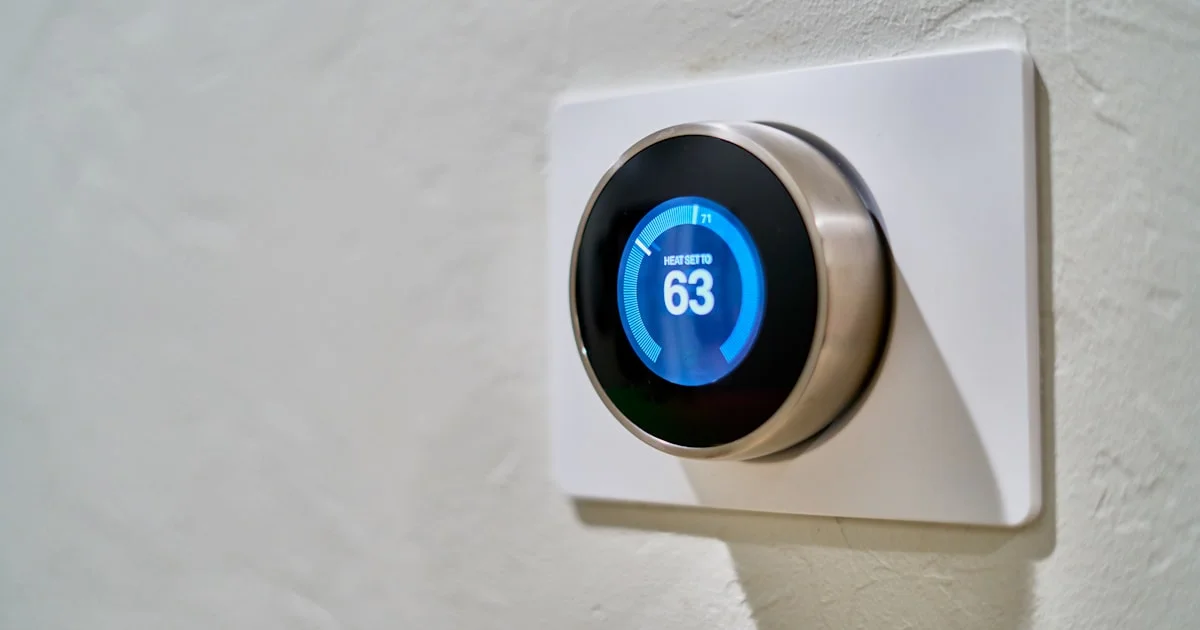
Every smart thermostat listing promises to cut your bill. Almost none of them mention that the size of that cut depends on your house, your schedule, and what kind of heating you have. The best smart thermostat for energy savings is the one that fits your situation, and in some situations the honest answer is that the savings will be small.
So start with where you live and how you live, not with the model names.
Key Takeaways
- ENERGY STAR puts average savings at about 8% of heating and cooling costs, or roughly $50 a year.
- Savings are largest in climates with big seasonal swings and homes with variable-capacity heat pumps or AC.
- Savings are smallest in mild climates, in homes where somebody is always there, and with single-speed equipment.
- The C-wire question decides your shortlist before any feature does. Some models solve it with a free adapter, one runs on AA batteries.
- Mini-splits, window units, and electric baseboard need a different category of thermostat entirely.
What the Best Smart Thermostat for Energy Savings Really Saves
The short answer: about 8% of your heating and cooling bill, roughly $50 a year on average, and the spread around that average is wide enough to matter.
That number comes from ENERGY STAR, and the certification behind it is stricter than most marketing. To earn the label, a thermostat has to show real-world field data from a year in each sample home: at least an 8% reduction in heating runtime and 10% in cooling at the lower 95% confidence limit, or 4% and 5% respectively at the 20th percentile. The EPA analyzes that data with its own software rather than accepting laboratory estimates.
What pushes you above the average: wide seasonal temperature swings, and variable-capacity heat pumps or air conditioning that a smart controller can actually modulate. What pushes you below it: a temperate climate where the HVAC bill is small to begin with, a house that is occupied around the clock, and single-speed equipment that only knows on and off.
If you read that list and recognized your own home in the second group, you can still want a smart thermostat — for scheduling, for remote control, for not arriving at a freezing house — but buy it for those reasons, not for a payback calculation that will not arrive.
Renting: What You Can Install and Take With You
The rental version of this purchase has one rule: keep the original thermostat. Put it in a labeled bag in a closet, because you will need it on move-out day, and a $30 replacement is a silly way to lose a deposit.
Beyond that, the install is genuinely small. Most units mount on the same wall plate footprint and use the same low-voltage wires. What you should do, in order:
- Photograph the existing wiring before you disconnect anything. Wire colors are not a reliable guide; the letters on the terminals are.
- Check whether there is a C-wire behind the plate. This decides everything else.
- Ask your landlord in writing. Most do not care; the ones who do care would rather be asked than discover it.
- Skip anything that requires touching the furnace itself unless you own the building.
That last point rules out several adapter kits, which install at the furnace rather than at the wall. In a rental, a model that needs no work at the equipment is worth more than a slightly cheaper one that does.

An Old House With No C-Wire
The C-wire, or common wire, closes the 24-volt circuit that powers the thermostat. Old mechanical thermostats did not need one. A smart thermostat running a screen, a Wi-Fi radio, and sensors does. Any useful wifi thermostat review should tell you how a model handles this, because it is the single most common reason an install goes wrong.
There are three ways around it. Some models include a power extender kit at no extra charge — the Ecobee Smart Thermostat Premium does. Some sell an adapter separately, around $25 for the Google Nest Learning Thermostat 4th Gen and roughly $35 for the Honeywell Home T5. And some avoid the problem: the Nest Learning Thermostat 4th Gen uses an internal rechargeable battery charged off the signal wires and is described as working in over 99% of homes, while the Sensi Lite simply runs on two AA batteries, with exceptions for heat-only, cool-only, and heat-pump setups.
One more compatibility trap in older houses: dual-fuel systems, where a heat pump hands off to a furnace in deep cold. Ecobee and Nest models support dual fuel. The Amazon Smart Thermostat and the Honeywell Home T5 do not.
Somebody Is Home All Day
Remote work quietly broke the main savings mechanism. A smart thermostat saves money largely by noticing that nobody is home and letting the temperature drift. If the house is occupied from 7 a.m. to 11 p.m., there is very little drift to harvest, which is exactly why ENERGY STAR lists constant occupancy among the conditions that reduce savings.
What still helps in an always-occupied house:
- A real overnight setback, which is comfortable anyway since most people sleep better in a cooler room.
- Geofencing for the hours everyone genuinely is out, even if that is only two afternoons a week.
- Room sensors, so the system stops heating the whole house to fix one cold office.
- Usage reports, which are often the first time a household sees what its habits actually cost.
This is also the case where a plain programmable thermostat is not embarrassing. A programmable thermostat comparison against a smart model usually comes down to whether your schedule is predictable. If it is genuinely the same every week, a programmable unit captures most of the benefit for a fraction of the price.
Heat Pumps, Mini-Splits, and Window Units
This is where people buy the wrong thing. A ductless mini-split, a window air conditioner, or electric baseboard heat is not controlled by a standard low-voltage wall thermostat, so the popular models do not apply at all.
Consumer Reports tests these as a separate group, covering the Boldr Klima Smart, Cielo Breez Max, Mysa Smart, and Sensibo Air. Several of these work by learning your existing remote’s infrared signals rather than by wiring into anything — which, incidentally, makes them the most renter-friendly option in the whole category.
On the ducted side, variable-capacity heat pumps are where smart control pays best, since the system can run long and low instead of blasting and stopping. If you have one, you are in the group that beats the 8% average.
Rooms That Never Match the Hallway
Almost every house has one room that is wrong — the bedroom over the garage, the office at the end of the duct run. A thermostat in the hallway measures the hallway, so the house feels comfortable everywhere except the room you are sitting in.
Remote sensors fix this by letting the system prioritize whichever room is occupied. They run about $39 to $100 depending on brand, and for anyone choosing the best thermostat for smart home use, sensor support is worth more than a nicer screen. Consumer Reports makes the same broader point about the category: the most expensive models are not necessarily the smartest.
Which Situation Needs What
| Your situation | What it needs | What to skip |
|---|---|---|
| Renting, standard furnace and AC | Wall-mount model with an included adapter | Anything installed at the furnace |
| Old house, no C-wire | Battery-powered or included power extender kit | Models that assume a C-wire exists |
| Mini-split or window AC | An infrared controller built for that | Every standard low-voltage thermostat |
| Heat pump with backup furnace | A model that states dual-fuel support | Entry-level units that do not |
| Someone home all day | Overnight setback plus room sensors | Paying extra for geofencing |
| Mild climate, small HVAC bill | A basic programmable thermostat | A premium model bought for payback |
Related Articles
- Best Smart Plug for Home Automation: A Buyer’s Guide
- Best Smart Garage Door Opener: A Complete Buyer’s Guide
- Top 5 Air Purifiers for Allergies Under 150: A Buyer’s Guide
Frequently Asked Questions
These come up once someone has pulled the old thermostat off the wall and found fewer wires than they expected.
How much will a smart thermostat actually save me?
ENERGY STAR reports about 8% of heating and cooling costs on average, roughly $50 a year, and states plainly that results depend on climate, comfort preferences, occupancy, and equipment type. Treat $50 as a midpoint, not a promise.
Can I install one myself?
Usually yes, if there is a C-wire and the system is standard low-voltage. Photograph the wiring first, turn off power at the breaker, and follow the app’s compatibility check before buying. Adapter kits that mount at the furnace are the point where many people call an HVAC tech instead.
Do I need a C-wire?
Not always. The Nest Learning Thermostat 4th Gen charges an internal battery from the signal wires and is claimed to work in over 99% of homes, and the Sensi Lite runs on two AA batteries with some system-type exceptions. Everything else needs either a C-wire or an adapter.
Is a smart thermostat worth it in an apartment?
It depends on what you control. If you pay the heating and cooling bill and can access the thermostat, yes — especially with a model that installs at the wall only. If heat is included in your rent or controlled by the building, the savings are not yours to capture.
The Bottom Line
Answer three questions before you shop: is there a C-wire, what kind of system do you have, and is the house empty during the day. Those answers narrow the field faster than any feature list, and they also tell you honestly whether the savings will be worth the purchase.


1 Comment
Comments are closed.