

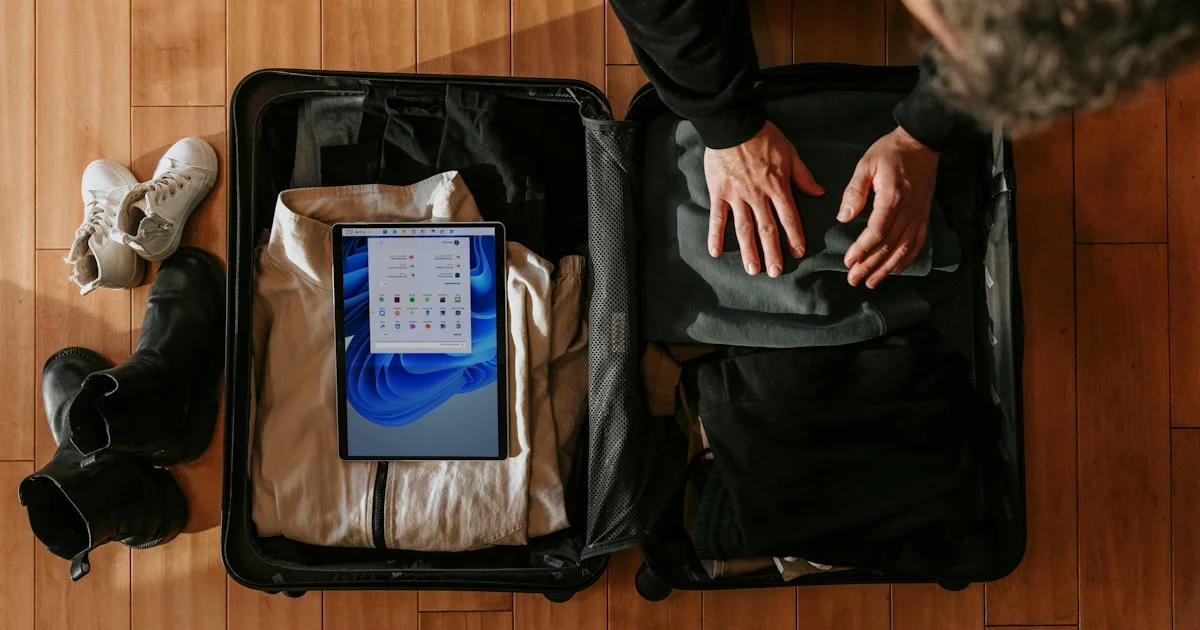
There is a specific kind of dread that hits at the airline counter when the belt scale reads 53 pounds and the agent looks up at you. It is a $100 mistake that takes fifteen seconds to prevent at home. The best smart luggage scale is not a clever gadget so much as cheap insurance — a palm-sized tool that tells you the number before it costs you anything.
Key Takeaways
- Most US airlines cap checked bags at 50 pounds, and going over triggers a fee of $100 or more per bag, each direction.
- Look for a 110-pound capacity, a hold or auto-lock function, and a tare button. Everything else is a preference.
- Hooks are faster for bags with sturdy handles; straps are safer for soft duffels and awkward shapes.
- Technique affects the reading as much as the hardware. Lift slowly and let the number settle.
- Test the scale against a known weight at home before you trust it on a trip.
Why the Best Smart Luggage Scale Pays for Itself
The short answer: one avoided overweight fee covers the cost of the best smart luggage scale several times over, which makes this one of the few travel gadgets with math clearly on its side.
Here is what you are avoiding. The standard checked-bag limit at major US carriers is 50 pounds, or 23 kilograms, with a size cap of 62 linear inches — that is length plus width plus height added together. Cross the weight line and the charges start immediately.
As of mid-2026, Delta, American, United and Alaska all charge $100 for a bag between 51 and 70 pounds, and $200 between 71 and 100 pounds, per bag and per direction. Southwest raised its overweight fees on April 9, 2026 to the same $100 and $200 structure, though Southwest applies only the single highest fee rather than stacking overweight and oversize charges the way the others do. JetBlue takes a different approach: a flat $150 for anything from 51 to 99 pounds. Most carriers refuse bags over 100 pounds entirely.
Note the phrase “per direction.” A single bag that sneaks over on a round trip is not a $100 problem. It is a $200 problem.
What to Look For in a Digital Luggage Weight Scale
A good digital luggage weight scale comes down to a handful of features. Most listings bury them under marketing language, so here is what each one actually does for you.
- Capacity of 110 pounds (50 kg). This covers every checked and carry-on bag you are likely to lift. Lower-capacity scales exist and will simply refuse to read a heavy bag.
- Auto-lock or hold. The scale freezes the reading so you can set the bag down and then look at the display. Without it you are trying to read a number while holding 45 pounds at arm’s length.
- Tare function. Zeroes out the strap or any attachment so you weigh only the bag.
- Unit toggle. Pounds for US domestic flights, kilograms for international carriers that publish limits that way.
- Backlit display. Genuinely useful in a dim hotel room or a badly lit hallway at 5 a.m.
- Resolution of 10 to 50 grams. Finer resolution is not the same as better accuracy, but very coarse resolution means the scale rounds away the margin you are trying to protect.
Hook or Strap: Which Attachment Fits Your Bags
This is the one hardware choice people regret, and it depends entirely on what you pack.
Hooks are faster, lighter, and perfect for a rolling suitcase with a solid top handle. You clip, lift, and read. The catch is that a hook needs something strong to grab. On a bag with a soft fabric loop, a hook concentrates all the weight on a small patch of stitching.
Straps cradle the handle instead, spreading the load. That makes them the safer choice for duffel bags, soft-sided luggage, and anything shaped oddly enough that a hook would slip. They take a few seconds longer to attach and add a little bulk.
If most of your travel is a hard-shell roller, take the hook. If you own a duffel, or you are buying one scale for a household with mixed luggage, the strap is the more forgiving pick.

How Accurate Are These, Really?
Typical accuracy for a handheld travel scale runs about plus or minus 50 to 100 grams, which is roughly 0.1 to 0.2 pounds. That is far tighter than the margin that matters. You are not trying to hit 50.0 pounds. You are trying to stay a comfortable distance below it.
The real source of error is not the sensor. It is how you lift. A jerky pull, a bag brushing the floor, or reading the display before the number settles will all throw the result off by more than the scale’s own tolerance.
Build in a buffer, too. Airport belt scales are not all calibrated identically, and a bag that reads 49.8 pounds at home is uncomfortably close to the line. Aim for 47 pounds and you have absorbed both the scale variation and whatever you buy at the destination.
How to Weigh a Bag Correctly
The whole process takes under a minute once you have done it twice.
- Turn the scale on and let it zero out on its own before attaching anything.
- Attach the hook or loop the strap around the strongest handle on the bag, not a decorative one.
- Lift straight up, slowly and smoothly. No swinging.
- Hold steady, clear of the floor, until the display stops changing and the reading locks.
- Set the bag down and read the locked number.
- Weigh again if the first reading looked odd. Two matching numbers mean you can trust it.
To confirm the scale itself is honest, weigh something whose weight you already know — a sealed bag of pet food, a dumbbell, a case of bottled water — or step on a bathroom scale, then step on again holding the suitcase and compare the difference to what the travel scale reported.
Scale Types Compared
A quick qualitative comparison of what is on the market, since prices in this category shift constantly.
| Type | Best for | Trade-off |
|---|---|---|
| Hook, coin-cell battery | Frequent flyers with hard-shell rollers who want the lightest option | Needs a strong handle; you will eventually need a spare CR2032 |
| Strap, coin-cell battery | Duffels, soft luggage, and households with mixed bag types | Slightly bulkier and slower to attach |
| Rechargeable, app-connected | Travelers who want weight history saved on a phone | One more cable to pack; the app adds little for most people |
| Bathroom scale method | Occasional travelers who do not want to buy anything | Awkward with heavy bags and less precise than a dedicated scale |
Is a Smart Scale Worth It Over a Basic One?
Any honest portable baggage scale review has to address the app question, because that is what separates a $12 scale from a $35 one.
App connectivity logs each weighing to your phone. If you travel constantly and want a record of how heavy your bag runs on different trips, that is mildly useful. For everyone else it adds a pairing step to a task that takes ten seconds without one — and a scale whose app is abandoned in three years is just a scale with an extra chip in it.
What genuinely justifies spending more is build quality: a strap that does not fray, a display that stays readable, and a battery door that still closes after fifty trips. The best travel scale gadget is the one still working in your suitcase pocket five years from now, and that has almost nothing to do with whether it talks to your phone.
Related Articles
- Smart Water Bottle Review: Are They Worth Buying?
- Portable Neck Fan for Summer: A Practical Buying Guide
- Fitness Tracker Buying Guide: Features, Accuracy, Budget
Frequently Asked Questions
These are the questions travelers ask most often once they start looking at luggage scales. Short answers below.
Can I just use my bathroom scale instead?
Yes, and it works reasonably well. Weigh yourself, then weigh yourself holding the bag, and subtract. The drawbacks are that it is awkward with a heavy suitcase and that bathroom scales often round to the nearest half pound, which eats into your margin.
What weight should I actually aim for?
Around 47 pounds for a 50-pound limit. That buffer covers differences between your scale and the airport’s, plus anything you pick up along the way.
Do carry-on bags get weighed?
US carriers rarely weigh carry-ons, but many international and budget airlines do, and their limits are much lower. If any part of your trip is on a non-US carrier, check that airline’s carry-on weight limit specifically.
Will a luggage scale survive being packed in a checked bag?
Generally yes — they are small and simple. The failure point is usually the strap or hook attachment rather than the electronics. Storing it in an interior pocket rather than loose in the main compartment helps.
The Bottom Line
A luggage scale is one of the rare travel purchases where the payback is a single number you can calculate: one avoided overweight fee. Buy one with a 110-pound capacity and a hold function, pick the attachment that suits your bags, and aim for 47 pounds instead of 50.


3 Comments
Comments are closed.