

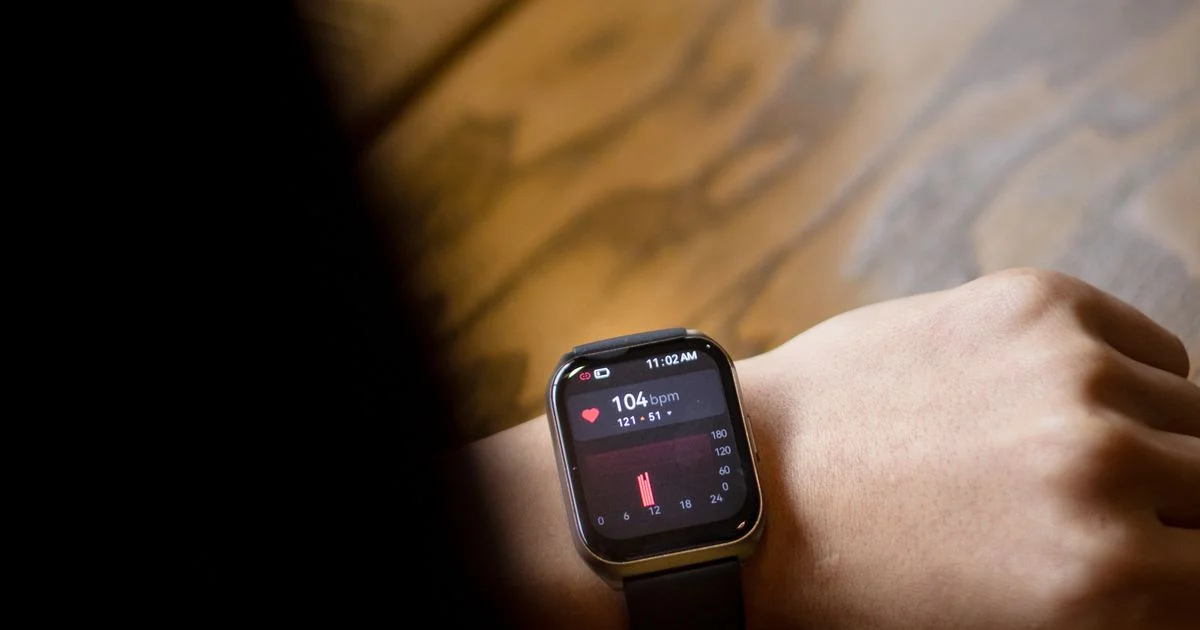
Three people can buy the same watch on the same afternoon and need three different things from it: someone training for a race, an eleven-year-old walking home from school, and a grandparent whose doctor asked about their heart rate. The best smartwatch for fitness is not one product. It is whichever one answers the question that is actually in front of you, and the three questions barely overlap.
This is an independent editorial article. We are not affiliated with Apple, and no brand reviewed or approved this article.
This is general information, not medical advice. A consumer wearable is not a diagnostic device, and nothing it displays should change how you take a medication without talking to a clinician.
Use case 1: what the best smartwatch for fitness is allowed to claim at the gym
Start with the regulatory floor, because it explains almost every strange thing about how these watches are marketed.
The FDA operates a general wellness policy for low-risk products. A general wellness product is one “intended for maintaining or encouraging a healthy lifestyle and is unrelated to the diagnosis, cure, mitigation, prevention, or treatment of a disease or condition,” and for such products the agency says it “does not intend at this time to examine whether they are devices, or if they are devices, whether they comply with device requirements.”
Step counts, calorie estimates, sleep stages, training load and recovery scores all sit inside that policy. Nobody has checked them. That is not an accusation; it is the stated arrangement, and it explains why two watches on the same wrist on the same run will disagree and both be compliant.
The practical consequence is that a fitness watch is useful as a record of your own trend and unreliable as an absolute number. Which makes the buying question narrower than the spec sheets suggest:
- Does it record the sport you actually do, in the units your training plan uses?
- Does the battery survive the longest session you do, with GPS running, without a mid-week charge?
- Can you export or read your own history a year from now, or does it live inside one app?
- Is the band something you will wear to sleep, given that the sleep data is the part people keep?
If you want the broader version of this comparison across the whole tracker category rather than watches specifically, our guide to reading the numbers a consumer health device gives you covers the same trap on the bathroom scale.
Use case 2: a smartwatch for kids, where the data leaves the house
A smartwatch for kids is bought for one reason above all others, which is knowing where the child is. That makes it a very different purchase from an adult’s watch, because the thing it collects is regulated.
The Children’s Online Privacy Protection Rule, at 16 CFR Part 312, treats “geolocation information sufficient to identify street name and name of a city or town” as personal information, and it does the same for “a persistent identifier that can be used to recognize a user over time and across different websites or online services.” An operator “is required to obtain verifiable parental consent before any collection, use, or disclosure of personal information from children.”
Two further provisions are the ones worth checking a product against before you buy:
- Section 312.7 says an operator “is prohibited from conditioning a child’s participation in a game, the offering of a prize, or another activity on the child’s disclosing more personal information than is reasonably necessary.” A watch that will not run its step counter unless location sharing is on is the pattern that rule exists to stop.
- Section 312.10 requires that personal information be retained “for only as long as is reasonably necessary to fulfill the specific purpose(s) for which the information was collected,” together with a written deletion policy.
So the honest checklist for a child’s watch is not about sensors at all. Find the privacy policy before you find the product page. Look for a plain statement of how long location history is kept, whether the parent account can delete it, and whether the fitness features still work with location sharing turned off. A watch that cannot answer those three questions is a watch that has decided them for you.
Use case 3: a smartwatch for seniors, and the one reading not to act on
The pitch for a smartwatch for seniors is health monitoring, and this is where the general wellness policy from use case 1 stops being an abstraction.
On 21 February 2024 the FDA issued a safety communication that could not be clearer: “The FDA has not authorized, cleared, or approved any smartwatch or smart ring that is intended to measure or estimate blood glucose values on its own.” It covers any such device, regardless of brand, that claims to measure blood glucose without piercing the skin. The agency draws one distinction: a watch app that displays readings from an FDA-authorized continuous glucose monitor is a different thing, because the authorized device is doing the measuring.
The stated risk is not vague. Inaccurate readings can lead to incorrect medication dosing, which the FDA says can cause dangerously low glucose “leading to mental confusion, coma, or death within hours.” Its advice to consumers is to not buy or use these devices and to ask a clinician about an FDA-authorized one instead.
Generalize that, because it is the rule the whole category runs on. A wearable number that carries a clinical name is either attached to an authorized device or it is a wellness estimate. There is no third category. For an older relative that turns the buying decision into a short list:
- Features that help without claiming a diagnosis, such as fall alerts, a loud reminder, an easy-to-read face and a simple charging routine.
- A watch face the person can read without glasses, because a health feature nobody looks at is not a health feature.
- Nothing that invites a medication decision. A number on a wrist is a prompt to call the doctor, never a substitute for asking them.

Use case 4: a smartwatch for swimming, and what fifty meters actually buys
Choosing a smartwatch for swimming is the one case where a published number really does decide it, as long as you read the number correctly.
Apple states that “Apple Watch Series 2 and later have a water-resistance rating of 50 meters under ISO standard 22810:2010.” That standard is the right reference point for any watch, not just this one, and the fifty in it is a test pressure rather than a depth you may swim to. Apple’s own wording draws the line: the watch “can be used for shallow-water activities like swimming in a pool or ocean,” but models other than the Ultra line should not be used “for diving, water skiing, or other activities involving submersion below shallow depth or high-velocity water.”
Two sentences on the same page matter more than the rating and get quoted far less often. “Water resistance isn’t a permanent condition and can diminish over time.” And: the watch “can’t be rechecked or resealed for water resistance.” A seal that degrades and cannot be restored is a component with a quiet expiry date on a product people keep for five years.
Apple also warns against exposing the watch to soap or soapy water, which rules out wearing it in the shower as a matter of routine. Chlorine, sunscreen and salt all belong in the same mental category: rinse with fresh water and dry it.
Side-by-side by situation
| Your situation | What it needs | What to ignore |
|---|---|---|
| Training for a distance event | GPS battery life through your longest session, exportable history | Absolute calorie and recovery numbers |
| Everyday gym and step counting | A band you will sleep in, a trend you can read weekly | Small differences between two watches on the same walk |
| A child walking to school | A readable privacy policy, parental deletion, features that work with location off | Sensor counts and screen resolution |
| An older relative living alone | Fall alerts, a legible face, simple charging | Any reading that names a blood value |
| Lap swimming | An ISO 22810 rating stated by the maker, fresh-water rinsing | The word waterproof anywhere in a listing |
| Open water or diving | A watch rated for it, explicitly, by the manufacturer | A 50 meter rating treated as a depth limit |
Related Articles
- Best Fitness Tracker for Running: Road, Treadmill, Pool, or Gym
- Fitness Tracker Buying Guide: Features, Accuracy, Budget
- Best Smart AR Glasses for Gaming: Handheld, Couch, or a Flight
Frequently Asked Questions
These are the questions that arrive after the watch is on the wrist and the first week of data looks odd.
Why do two watches give different heart rates on the same run?
Because nobody has to make them agree. Fitness metrics sit inside the FDA’s general wellness policy, where the agency does not examine whether the product meets device requirements at all. Compare each watch against its own history rather than against the other one.
Is a 50 meter rating enough for the pool?
For shallow-water swimming, yes, when the manufacturer says so in those words. It is not a diving rating, and the seal behind it degrades with age in a way that cannot be restored.
Can a watch tell me my blood sugar?
No. The FDA has authorized no smartwatch or smart ring that measures or estimates blood glucose on its own. An app showing readings from an authorized continuous glucose monitor is a different case.
What should I check before giving one to a child?
The privacy policy, in this order: how long location history is kept, who can delete it from the parent account, and what happens to the fitness features when location sharing is switched off.
Conclusion
Decide which of the four situations above is yours before you compare a single spec, because each one is decided by a different document: a privacy policy, a safety communication, a water-resistance standard, or nothing at all. The watch that suits a runner is rarely the watch that suits a child, and the one thing none of them can do is give you a clinical number you should act on alone.


1 Comment
Comments are closed.