

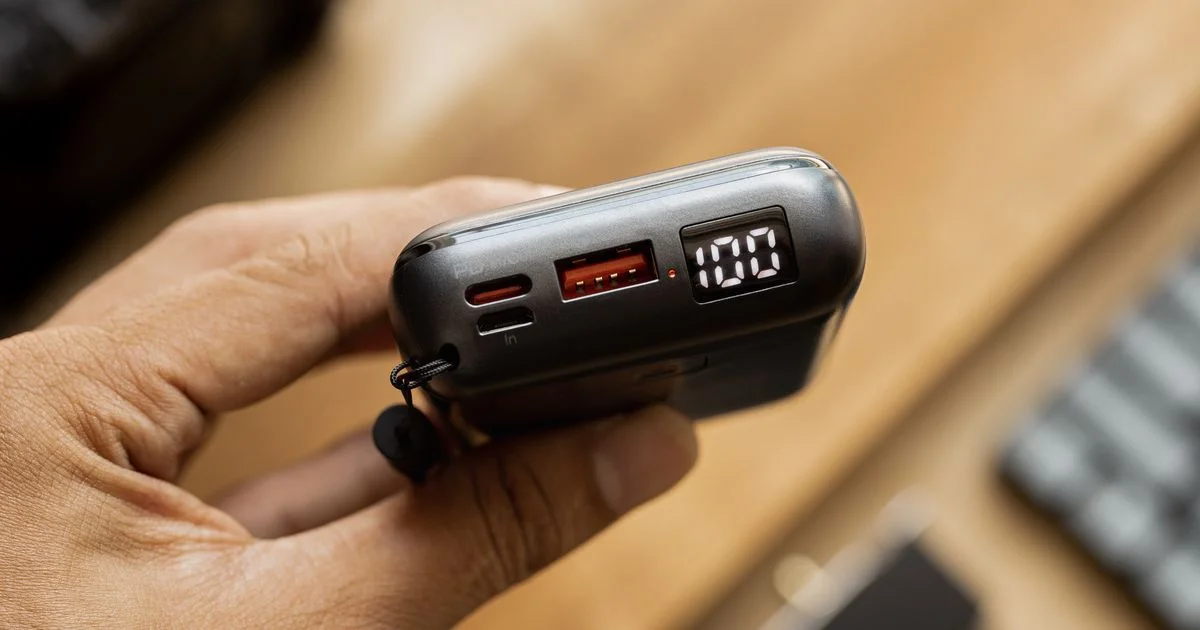
The outlet at seat 34B does not work, the phone is at 18 percent, and there are five hours left. That moment is why the best portable charger for travel is worth thinking about before a trip rather than in an airport shop the morning of one. The right pack is not the biggest one on the shelf — it is the one that suits the specific place your battery runs out.
This is an independent editorial comparison. We are not affiliated with Apple, and no brand reviewed or approved this article.
Use case 1: A long flight, no seat power, and the best portable charger for travel
This is the situation that has changed most, and the change is recent. In 2026 the International Air Transport Association issued guidance that separates power banks from ordinary spare batteries for the first time. Under it, a power bank must not be recharged while onboard the aircraft, and passengers are advised that it “should not be used to recharge a portable electronic device while onboard” either. IATA points at “an increasing concern with the threat of thermal runaway and fire risk in aircraft” as the reason.
So a portable charger for long flights is best understood as a pack you fill on the ground and use on the ground. It refills your phone in the lounge, at the gate, during a layover, and in the taxi line at the other end. Treating it as a substitute for a working seat outlet is the assumption most likely to leave you disappointed — and, on an airline enforcing the guidance strictly, told to put it away.
Two limits decide what you can legally bring:
- 100 watt-hours per battery. The FAA allows lithium-ion batteries rated up to 100 Wh without any airline approval. Between 101 and 160 Wh you need the carrier’s permission, and you may carry at most two. Above 160 Wh is not permitted at all.
- Two power banks per person. The IATA guidance sets this limit, with a 100 Wh ceiling and no provision for larger models.
Capacity is printed in milliamp-hours, and the limit is in watt-hours, so you may have to convert. The FAA’s own instruction is to multiply volts by amp-hours; for a milliamp-hour figure, divide by 1,000 first, then multiply by the cell voltage. Reputable packs print the watt-hour figure on the case, usually in small type near the model number. If yours does not print it anywhere, that is itself worth knowing before you reach a security line.
Use case 2: Camping, where nothing gets recharged for days
On a flight the pack has to last hours. At a campsite it has to last the trip, because there is nothing to plug it into. A portable charger for camping is therefore sized by arithmetic rather than by preference: count the devices, count the nights, and accept that the pack itself is dead weight once it is empty.
Three habits stretch a single pack further than any spec on the box:
- Charge devices to full before you leave, including the pack. A pack that left home at 80 percent has already given away a night.
- Put the phone in airplane mode. A phone hunting for a tower it cannot find is the single largest drain in the backcountry, and it will empty a battery faster than any amount of screen time.
- Keep the pack warm overnight. Lithium cells deliver less in the cold. In freezing conditions the pack goes in the sleeping bag, not in the vestibule with the boots.
The FAA is also clear about damaged cells: a battery or battery-powered device that is damaged or has been recalled “must not be carried aboard an aircraft” unless the battery has been removed or made safe. A pack that has been dropped down a rock face, swelled in the heat, or taken a soaking is a pack to leave behind on the trip home, not one to talk your way through a checkpoint with.

Use case 3: An iPhone, a coat pocket, and a magnetic pack
The snap-on magnetic packs have made life easier for a portable charger for iPhone users, because there is no cable to lose and the pack rides on the back of the phone. The trade-off is real, though: wireless transfer loses energy as heat, so a magnetic pack returns less of its stated capacity to the phone than the same pack would through a cable. On a cold platform that heat is a minor bonus. In an August rental car it is the reason the phone throttles its own charging speed.
IATA’s guidance singles this category out. It notes that wireless power banks are a particular concern because of counterfeiting, and that “several passengers have reported these power banks entering thermal runaway and self-destruction.” That is an argument for buying the magnetic pack from a seller who will honor a return, not an argument against the format — but it is a reason to be suspicious of a no-name pack bought from a marketplace listing with one photograph.
If the same pack has to serve both a phone and a laptop, the honest answer is usually two devices rather than one compromise, and the second one is a cable.
Use case 4: A commute, where small beats big every time
A pack bought for a two-week trip is the wrong pack for a Tuesday. Commuting needs one top-up, carried every day, in a bag that already has a laptop in it. The deciding features are weight, whether it fits the pocket you will actually use, and whether it charges back up overnight from the same brick your phone uses.
The pack that gets carried is the pack that works. A large one left on the hall table on the morning you needed it has a capacity of zero.
Use case 5: Checked bags, gate-checks, and the rule people get wrong
Spare lithium-ion batteries and power banks must travel in carry-on baggage only. The part that catches travelers out is the gate-check: when a carry-on bag is taken at the aircraft door, the FAA requires that “all spare lithium batteries and power banks must be removed from the bag and kept with the passenger in the aircraft cabin.” A boarding group with a full overhead bin is exactly when this happens, and exactly when nobody wants to unpack a bag.
Two small practices remove the problem entirely. Keep the pack in the same pocket every trip, so retrieving it takes five seconds. And protect the terminals — the FAA asks that they be shielded from short circuit by leaving batteries in retail packaging, taping the contacts, or using a case. A loose pack rattling against keys and coins in a tote is the arrangement the rule exists to prevent.
Anyone who travels with a bag that has a battery built into it should also read our guide to smart luggage with a removable battery, because the same removal rule decides whether that suitcase can fly at all.
Side-by-side by situation
| Your situation | What it needs | What to skip |
|---|---|---|
| Long-haul flight, no working outlet | Filled before boarding, under 100 Wh, kept with you rather than in a checked bag | Planning to recharge the pack in flight — the 2026 IATA guidance says not to |
| Multi-night camping | Enough capacity for the whole trip, and a phone kept in airplane mode | Anything you will not carry the weight of on day three |
| iPhone, cold weather, no cable | A magnetic pack from a seller you can return it to | Unbranded marketplace packs with a single stock photo |
| Daily commute | One phone top-up in the smallest case that delivers it | A trip-sized pack you leave at home five days a week |
| Bag likely to be gate-checked | The pack in a pocket you can reach in seconds, terminals protected | Burying it under packed clothes |
Related Articles
- Best Budget Smartphone 2026: What to Look For
- Portable Monitor for Laptop: Hotel Desk, Kitchen Table, or Cafe
- Top 10 External Hard Drives for Backup: Desk, Travel, or Off-Site
Frequently Asked Questions
These are the questions that come up once someone has read the rules and is trying to work out what they mean for an actual trip.
How do I find the watt-hour rating on my power bank?
Look on the case itself, usually printed in small type near the model and certification marks. If only a milliamp-hour figure is given, the FAA’s method is to divide the milliamp-hours by 1,000 and multiply by the voltage printed alongside it. A pack that prints no watt-hour figure and no voltage anywhere is a pack you cannot demonstrate is legal, which is a problem at a checkpoint rather than in your kitchen.
Can I put a power bank in my checked suitcase?
No. Spare lithium-ion batteries and power banks must be carried in the cabin. This also applies when a carry-on bag is taken from you at the gate — the batteries come out and travel with you.
Is a bigger capacity always better?
Only up to the point where the rules and your shoulders stop you. Past 100 watt-hours you need airline permission and are limited to two batteries, and past 160 watt-hours the pack cannot fly on a passenger aircraft at all. For everything short of a multi-day trip off-grid, weight matters more than headline capacity.
What should I do if a power bank gets hot in my bag?
On an aircraft, the FAA asks passengers to notify the flight crew immediately if a battery or device is overheating, expanding, smoking, or burning. IATA’s advice is to switch it off if you can, tell the crew, and not try to cool it or move it yourself. Cabin crew are trained for this and have equipment on board for it.
Conclusion
The rules did most of the choosing for you this year: under 100 watt-hours, at most two packs, in the cabin, filled before you board. Within those lines, pick for the place your phone actually dies — a trip-sized pack for the campsite, a pocket-sized one for the commute, and the discipline to charge it the night before either way.


1 Comment
Comments are closed.