

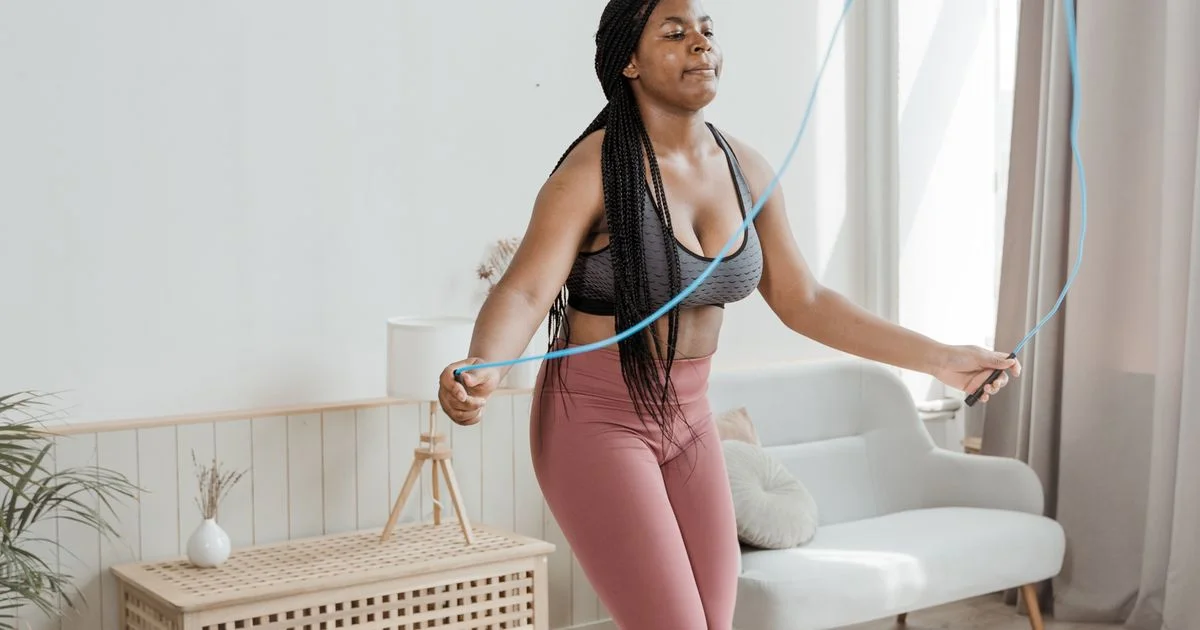
Go and stand in the spot where you would actually do this. Reach straight up, then add a hand’s width above your fingertips. If the ceiling is closer than that, a smart jump rope for home workouts is going to spend its life in a drawer, and no feature on the box changes that. The question this article answers is not which rope is best but whether the room you own can hold one at all.
Scope and sourcing: the activity figures here come from the U.S. Department of Health and Human Services Physical Activity Guidelines for Americans and the CDC, the ceiling dimensions from the International Residential Code, and the floor-noise material from the ASTM test methods behind Impact Insulation Class. This is general information, not medical advice. If you have a joint, heart or balance condition, or you have been inactive for a while, talk to a clinician before you start jumping.
Use case 1: what a smart jump rope for home workouts needs above your head
Skipping is the only common indoor exercise where the room fights back from above. The rope has to clear your head on every pass, and your head is already three to five inches higher than normal because you are in the air.
The International Residential Code sets the floor for how much room you are likely to have. Habitable spaces, hallways and finished basement rooms “shall have a ceiling height of not less than 7 feet.” Bathrooms, toilet rooms and laundry rooms drop to “not less than 6 feet 8 inches.” In a basement, “beams, girders, ducts or other obstructions” are allowed to hang down to within 6 feet 4 inches of the floor.
That last clause is the one that catches people. A basement can legally be a habitable room and still have a duct crossing it at a height that will take the rope out of your hands on the first rotation. Before you buy anything:
- Stand in the exact spot, arms at your sides, and have someone measure from the floor to the ceiling above your head.
- Walk the four corners of the space and find the lowest point, not the average one — a light fixture, a duct, a sloped ceiling edge, a smoke detector.
- Subtract about ten inches from that lowest point for your jump plus the arc of the rope.
- If the number that is left is less than your own height, look at a different room or plan to skip outdoors.
Ropeless handles, which spin weighted ends instead of a cable, exist precisely for this problem. They will keep a cadence and they will keep a count. What they will not do is punish a sloppy rotation, which is most of what a rope teaches.
Use case 2: an upstairs apartment, and the person underneath you
The floor between you and your downstairs neighbor was rated for footsteps. It was not rated for you.
Impact Insulation Class is the number that describes how well a floor-ceiling assembly blocks impact sound. It comes from ASTM E989, which uses the tapping machine specified in ASTM E492 for laboratory testing, with ASTM E1007 used for field measurements. Two things in that standard matter to anyone skipping upstairs. First, the field-measured figure for a real installed floor “is typically several points lower than its laboratory IIC,” because a finished building has paths for sound that a test rig does not. Second, and more damning, the test only covers 100 to 3150 Hz, while real footfall noise sits below 100 Hz — so the rating “may not accurately describe the complete noise attenuation profile of a floor.”
In plain terms: the thud your neighbor hears is in the part of the spectrum your building’s own sound rating was never measured at. This is why a jump rope can be inaudible in your own apartment and intolerable one floor down.
What actually helps, in rough order of effect:
- Jump on the lowest floor you have access to — a slab-on-grade room transmits almost nothing downward because there is nothing below it.
- Put a thick mat down. It will not fix the low frequencies, but it removes the sharp slap of a shoe on hardwood or tile.
- Keep the jump small. Clearing the rope takes about an inch. Everything above that is noise and knee.
- Pick your hours, and ask the neighbor once rather than wondering for a year.

Use case 3: day one, when thirty unbroken seconds is the whole session
A smart jump rope for beginners is sold on the idea that the data will keep you honest. The data is usually the opposite of encouraging in week one, because the first thing it records is how often you stop.
That is fine, and the federal guidance agrees. The Physical Activity Guidelines for Americans state plainly that “some physical activity is better than none,” and the second edition removed the old rule that only bouts of ten minutes or more counted, specifically “to encourage Americans to move more frequently throughout the day.” Forty seconds, a miss, twenty more seconds, a miss — that is a workout under the current guidance, and it is also what learning looks like.
Two setup details do more for a beginner than any feature:
- Rope length. Stand on the middle of the cable; the handles should reach roughly to your armpits. Too long is the single most common reason a new skipper trips, and almost every rope ships longer than anyone needs.
- Surface. A cable on concrete frays fast and stings when it catches you. A cable on carpet drags. A mat or a smooth wood floor is the easy middle.
Use case 4: fitting it into a week that already has a step count
If you already walk a lot, the interesting question about a smart jump rope for cardio is what it adds rather than what it replaces. The guidelines give adults a weekly target of “at least 150 minutes (2 hours and 30 minutes) to 300 minutes (5 hours) a week of moderate-intensity, or 75 minutes (1 hour and 15 minutes) to 150 minutes (2 hours and 30 minutes) a week of vigorous-intensity aerobic physical activity,” or an equivalent combination of the two, plus “muscle-strengthening activities of moderate or greater intensity and that involve all major muscle groups on 2 or more days a week.”
Skipping lands firmly in the vigorous column for almost everyone, which is the practical argument for it: the vigorous half of that range is the smaller number. A walking habit that is already covering the moderate target does not need much rope to round out the week. What skipping does not cover is the muscle-strengthening requirement, and no counter on a handle will tell you that.
If you already own a wrist device, note that it is measuring your effort from a completely different place. Our guide to a fitness tracker for running across road, treadmill, pool and gym covers why two devices on the same body routinely disagree, and the same applies here.
Use case 5: buying it specifically to lose weight
The honest framing for a smart jump rope for weight loss is that the rope is a scheduling tool, not a metabolic one. It is small, it needs no setup, and it removes the excuse of not getting to a gym. That is genuinely worth something, and it is the reason the habit sticks for people it sticks for.
What it does not do is make the arithmetic of weight change work differently from any other activity. The federal guidelines set targets for health, and they do not publish a prescription for weight loss at all — a silence worth noticing, given how confidently the number is quoted elsewhere. Any energy figure a handle shows you is an estimate built from your entered height and weight and a cadence count, not a measurement of you.
The other limit is structural. Skipping is a repeated landing on the same two feet, and adding volume fast is how ankles and shins get angry. A rope you can only use for six minutes a day without pain is a rope that will not move a scale, whatever the display says.
Side-by-side by situation
| Your situation | What it actually needs | What to ignore |
|---|---|---|
| Ceiling under about 8 feet at its lowest point | A ropeless handle set, or an outdoor spot | Cable material and bearing claims |
| Second floor or above, neighbors below | A thick mat, a small jump, and a ground-floor alternative for hard days | Your building’s sound rating — it was measured above the frequencies that matter here |
| Complete beginner | Correct rope length and a forgiving surface | Session streaks and leaderboards in week one |
| Already walking 8,000 steps a day | Short vigorous blocks to top up the week, plus two strength days the rope cannot cover | Comparing its numbers against your watch |
| Bought for weight change | A volume you can repeat six days out of seven without shin pain | The calorie readout |
| Shared or carpeted room only | A heavier cable that will not drag, or a different exercise | Speed-rope marketing entirely |
Related Articles
- Smart Yoga Mat for Beginners: Small Rooms, No Teacher, Day One — the other sensor-equipped floor product, and the same room-size problem.
- Smart Water Bottle Review: Are They Worth Buying? — what a sensor in an everyday object can and cannot tell you.
Frequently Asked Questions
These are the questions that come up once the rope is out of the box and the ceiling has already been measured.
How much ceiling height do I really need?
Take your own height, add roughly ten inches for the jump and the rope’s arc, and measure to the lowest obstruction in the room rather than to the ceiling itself. Code minimums tell you the likely worst case — 7 feet for a habitable room, and as little as 6 feet 4 inches under a basement duct — but your own tape measure is the only number that counts.
Will the counter be accurate?
Treat any count as a consistent estimate rather than a measurement. It will be reliable enough to compare this Tuesday against last Tuesday, which is the only comparison that matters, and it will not match a separate wrist device. Do not buy on counting claims.
Is it worse for my downstairs neighbor than running on a treadmill?
Probably, because both feet leave the floor and land together. A treadmill deck absorbs some of that; a bare floor does not. A mat helps with the sharpness of the sound and much less with the thud.
Can I skip barefoot on a wood floor?
You can, and it will teach you a softer landing quickly. It also puts every landing straight into your heels and the floor finish, so it suits short sessions and light contact rather than a twenty-minute block.
Conclusion
The useful specification for this product is not in the product. It is the distance from your floor to the lowest thing hanging off your ceiling, and the construction of the floor you are standing on. Measure both before you shop, and the rest of the decision gets very small.


