

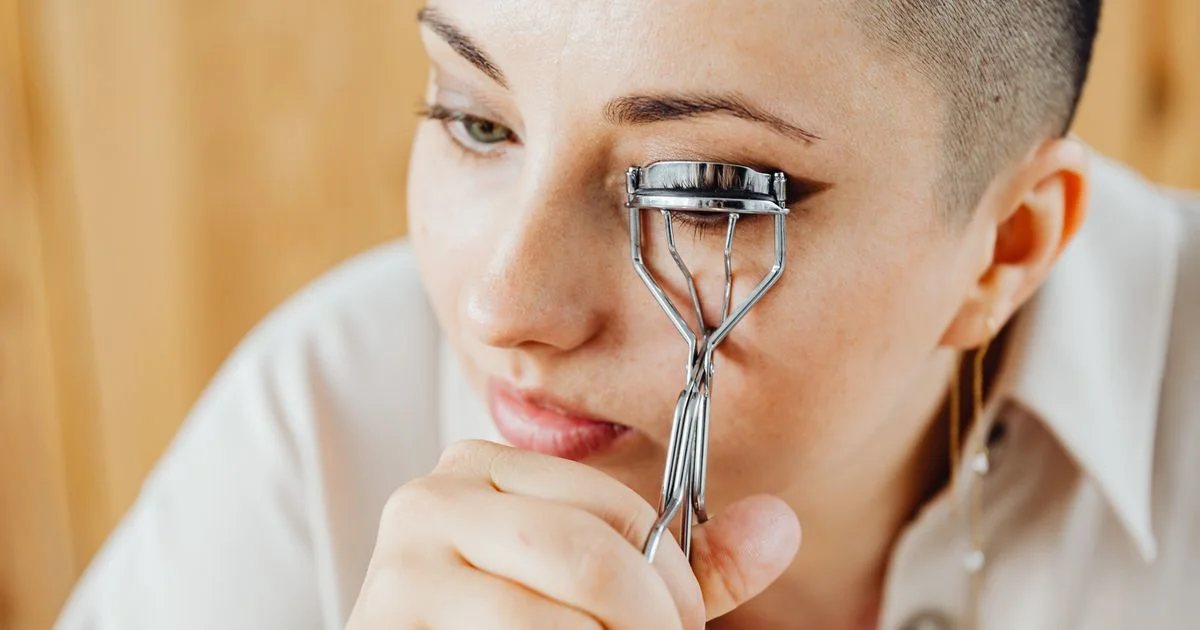
Three different people reach for this tool for three different reasons: one whose lashes drop flat again within the hour, one trying to shave a step off a weekday face, and one who wants something that survives a toiletry bag. Only the first of those is really buying a heated eyelash curler for straight lashes, and only the first is reliably happy afterwards. Sorting out which of the three you are is most of the decision.
Scope and sourcing: the eye-area safety material here comes from the U.S. Food and Drug Administration’s consumer pages on eye cosmetic safety and from the Modernization of Cosmetics Regulation Act. This is general information and not medical advice. Redness, swelling, pain or any change in vision belongs with a clinician rather than with a product page.
Use case 1: a heated eyelash curler for straight lashes, and what it cannot change
Lashes that will not hold a curl are usually not weak. They are growing out of the lid at an angle that sends them forward and down, and they are often thicker than average, which is why a clamp closes on them and they spring straight again the moment it opens. Heat gives the curl somewhere to set while it cools, which is the entire mechanism and the entire promise.
What heat cannot do is change the angle they grow at, so the effect is always temporary and always needs repeating. It also cannot do anything for lashes that are very short, because a heated wand needs something to wrap around. If a plain metal clamp already holds your curl until lunchtime, you are not the buyer this category exists for.
There is one thing worth knowing before any of that, and it is a regulatory gap rather than a product flaw. The FDA regulates what goes on your lashes. The Modernization of Cosmetics Regulation Act requires a responsible person to “ensure and maintain records supporting adequate safety substantiation of their cosmetic products,” to register manufacturing facilities and renew “every two years,” to list each marketed product and its ingredients with annual updates, and to report serious adverse events “to FDA within 15 business days.” None of that framework attaches to the heated metal comb itself. The mascara is inside a system; the appliance that warms it is not.
Use case 2: the five-minute face, and the one place you must not do it
The argument for a heated eyelash curler for daily makeup is that it removes a fiddly two-handed squeeze from a routine that is already running late. That is a fair argument. The FDA’s own eye cosmetic guidance, though, quietly rules out the exact moment most rushed people would use it.
The agency says to “never apply or remove eye cosmetics in a moving vehicle,” because a bump or a sudden stop turns any applicator held near the eye into a risk of a scratched cornea. A heated wand pressed against the lash line on a commuter train is that warning with a heating element added. If the reason you are buying this is that mornings are short, the honest answer is that it moves the step, it does not move it into the car.
The rest of the FDA’s list reads like a set of house rules for anything that touches a lash:
- Wash your hands before you start.
- Do not share it, and do not borrow one — “another person’s germs may be hazardous to you,” and the agency notes that in rare cases an infection from an eye cosmetic has caused temporary or permanent blindness.
- Skip it entirely if you have an eye infection or the skin around the eye is inflamed.
- Stop immediately if anything stings, and see a doctor if it does not settle.
A heated comb is easier to keep clean than a clamp with a rubber pad, which is a genuine point in its favor and one nobody puts on the box.
Use case 3: thirty seconds, and why the sequence matters
Buying a heated eyelash curler for quick curls means buying a tool whose whole selling point is the warm-up-to-done interval. The part that decides whether those thirty seconds work is not the tool at all — it is where the step sits in your order of operations.
- Clean, completely dry lashes first. Any residue of oil or remover and the curl slides straight back out.
- Let the wand reach its working temperature before it touches anything, rather than chasing it with your eye already open.
- Work from the base outward in two or three short passes instead of one long hold.
- Give it a few seconds to cool in the curl. The shape sets as it cools, not while it is hot.
- Mascara last, and only once the lash is cool.
Reversing steps 4 and 5 is the single most common reason a heated curler seems not to work. Warming a lash that already has product on it is also how a wand ends up with a baked residue that no rinse removes.

Use case 4: a bag that lives in a hot car or a suitcase
A heated eyelash curler for travel is a reasonable thing to want, because the alternative is a metal clamp with a rubber pad that gets crushed flat by everything packed on top of it. Two cautions apply, and one of them is about the company it keeps rather than the tool.
The FDA’s storage line is blunt: do not store cosmetics “at temperatures above 85 degrees F,” because “cosmetics held for long periods in hot cars, for example, are more susceptible to deterioration.” A bag that lives in a glovebox in July is already degrading the mascara you plan to put on afterwards, whatever the curler is doing.
The second is the mascara clock. The FDA’s product page says manufacturers “usually recommend discarding mascara two to four months after purchase,” while its consumer question-and-answer page gives the tighter instruction to “discard mascara three months after purchase.” Both are in the same neighborhood and both are shorter than a tube typically lasts, so take the earlier date if your travel kit is one you dip into a few times a year. The agency also warns against topping up a drying tube: “don’t add saliva or water to moisten it. The bacteria from your mouth may grow in the mascara and cause infection.”
Use case 5: extensions, lifts, contacts, and an eye that is already busy
This is the group the category is wrong for, and it is larger than the marketing suggests.
Extensions are attached with adhesive, and a heated wand is the obvious way to compromise that bond. A lash lift has already set the curl chemically, so there is nothing left for heat to add. Contact lens wearers do not have a hard rule against a heated curler, but they do have a stronger reason than anyone to follow the hand-washing and no-sharing rules, because a scratch or an infection has a lens sitting on top of it.
And there is a whole adjacent product family the FDA treats far more severely. Its guidance warns that “permanent eyelash and eyebrow tints and dyes have been known to cause serious eye injuries, including blindness,” and tells consumers to avoid color additives “that are not approved for use in the area of the eye,” naming permanent lash tints and kohl specifically. A heated curler is not that, but anyone shopping this shelf is being shown those products alongside it.
Side-by-side by situation
| Your situation | What it actually needs | What to ignore |
|---|---|---|
| Thick lashes that drop flat within an hour | Heat plus a proper cool-down in the curl | Nothing — this is the case the product is built for |
| Very short or sparse lashes | A clamp that can reach the base, or mascara alone | Comb-style heated wands entirely |
| Weekday morning, getting ready at speed | A tool you can use one-handed at a mirror, and the discipline not to do it in a moving car | Warm-up times quoted in seconds |
| Travel kit, hot car, a few uses a year | A hard case, and a mascara you date and throw out on schedule | Bundled pouches |
| Lash extensions or a recent lash lift | Neither product — leave the curl to the treatment | The whole category |
| Contact lenses or a currently irritated eye | Clean hands, nothing borrowed, and a pause until the eye settles | Any claim of being gentler than a clamp |
Related Articles
- Eye Massager for Dark Circles: Late Nights, Allergies, or Screens — another eye-area gadget, and the same question of what is and is not reviewed before sale.
- Hair Straightener for Thick Hair: Morning Rush or Weekly Reset — the same heat-sets-a-shape logic at a much larger scale.
- Sonic Facial Cleansing Brush Review: What the Evidence Says — how to read the claims on a small powered beauty tool.
Frequently Asked Questions
These come up once the box is open and the first attempt has either worked or very much not.
Is a heated curler safer than a metal clamp?
They fail in different ways. A clamp can pinch or pull if you close it on the lid, and a heated comb can scorch a lash if it is held in one place. The hygiene rules matter more than the mechanism: clean hands, nothing shared, and a pause whenever the eye is irritated.
How often should I replace it?
The tool itself has no expiry, but the mascara that follows it does — the FDA’s guidance points at two to four months on one page and three months on another. Replace the mascara on that clock and clean the wand after every few uses, when residue has not had time to bake on.
Will it work on lashes that have never held a curl at all?
Usually better than a clamp does, and still not permanently. A day is a realistic expectation; a week is not. If a clamp has never worked and heat does not either, the limiting factor is lash length rather than the tool.
Can I use it on the lower lashes?
It is not designed for it, and the lower lid gives you almost no margin for a slip. If the look needs lower definition, that is a job for mascara.
Conclusion
This is a narrow product that is very good at one job and oversold for four others. If your lashes fight a clamp, it earns a place on the shelf; if they do not, the clamp you already own is doing the work and the heat is buying you nothing but a charging cable.


2 Comments
Comments are closed.