

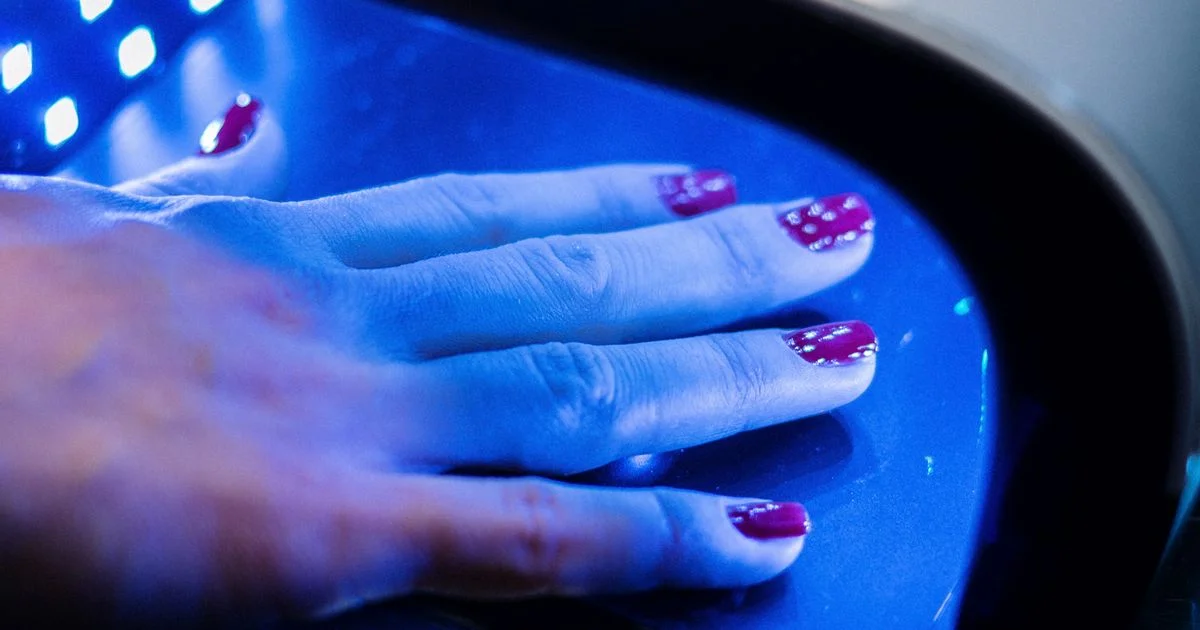
The safety rules written for a nail salon are written for the technician, not for the person sitting in the chair. That single fact reorganizes the whole decision, because it means choosing a UV nail lamp for gel manicures at home is not only about curing power. It is about who is looking after your hands when nobody is paid to.
Scope and sources: the guidance here comes from the American Academy of Dermatology, the FDA and OSHA. This is not medical advice. Skin changes on the hands, a reaction around the nail, or nails that keep lifting are questions for a board-certified dermatologist, not for a different lamp.
Use case 1: your own nails at the kitchen table, where a UV nail lamp for home use changes what you are responsible for
Buying a UV nail lamp for home use moves three jobs onto you that a salon was quietly doing: cure timing, cleanup, and skin protection. The third is the one people skip.
The American Academy of Dermatology is specific about it. Before a gel manicure, “apply a broad-spectrum, water-resistant sunscreen with an SPF of 30 or higher to your hands,” or “put on dark, opaque gloves with the fingertips snipped off.” The AAD also states plainly that “gel manicures can cause nail brittleness, peeling and cracking, and repeated use can increase the risk for skin cancer and premature skin aging.”
Notice what that advice is actually about. It is not about the lamp’s specification sheet. It is about the two square inches of skin on the back of each hand that sit in the light for the length of every cure, several times per manicure, for as long as you keep the habit. The lamp you buy cannot change that. The glove costs almost nothing and does.
A home setup that respects the AAD guidance looks like this:
- Fingerless gloves or SPF 30 or higher on the backs of both hands, applied before the first coat rather than after.
- A removal routine that soaks only the nail, using cotton wrapped in foil, rather than dropping whole fingertips into a bowl of acetone.
- A rest period, because the AAD advises going “one to two weeks or longer” without polish so nails can repair.
- Good ventilation, which the FDA also asks for on nail products generally.
Use case 2: the salon chair, and what a UV nail lamp for nail salons is regulated for
When you sit down in a salon, the rules in the room are occupational rules. OSHA’s nail salon guidance runs on the Bloodborne Pathogens Standard at 29 CFR 1910.1030, and it tells the worker to “bandage open cuts or broken skin to prevent contact with blood or other potentially infectious materials from a client or coworker,” to “avoid all contact with blood or bodily fluids,” and to avoid “clients with cuts, open wounds/sores, blisters, or visibly infected skin on their hands, feet, or nails.” Instruments are to be cleaned and disinfected after each client with an EPA-registered disinfectant, following the state cosmetology board’s policy.
Every one of those lines protects the technician. None of them is about how long your hand spends under the light. A UV nail lamp for nail salons is chosen for throughput and durability, and the exposure question is left to you and, if you ask, to your dermatologist. That is not a scandal. It is simply the wrong place to look for reassurance.
The client-side reading of the same rules is still useful: if the salon is turning away hands with open cuts, disinfecting between clients and visibly following a written procedure, the parts of the visit that carry real infection risk are being handled. The UV exposure is the part you bring your own gloves for.

Use case 3: ten minutes before you leave, when a UV nail lamp for quick drying is the whole point
The reason most kitchen-table lamps get bought is time. Regular polish is touchable in minutes and ruinable for an hour; a cured gel coat is finished when the cycle ends. A UV nail lamp for quick drying is really being bought as a scheduling device, and it is worth being honest that it only compresses the drying, not the prep.
Two things follow. The cycle length on the box is a property of the gel as much as the lamp, so the useful step before buying is to read the label on the polish you already own and follow the warning printed there, which is exactly what the FDA asks consumers to do with nail products. And a rushed manicure is where the skin step gets dropped, which is the one step with a published recommendation behind it.
A morning routine that survives being hurried runs in this order:
- Read the cure time on the gel bottle, not on the lamp, and set that time before you start.
- Put the gloves on or the sunscreen down while your hands are still clean and dry.
- Prep and paint thin coats, since a thick coat is the usual reason a cure fails and has to be repeated.
- Cure, then leave the lamp where it lives rather than putting it away, so the gloves stay beside it.
- Keep the removal kit in the same drawer, because peeling a gel coat off in a hurry is what damages the nail plate.
Use case 4: skin you have to be careful with, and when a UV nail lamp for gel manicures is the wrong purchase
Some people should treat this category differently, and the reason is not the hardware. If you have a history of skin cancer on the hands, if you are taking something that makes you sensitive to light, or if your nails are already brittle, peeling or lifting, the decision is a clinical one before it is a shopping one. The AAD’s line for that situation is to “see a board-certified dermatologist if you notice any unusual changes to your nails or have a persistent nail problem.”
There is also a regulatory point worth knowing before you spend, and it applies to the polish rather than the lamp. Under federal law, as the FDA puts it, “cosmetic products and ingredients, including nail products, do not need FDA approval before they go on the market, with the exception of most color additives.” The agency adds that “no regulation specifically prohibits the use of methyl methacrylate monomer in cosmetic products,” and that it is “still used occasionally in some artificial nail products.” So the label is the safety document here, and the FDA’s own advice is the blunt version: “consumers should read labels of nail products carefully and follow any warnings.”
Side-by-side by situation
| Your situation | What the situation needs | What to ignore |
|---|---|---|
| Doing your own gels every two weeks | Fingerless gloves or SPF 30 plus, and a foil-and-cotton removal kit | Wattage claims on the carton |
| Salon visits, no lamp at home | Your own sunscreen in your bag, and a salon that turns away broken skin | Worrying about which lamp the salon owns |
| Rushed weekday mornings | A lamp matched to the gel already in your drawer, and the gloves beside it | The shortest advertised cure time |
| Brittle, peeling or lifting nails | A break from polish of one to two weeks, and a dermatologist if it persists | A stronger lamp as a fix for a curing failure |
| Light-sensitive skin or medication | A conversation with a clinician before any purchase | Reassurance from a product listing |
Related Articles
- Heated Eyelash Curler for Straight Lashes: Rushed Mornings or Travel
- Best Teeth Whitening Kit for Sensitive Teeth: Coffee Stains or a Wedding
- Sonic Facial Cleansing Brush Review: What the Evidence Says
Frequently Asked Questions
These are the questions that come up once the wavelength arguments are set aside and the decision becomes practical. The answers stay with what the AAD, the FDA and OSHA actually publish.
Should I put sunscreen on before a gel manicure?
The AAD says to apply a broad-spectrum, water-resistant SPF 30 or higher to your hands, or to wear dark opaque gloves with the fingertips snipped off. Either one is applied before the first coat goes on, not afterward.
How long should I go between gel manicures?
The AAD’s guidance is to try not to wear nail polish for one to two weeks or longer between manicures, to give the nails time to repair. Brittleness, peeling and cracking are the effects that rest period is meant to address.
Has the FDA approved the gel polish I am buying?
Almost certainly not, and that is how the law works rather than a red flag about one product. Cosmetic products and ingredients, nail products included, do not need FDA approval before going on sale, with the exception of most color additives. The label and its warnings are the document to read.
Is a salon lamp safer than a home one?
The salon’s regulatory obligations are about infection control and worker protection, not about how much light reaches your skin. Bring your own protection to either setting and judge a salon on its disinfection routine instead.
Conclusion
The lamp is the cheapest decision in this whole category and the one everyone spends the longest on. Match it to the gel you already own, then spend the remaining attention on the gloves, the rest period and the removal, because those are the parts with published guidance behind them.


