

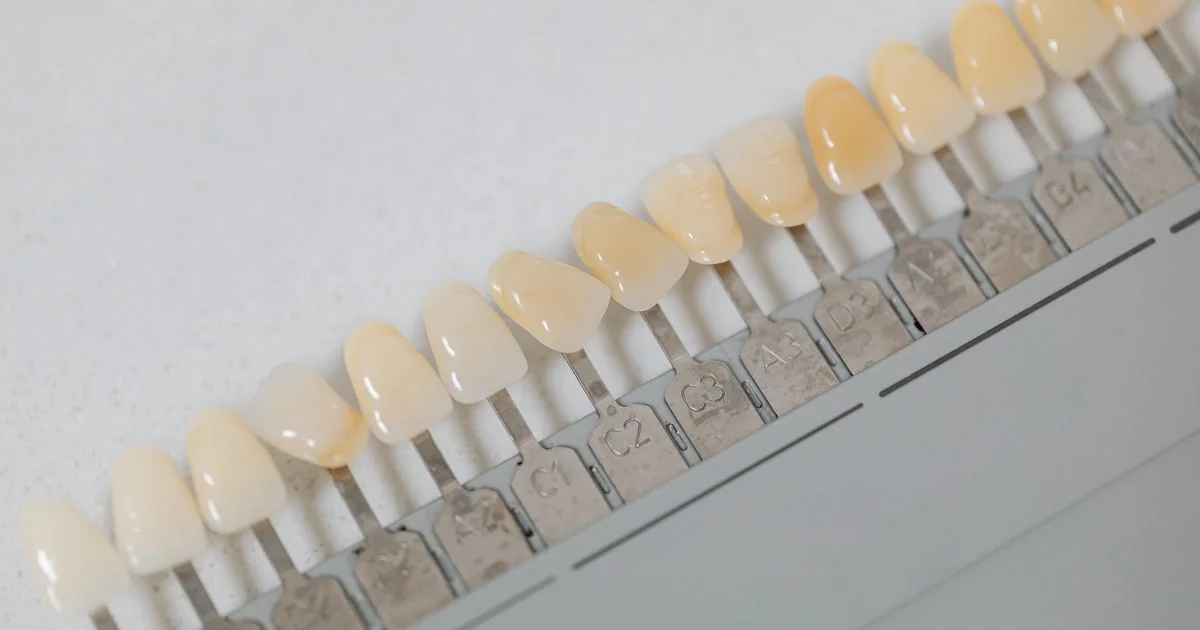
Whitening usually fails in the same order. The strips go on Sunday night, a cold drink on Tuesday produces a jolt through one front tooth, and the box sits unopened in a drawer for a year. Choosing the best teeth whitening kit for sensitive teeth is less about finding a gentler gel than about matching the strength and the wear time to the teeth you actually have — and knowing which two weeks before you start do most of the work.
This article draws on published guidance from the American Dental Association and on dental literature on bleaching sensitivity. It is general information, not dental advice — a dentist who has looked at your teeth is the only person who can tell you whether whitening is appropriate for you.
Use case 1: coffee and tea stains on ordinary teeth
This is the easiest version of the problem and the one most kits are designed for. A teeth whitening kit for coffee stains is working on extrinsic staining — colored compounds sitting on and near the surface — and peroxide handles it well.
The chemistry is worth understanding because it explains every trade-off further down. Hydrogen peroxide diffuses through the spaces in enamel, and the reactive oxygen it releases oxidizes the colored compounds inside enamel and dentin. Nothing is scraped off. That is why a whitening toothpaste is a different product entirely: those rely mainly on abrasives to remove surface stain, and a 2020 review found whitening toothpastes were about as effective as a paint-on gel and less effective than whitening strips.
Speed follows concentration. Over-the-counter kits, at their lower peroxide levels, typically need around 16 days to do what a dentist-supplied at-home tray does in about 7, and what an in-office treatment does in one appointment.
Use case 2: teeth that are already sensitive before you start
Here is the part most packaging skips. Bleaching sensitivity is not the same thing as everyday sensitive teeth. It is not caused by exposed dentin tubules — the peroxide molecule passes through intact enamel and dentin and reaches the pulp within roughly 5 to 15 minutes, and what follows is a reversible pulpitis that shows up a few days into the course.
That timing matches what the ADA reports: transient mild to moderate sensitivity affects up to two-thirds of users in the early stages, usually appearing within two to three days of starting and typically resolving by the fourth day after treatment ends.
The useful response is preparation rather than endurance. Potassium nitrate at 5% — the maximum concentration approved for over-the-counter use — reduces the pain signal by preventing the nerve from repolarizing, and it does not reduce how well the bleaching works. In a desensitizing toothpaste it needs roughly two weeks of regular brushing to take effect, which is why the standard advice is to start brushing with it two weeks before the first strip goes on. Placed directly in a bleaching tray, the same ingredient can work in 10 to 30 minutes. Fluoride, as a gel, paste or varnish, works differently, occluding the dentin tubules to reduce fluid movement toward the pulp.
If you know your teeth twinge already:
- Start the potassium nitrate toothpaste two weeks ahead, not on day one.
- Choose the lowest concentration that will get you there, and accept a longer course.
- Shorten the daily wear time before you abandon the product — a poorly tolerated 8-hour overnight tray is not the only option.
- Skip a day when a tooth is complaining. The sensitivity is transient, and pushing through is what makes people quit entirely.
Use case 3: at-home trays, strips, and the gap between them
A teeth whitening kit for at-home use can mean two quite different things. Dentist-supplied at-home systems typically run 10% to 38% carbamide peroxide, worn from 2 to 10 hours a day over 6 to 28 days. Drugstore kits sit below that range, which is why they take longer, and also why they are more forgiving if your teeth object.
Gum irritation is the other common complaint, and its cause is mechanical rather than chemical: it comes from gel contacting the gums, usually because of a poorly fitting tray or sloppy application. Like sensitivity, it is transient and settles once the course ends. A tray that fits, and less gel rather than more, fixes most of it.
The ADA Seal of Acceptance is the one shortcut worth using on a drugstore shelf. It means the product has met the program’s requirements for safety and effectiveness when used as directed, and both whitening toothpastes and whitening strips can carry it. Professional products supplied by a dentist are not eligible for it, so its absence on a dentist-dispensed kit means nothing.

Use case 4: a wedding, a reunion, or anything with a date on it
A teeth whitening kit for special occasions needs a calendar more than it needs a stronger gel, because the two things that can go wrong — sensitivity and gum irritation — both peak early.
- Eight weeks out: see a dentist if you have not recently. Whitening sits on top of existing dental work and existing problems; neither improves with peroxide on it.
- Six weeks out: start the potassium nitrate toothpaste if your teeth are at all sensitive.
- Four weeks out: begin the course. An OTC kit may need around 16 days, and you want slack in case you have to skip days.
- One week out: stop. Sensitivity from an in-office treatment can be more intense and last several days, and you do not want that in the same week as the event.
- The week itself: protect the result — cut back on coffee and red wine, and use a straw for drinks that stain.
Well cared for, results can last more than a year. The dentist route is the fast one: in-office bleaching can brighten teeth by up to eight shades in a single visit of roughly an hour and a half, using high-concentration hydrogen peroxide applied for up to 30 minutes at a time. That is the option to price out if the date is close.
Use case 5: crowns, veneers and fillings in the smile line
This is the scenario where a kit cannot deliver whatever the box implies. Only natural teeth whiten. Tooth-colored restorations do not, which means a crown on a front tooth, a veneer or a large white filling stays exactly the shade it was while everything around it gets lighter.
Intrinsic staining is a similar story with a longer timeline. Brown staining from fluorosis or tetracycline responds better than the white spots left by orthodontic treatment, and tetracycline staining in particular may need three to four months of nightly treatment. That is a plan to make with a dentist, not a two-week drugstore purchase.
It is also worth knowing what does not work at all. The ADA is clear that do-it-yourself methods lack evidence: charcoal mixtures were found abrasive and ineffective, producing deep concave abrasion cavities, and oil pulling has been associated with adverse events ranging from an upset stomach to lipoid pneumonia. On safety, a 2022 systematic review concluded that hydrogen peroxide tooth whitening products do not appear to have carcinogenic effects on the oral mucosa — but full-arch cosmetic bleaching is discouraged for children and adolescents.
Side-by-side by situation
| Your situation | What suits it | What to avoid |
|---|---|---|
| Coffee stains, no sensitivity | OTC strips with the ADA Seal, about a 16-day course | Whitening toothpaste as the main method |
| Teeth already twinge | Two weeks of potassium nitrate first, then the lowest strength that works | Overnight high-concentration trays on day one |
| Sore gums last time | A well-fitting tray and less gel | Blaming the gel before checking the tray |
| Event on a fixed date | An eight-week plan, finishing a week early | Starting the week of the event |
| Crown or veneer in front | A conversation with a dentist about matching | Any kit, on its own |
| Deep tetracycline staining | Months of supervised nightly treatment | Judging a kit as a failure after two weeks |
Related Articles
- Sonic Facial Cleansing Brush Review: What the Evidence Says
- Facial Toning Device Guide: What Works and What Doesn’t
Frequently Asked Questions
These come up constantly, and most of them have answers that are more specific than the packaging suggests.
How long does the sensitivity last?
It is described in the dental literature as transient. It typically develops within two to three days of starting a course and usually resolves by the fourth day after the treatment finishes. Sensitivity following an in-office treatment can be sharper and persist for several days.
Does a desensitizing toothpaste make the whitening less effective?
Potassium nitrate does not affect how well the bleaching works. That is the reason it is the standard recommendation rather than simply using a weaker gel — you keep the result and lose some of the discomfort.
Are whitening toothpastes worth using at all?
As maintenance, yes; as the main event, no. They work mostly by abrasion on surface stain, and a 2020 review put them on a par with a paint-on gel and below whitening strips. Use one to hold a result you got another way.
Can teenagers use these kits?
Full-arch cosmetic bleaching is discouraged for children and adolescents. If a teenager is unhappy with the color of their teeth, that is a conversation for their dentist, who can say whether the cause is staining at all.
Conclusion
Sensitive teeth do not rule out whitening; they rule out doing it in a hurry. Two weeks of preparation, the lowest concentration that will get you where you want to go, and a tray that actually fits will do more for comfort than any product claim on the front of a box.


