

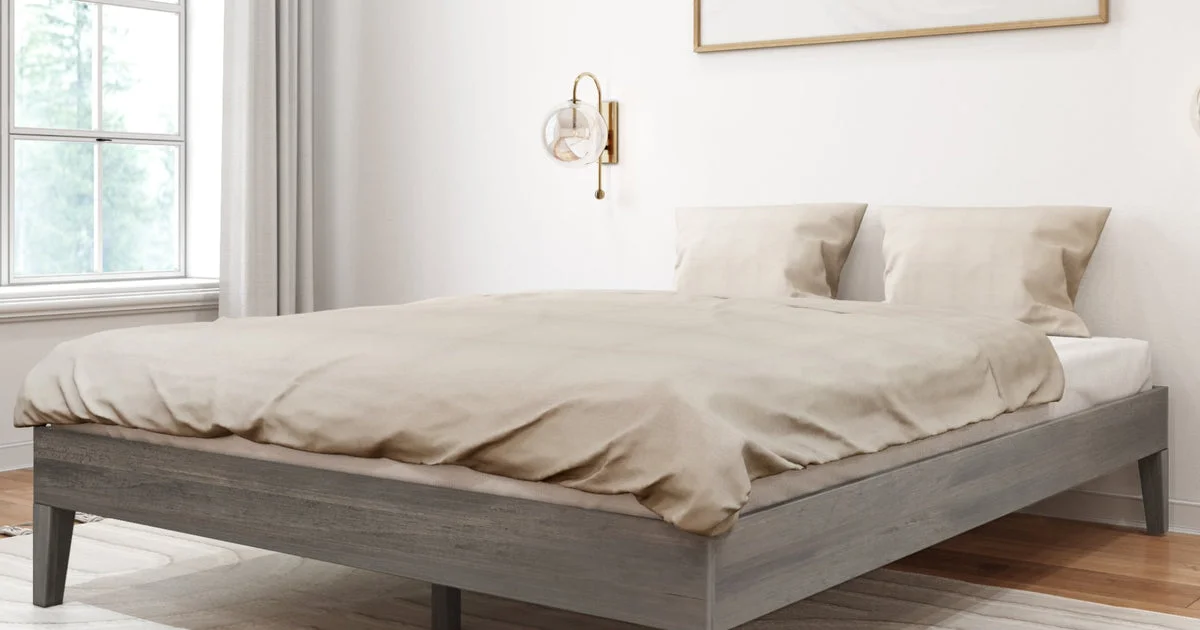
Plank+Beam will take a bed back within 30 days, but only while it is “new, unused, unassembled, and undamaged.” That sentence is the most useful thing on the whole site, because it means the room measurement has to be right before the box is opened. Choosing a solid wood bed frame for small bedrooms from this brand is therefore a measuring job first and a shopping job second.
This is an independent editorial review. Plank+Beam did not review or approve this article.
Safety scope: the bunk bed section below cites the federal bunk bed standard at 16 CFR Part 1213 and is general information. Your own bed’s assembly instructions and mattress thickness limits govern your bed, and a bunk should be assembled exactly as the manufacturer specifies. Prices quoted are what the brand listed at the time of writing and change often.
Use case 1: the small room, where a solid wood bed frame for small bedrooms has to give the floor back
In a room where the bed is most of the floor, the numbers that matter are height, footprint and what fits underneath. The Plank+Beam Twin Platform Bed measures 77.5 inches long, 41 inches wide and 14 inches high, and the brand puts roughly 11 inches from the floor to the bottom of the bedside rails with about 8 inches of clearance under the frame itself. That 8 inches is the storage number: it decides whether the flat boxes go under the bed or stay in the closet.
Two design choices help a tight room more than any finish does. The platform beds carry wooden slats and a metal support bar, so the brand states no box spring is needed, which removes several inches of height from the sleeping surface. And the basic platform models have no headboard, so the frame can sit flush against a wall without stealing length from a short room.
Before ordering anything, measure in this order:
- Wall to wall, at floor level, where the bed will actually sit.
- The swing of the bedroom door and any closet door, since a 14-inch frame plus a mattress can foul a door that opens inward.
- The height of whatever you plan to slide underneath, against the roughly 8 inches of clearance.
- The narrowest point on the route from the front door to the bedroom, because the queen ships in one box.
- The mattress you already own, measured rather than assumed.
Use case 2: the room you sleep in every night, and what a solid wood bed frame for master bedrooms adds
Moving up a size changes the engineering rather than the styling. The Queen Platform Bed measures 82.75 by 62.25 by 14 inches and is rated at 750 pounds of resting weight, against 500 pounds for the twin. The brand attributes that to wooden slats, a metal support bar and three underbed support legs, and lists it as fitting a standard 60 by 80 inch queen mattress in memory foam, spring, hybrid or latex without a box spring or a bunkie board.
A solid wood bed frame for master bedrooms is also where the material question gets real. Plank+Beam describes its wood as knot-free solid New Zealand pine, offered in Driftwood, Matte Pecan and Matte Walnut. Pine is a softwood, and a softwood frame in a room with a bedside table and a vacuum cleaner will pick up dents that a hardwood would shrug off. That is a trade the brand makes to keep a solid wood bed at this price, and it is worth going in knowing it.
The queen is also listed as GREENGUARD Gold Certified, and it is worth reading that mark for exactly what it is. UL’s GREENGUARD Gold program limits emissions of more than 360 volatile organic compounds and total chemical emissions, and requires compliance with the California Department of Public Health Standard Method. It is a chemical emissions certification about indoor air. It says nothing at all about how much weight the frame holds or how long the joints last, and no certification on this product does.

Use case 3: a solid wood bed frame for guest rooms that sits unused eleven months a year
A guest bed is bought against a different failure. Nobody is testing it nightly, so a fault surfaces the week your in-laws arrive, which is usually long after the cover has run out. Plank+Beam’s warranty is one year from the date of delivery, covering defects in materials or workmanship; it is non-transferable, does not apply to resold items, and excludes damage from misuse, accidents, modifications or commercial use.
The sensible move with a solid wood bed frame for guest rooms is therefore to assemble it the week it arrives, put a mattress on it, and sleep on it yourself for a night. That is the only way a materials defect gets found while the warranty is still young, and it costs one evening. Bear in mind that assembling it also ends the return window, since returns require an unassembled bed, so the measuring in the previous section has to be done first.
Two logistics details matter for a room that doubles as something else. The twin is listed as easy to assemble with instructions, tools and hardware included, and the queen as assemblable by one person and shipping in one box. The brand delivers anywhere in the continental United States, with free shipping on US orders over $400 by FedEx after a 2 to 5 business day processing window; returns are not accepted from Canada, Alaska or Hawaii.
Use case 4: a solid wood bed frame for heavy mattresses, and the slat spacing that decides it
This is the specification most buyers never look at, and the one that separates a frame that lasts from one that sags. On the twin, Plank+Beam lists seven slats spaced 9 inches apart with metal support bars as standard, and an upgraded deck of fourteen slats at 2.5 inches apart.
The gap is the whole story for a solid wood bed frame for heavy mattresses. A dense all-foam or latex mattress has no internal structure bridging a 9-inch gap the way an innerspring does, and many foam mattress warranties set their own maximum slat spacing. So the order of operations is to read your mattress warranty first, then pick the deck:
- Innerspring or a traditional hybrid on a twin or full: the standard seven-slat deck is the brand’s own default.
- All-foam, latex or a heavy hybrid: budget for the closer 2.5-inch deck rather than discovering the requirement later.
- Two adults plus a heavy mattress: the queen’s 750 pound resting rating and three underbed legs are the relevant numbers, not the finish.
- A mattress you are replacing soon: choose the deck for the mattress you are about to buy, not the one on the floor.
Use case 5: two children sharing one room
Plank+Beam’s Classic Twin over Twin Bunk Bed with underbed storage assembles to 81.5 by 42.5 by 65 inches, is rated at 400 pounds resting weight per sleeping surface, recommends an 8 inch mattress for best fit, and separates into two freestanding beds later.
The 8 inch recommendation is not a comfort note. The federal standard at 16 CFR Part 1213 requires the upper edge of an upper-bunk guardrail to sit “no less than 5 inches above the top surface of the mattress when a mattress of the maximum thickness specified by the bed manufacturer’s instructions is on the bed.” Fit a thicker mattress than the instructions allow and you quietly lower the effective guardrail. The same standard defines a bunk bed as one where the underside of any foundation sits over 30 inches from the floor, and applies to bunk beds manufactured in or imported into the United States on or after June 19, 2000.
Side-by-side by situation
| Your situation | The Plank+Beam pick | The number that decides it |
|---|---|---|
| Single sleeper, very small room | Twin Platform Bed, no headboard | 77.5 by 41 inches, about 8 inches of clearance |
| Two adults, main bedroom | Queen Platform Bed | 750 pound resting capacity, three underbed legs |
| Spare room used a few nights a year | Twin or full platform, assembled on arrival | One year warranty from date of delivery |
| Dense foam or latex mattress | The upgraded closer-spaced slat deck | 2.5 inch spacing instead of 9 inch |
| Two children, one room | Classic Twin over Twin bunk with storage | 400 pounds per surface, 8 inch mattress limit |
Related Articles
- Cordless Power Drill for Beginners: One Shelf, Flat-Pack, or an Old Wall
- Best Budget Office Chairs for Back Pain: What to Adjust
- Best Laser Level for Home Projects: DIY Buying Guide
Frequently Asked Questions
These come up repeatedly once the size is settled. Each answer sticks to what Plank+Beam publishes on its own product and policy pages, or to the federal standard where one applies.
Do I need a box spring with a Plank+Beam platform bed?
No. The brand states its platform beds use wooden slats and a metal support bar and do not require a box spring, and lists the queen as working with memory foam, spring, hybrid or latex mattresses without a box spring or a bunkie board. Skipping it also keeps the sleeping surface low, which is the point in a small room.
Can I return the bed after I have put it together?
No. The return window is 30 days from delivery, and the policy requires items to be new, unused, unassembled and undamaged. Pickup is arranged at no cost to you, but the refund is issued minus the shipping cost, and returns are not accepted from Canada, Alaska or Hawaii.
What does the GREENGUARD Gold mark on these beds actually cover?
Chemical emissions into indoor air. The program limits emissions of more than 360 volatile organic compounds and requires compliance with the California Department of Public Health Standard Method. It is not a strength, durability or weight rating.
How much weight will the frames hold?
Plank+Beam lists 500 pounds of resting weight for the twin platform bed, 750 pounds for the queen, and 400 pounds per sleeping surface on the twin over twin bunk. Those are the brand’s published figures and they refer to resting weight, not to impact.
Conclusion
Plank+Beam sells a low, honest platform bed in solid pine, and the decisions that matter are all made before the box is opened: the room measurement, the slat spacing your mattress needs, and the mattress thickness a bunk will allow. Get those three right and the rest of the range is mostly a question of size and finish.


2 Comments
Comments are closed.