

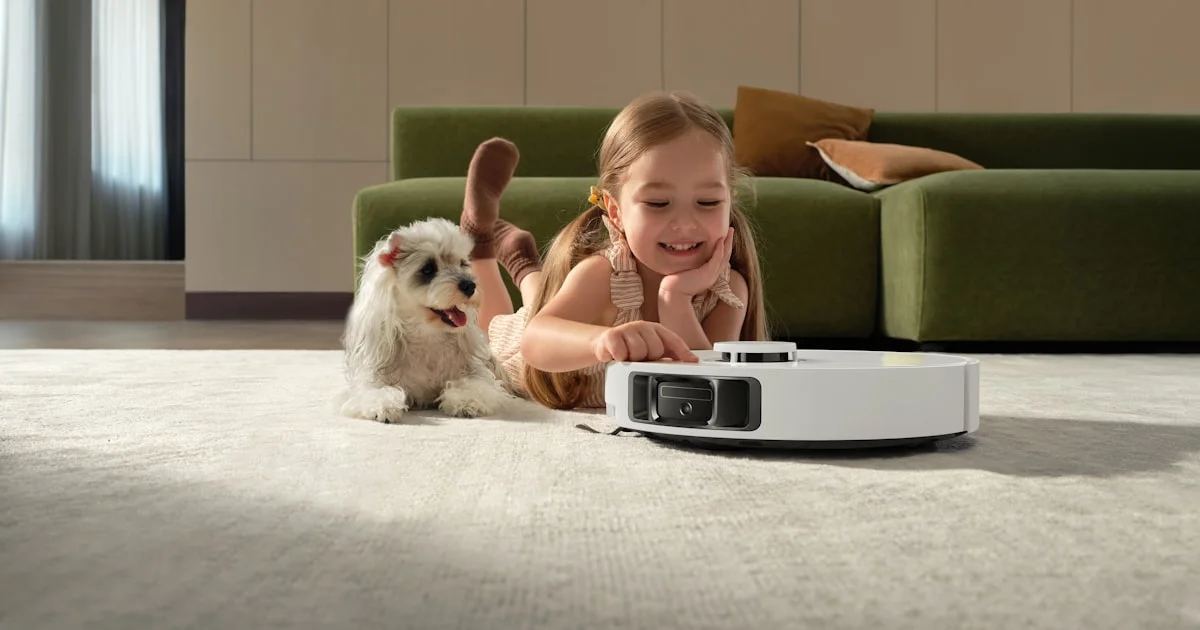
Anyone who lives with a shedding dog or cat knows the routine: you vacuum, and by the next afternoon the baseboards look untouched. A robot vacuum for pet hair is the rare gadget that fixes a daily problem by simply showing up every day. But the specs that sell these machines are not the specs that decide whether hair actually leaves your carpet.
Key Takeaways
- Brush design and carpet contact matter more than the suction number printed on the box.
- Anti-tangle brushes are now common at mid-range prices, and they save you a weekly session with scissors.
- Frequency beats power. A modest robot running daily out-cleans a strong one running twice a week.
- Self-emptying bases exist because pet homes fill a small onboard bin fast.
- Mopping and deep carpet cleaning pull the design in opposite directions, so decide which one you need most.
What Makes a Robot Vacuum for Pet Hair Different
The short answer: a good robot vacuum for pet hair is built around two things the marketing rarely leads with, which are a brush that hair cannot wrap around and a body that keeps that brush pressed into carpet. Suction helps, but it is the third factor, not the first.
Vacuum Wars, which runs standardized pickup tests, puts it plainly: pet hair pickup on carpets depends more on brush design and carpet contact than on suction alone. That is why two machines with similar pressure ratings can score very differently on the same rug. It is also why the number that dominates product listings, measured in pascals, is a poor shopping filter on its own.
Brush Design Beats the Suction Number
Hair is long, thin, and loves to spiral around a spinning bar. Older robots dealt with this by making you unwind it yourself. Newer ones use split or comb-style rollers that cut and release hair as it winds, so it travels into the bin instead of forming a rope around the axle.
The tested results show how far this has come. In Vacuum Wars testing, the Dreame L60 Ultra PE picked up 100% of flattened pet hair on carpet with 0% brush wrap, and the Dreame L60 Pro Ultra pulled 93.5% of embedded pet hair from carpet against a category average of 82%, also with no tangles. The Ecovacs T90 Pro Omni posted a perfect score on a 7-inch hair tangle test, and the Dreame L50 Ultra is rated to handle strands up to 11.8 inches with reduced tangling.
Two cautions. Those are premium machines, listed at roughly $999.99, $1,189.99, $598.99 and $799.99 at the time of writing, and street prices move constantly. And no design is immune: Vacuum Wars is blunt that brush-roll tangles are still inevitable with current technology, and recommends cleaning the brush thoroughly once a week. Anti-tangle means less maintenance, not none.
Robot Vacuum for Carpets: Where the Hair Actually Hides
Hard floors are the easy case. Hair sits on top, and almost any machine will collect it. Carpet is the real test, because shed hair works down into the pile and weaves itself around the fibers, where only physical agitation will lift it.

This is where a robot vacuum for carpets earns its price, and where hybrid designs get complicated. Vacuum Wars notes that models with built-in mopping often struggle on carpet because the brush roller has to sit higher to keep the mop pad from dragging. Machines that lift the pad well clear, or drop it off entirely before a vacuum-only run, avoid most of that penalty. If your home is mostly rugs and your pet sheds heavily, prioritize carpet contact over mopping cleverness.
The Self-Emptying Base Question
Onboard dustbins on these robots are small, often in the 250 ml to 395 ml range. A shedding pet fills that in a day or two, and a full bin means a robot that runs but collects nothing. A self-emptying dock solves it by pulling the contents into a much larger bag between runs.
The intervals are the useful part. The Dreame L50 Ultra’s 3.2 liter bag is rated at about 100 days, and Tom’s Guide reports the Eufy Omni C28 needing a bag change roughly every 75 days. In a heavy-shedding home, expect the short end of any estimate, and check replacement bag prices before committing to a platform.
What a Robot Vacuum Mopping Review Should Tell You
Almost every mid-range and premium robot now mops. Reading a robot vacuum mopping review carefully matters because mopping quality varies far more than vacuuming quality does, and the failure modes are specific rather than general.
Tom’s Guide’s testing shows the range. It praised the Dyson Spot+Scrub Ai for excellent mopping using a heated system with 140-degree Fahrenheit water, while finding that the Roborock Qrevo Curv 2 Flow left streaks on its built-in settings and that the Roborock Saros 20’s roller mop missed sticky spots. Same category, very different outcomes. If you have hard floors and a pet who knocks over a water bowl, read mop reviews closely. If you have wall-to-wall carpet, it is close to irrelevant.
Finding the Best Budget Robot Vacuum Without Regret
You do not need a four-figure machine. Chasing the best budget robot vacuum works if you accept one clear trade-off: cheaper models usually save money on navigation and obstacle recognition rather than on cleaning. The Roborock Q10 S5+ scored 96% on both carpet and pet hair pickup in Vacuum Wars testing while managing only 6 out of 24 on obstacle avoidance. It cleans well and bumps into things.
Here is a practical order of operations when shopping:
- Decide carpet or hard floor first. That single answer rules out half the market.
- Look for an anti-tangle or split main brush, described by name in the spec sheet rather than implied.
- Check the replacement bag and filter prices, not just the sticker price.
- If you leave cords, socks, or toys on the floor, pay for obstacle avoidance. If your floors stay clear, skip it.
- Confirm the robot’s height clears your lowest furniture, since that is where hair collects most.
How the Main Design Choices Compare
| Design choice | Best for | Trade-off |
|---|---|---|
| Anti-tangle split or comb brush | Long-haired pets and anyone tired of cutting hair off a roller | Usually appears on mid-range and up, rarely on entry models |
| Vacuum-only, no mop | Carpet-heavy homes wanting maximum brush contact | You still mop hard floors yourself |
| Vacuum and mop hybrid | Mixed floors and pets who make wet messes | Roller often sits higher, which can cost carpet performance |
| Self-emptying base | Heavy shedders and anyone who wants to forget the robot exists | Bigger dock footprint plus ongoing bag costs |
| Lidar navigation with obstacle avoidance | Cluttered floors, cords, and pet toys | Adds meaningfully to the price |
| Basic navigation, strong suction | Clear, open floor plans on a tight budget | More bumping, more rescue missions |
Keeping It Working After Month Three
Most disappointment with these machines is maintenance, not hardware. Check the brush weekly, rinse the filter on the schedule in the manual, wipe the drop sensors if the robot starts behaving strangely near stairs, and clear the side brush, which collects hair faster than the main roller does.
Frequency is the other half. Vacuum Wars advises that if you have multiple pets that shed a lot, running the robot daily helps keep pet hair under control. A scheduled daily run on a modest machine beats an occasional run on an expensive one.
Related Articles
- Top 5 Air Purifiers for Allergies Under 150: A Buyer’s Guide — pet dander is airborne as well as underfoot.
- Best Smart Plug for Home Automation: A Buyer’s Guide — the cheapest way to start automating a home.
- Best Smart Garage Door Opener: A Complete Buyer’s Guide — another retrofit that needs no rewiring.
Frequently Asked Questions
A few questions come up again and again from people shopping with a shedding pet at home. Here are straight answers.
Does higher suction mean better pet hair pickup?
Not by itself. Testing consistently shows that brush design and how firmly the brush meets carpet decide more of the result than the pascal rating does. Use suction as a tiebreaker between machines with similar brushes, not as your first filter.
How often should a robot vacuum run in a home with pets?
Daily, if your pet sheds heavily. Running every day keeps hair from working deep into carpet fibers, which is the situation that defeats any vacuum. Scheduling it while you are out is the whole point of owning one.
Will it get hair out of a thick rug?
Partly. Tested pickup of embedded hair ranges from about 82% to 100% depending on the model. That is excellent upkeep between deep cleans, but not a replacement for an occasional pass with an upright vacuum.
Do I need one with a mop?
Only if you have hard floors and a mess problem. On carpet-heavy homes a mop adds cost and can compromise brush height. Buy the mop for spills and paw prints, not because the listing offers it.
The Bottom Line
Buy for the brush, the carpet contact, and the ability to run every single day. Those three things separate the machines that quietly solve your hair problem from the ones that sit on a charging dock while you get the broom out anyway.


2 Comments
Comments are closed.