

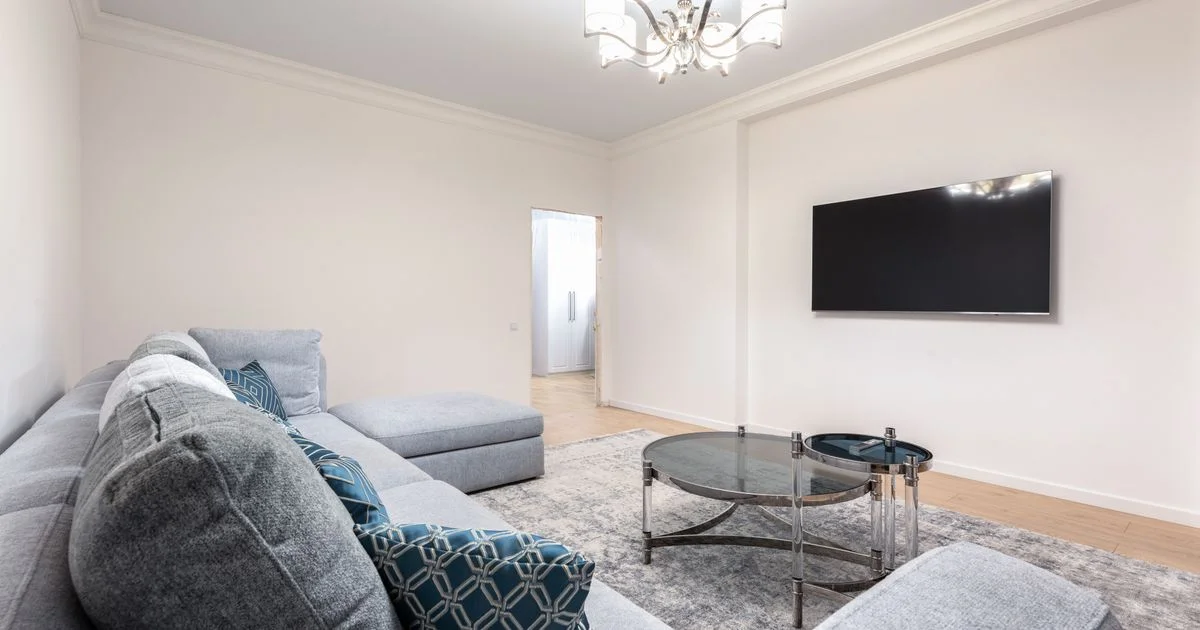
Three of the four questions people ask about a new television are settled by a tape measure rather than by a spec sheet. Choosing a smart TV for movie nights starts with the distance from the sofa to the wall, the width of the cabinet it has to stand on, and the ports on the back that decide what can be plugged into it. The panel argument comes last, and in an ordinary room it changes less than the furniture does.
Use case 1: sizing a smart TV for movie nights from the seat you already sit in
The number in the listing is a diagonal. That is not marketing shorthand, it is a federal requirement: under the Federal Trade Commission rule at 16 CFR 410.1, any size figure used to describe a television picture must be “the actual size of the viewable picture area” and must be measured “on a single plane basis”. Where the figure is not the horizontal dimension, the rule says the manner of measurement has to appear “clearly and conspicuously” next to it, and it states plainly that a footnote or an asterisk reference does not satisfy that requirement. The example the rule itself gives of an acceptable claim is a picture size “measured diagonally”.
So a 65-inch set is 65 inches corner to corner. On a standard 16:9 screen the width works out at roughly 87 percent of the diagonal, which puts that same set at about 57 inches across before you add the bezel. Rooms are measured in width, not in diagonals, and the gap between those two numbers is where delivery day goes wrong.
Before any model enters the conversation, do this with a tape measure and a pencil:
- Sit where you actually watch from and measure to the wall or cabinet the screen will occupy.
- Measure the usable width of that wall, stopping at the window frame, the radiator or the door swing rather than at the corner.
- Measure the cabinet: its width, its depth, and how far in from each end the top surface is actually flat.
- Write the three numbers down and carry them into every listing you open.
Light is the fourth measurement and the only one you cannot change after delivery, short of hanging a heavier curtain. Sit in the seat at the hour you usually watch and look at the wall. A window directly opposite the screen puts its reflection in the middle of the picture every evening the sun is out, and no setting in the menu moves the window.
You can check current options here:
Check on Amazon See on Walmart
Use case 2: what a smart TV for gaming needs from the ports, not the panel
If a console is going to live under the screen, the deciding spec is printed on the back panel rather than on the front of the box. A smart TV for gaming is sold on a version number, and the body that licenses that number has said in public what it does and does not promise.
The HDMI Licensing Administrator’s own explanation of HDMI 2.1 marketing is unusually direct. A product advertised as HDMI 2.1 “is compliant with the HDMI 2.1 Specification and supports one or more HDMI 2.1 features”. One or more, not all of them, because “Support for each HDMI 2.1 feature is optional”. The same page says “the manufacturer is required to list the HDMI 2.1 features supported by the product next to that messaging”, that “Products can no longer be certified for HDMI 2.0” because “The HDMI 2.1 Specification replaces the HDMI 2.0 Specification”, and that “it is up to consumers to check that a product supports the features they want.”
That turns a shopping question into a reading question, and the document you need is free and published before you buy. Open the manual or the support page for the exact model number and look for:
- Which named features the maker lists beside its HDMI claim, rather than the version number on its own.
- Whether every port on the set carries the same capability, or only some of them do.
- Which single port is the one a soundbar is meant to use, since that is usually not a free choice.
- How many ports are left once a console, a streaming box and a soundbar have each taken one.
Port counting is the unglamorous part of this and the part that gets regretted. A set with three inputs and a soundbar already attached has two left, and a household with a console, an older games machine in the cupboard and a visiting laptop has already run out.

Use case 3: fitting a smart TV for small living rooms around furniture you already own
A smart TV for small living rooms is a furniture problem wearing an electronics label. The diagonal from the listing tells you almost nothing about whether the thing will stand on your sideboard, because two sets with the same diagonal can need completely different surfaces.
The figure that matters is in the dimension table, and makers publish it in two forms: the size of the set on its own, and the size of the set with its stand attached. The second number is the one your cabinet has to beat. Feet set near the outer corners need a surface almost as wide as the screen itself; a central pedestal needs far less width but more depth and a cabinet that can take the load in the middle rather than at the ends.
Depth catches people out in the other direction. A shallow sideboard against a wall in a narrow room can hold the screen comfortably and still leave the stand overhanging at the front, which is both unstable and the first thing a passing elbow finds. Measure the flat area, not the outer edge, because a lot of cabinets have a lip or a raised rim that the stand cannot sit on.
If the set is going on the wall instead, that is a wall question rather than a television question, and it is worth settling before you choose a size. A panel on a wall needs the fixing to land in something solid, and the answer is different in a rented flat than in a house you own.
Use case 4: a smart TV for bedrooms, and the channels a second set can still pick up
A smart TV for bedrooms is usually the second set in the house, and second sets rarely get their own subscription. That makes the question of what arrives free more useful here than anywhere else in the home, and the Federal Communications Commission publishes the tool that answers it for your address rather than for your region.
The FCC’s DTV Reception Maps show which digital signals are available at your location, and its consumer guidance is blunt about what changes the answer. “Generally, an outdoor antenna will get better reception than an indoor antenna,” it says, while indoor reception can be affected by “nearby buildings, trees, terrain or home construction”. It also points out that being very close to a tower is its own problem, where a strong signal can overload the tuner.
Two practical notes follow from the same guidance, and both are free. “You need to rescan for available signals if you are missing channels,” and a scan is worth repeating now and then because, as the FCC puts it, “You should perform a channel scan periodically to check whether additional digital channels have become available.” A set that found eleven channels on the day it was unboxed is not a set that still only receives eleven.
One more bedroom detail has nothing to do with the picture. A screen placed on a dresser or a chest of drawers sits above the height where a small child can reach the drawer fronts and climb, so a set on furniture should be secured to the furniture or to the wall rather than left standing free.
Side-by-side by situation
| Your situation | What that situation actually needs |
|---|---|
| Long sofa, one wall, evening viewing | The seated distance and the usable wall width, measured first; curtains for the window opposite |
| A console lives under the screen | The maker’s list of named HDMI features, and a count of how many ports are left after the soundbar |
| Narrow room, existing sideboard | The with-stand width and the stand type, checked against the flat area of the cabinet |
| Second set in a bedroom, no subscription | A reception check for your own address, a rescan after setup, and the set secured to the furniture |
| Rented home, no drilling allowed | A stand-based set sized to the furniture rather than a wall mount |
Related Articles
- Sports Streaming Service for Cord Cutters: Where DAZN Fits
- Smart Board for the Home Office: The Wall, the Call, and Year Four
- Portable Monitor for Laptop: Hotel Desk, Kitchen Table, or Cafe
Frequently Asked Questions
These come up every time somebody measures a wall and then opens a listing. The answers are all in documents that are free to read before anybody spends anything.
Is the advertised screen size the width of the television?
No. The FTC rule requires the figure to be the actual viewable picture area, and the acceptable example it gives is a size measured diagonally. On a 16:9 screen the width is roughly 87 percent of that diagonal, and the outer frame of the set adds a little more on top.
Does HDMI 2.1 on the box mean the set supports every HDMI 2.1 feature?
No. The HDMI Licensing Administrator states that support for each feature is optional and that makers must list the supported features beside the claim. Read that list rather than the version number.
Can a second set still get free local channels without a subscription?
Often, yes, and the FCC’s reception maps will tell you what reaches your own address. Reception depends on the antenna and on what sits between you and the tower, and you need to rescan to pick up channels that were added after the set was first tuned.
How far from the screen should the sofa be?
Measure what you have before you look for a rule. The distance from your actual seat to the actual wall, the usable width of that wall and the flat area on the cabinet decide the size far more reliably than any formula applied to a room you have not measured.
Conclusion
A television is one of the few purchases where the room has already made most of the decision and the buyer finds out afterwards. The seated distance and the wall width set the size, the dimension table says whether the stand fits the furniture, the maker’s own feature list says what the ports will do for a console, and a reception check says what the set in the spare room can pull in for nothing. Take the three measurements first, read the two documents second, and the shortlist writes itself.


