

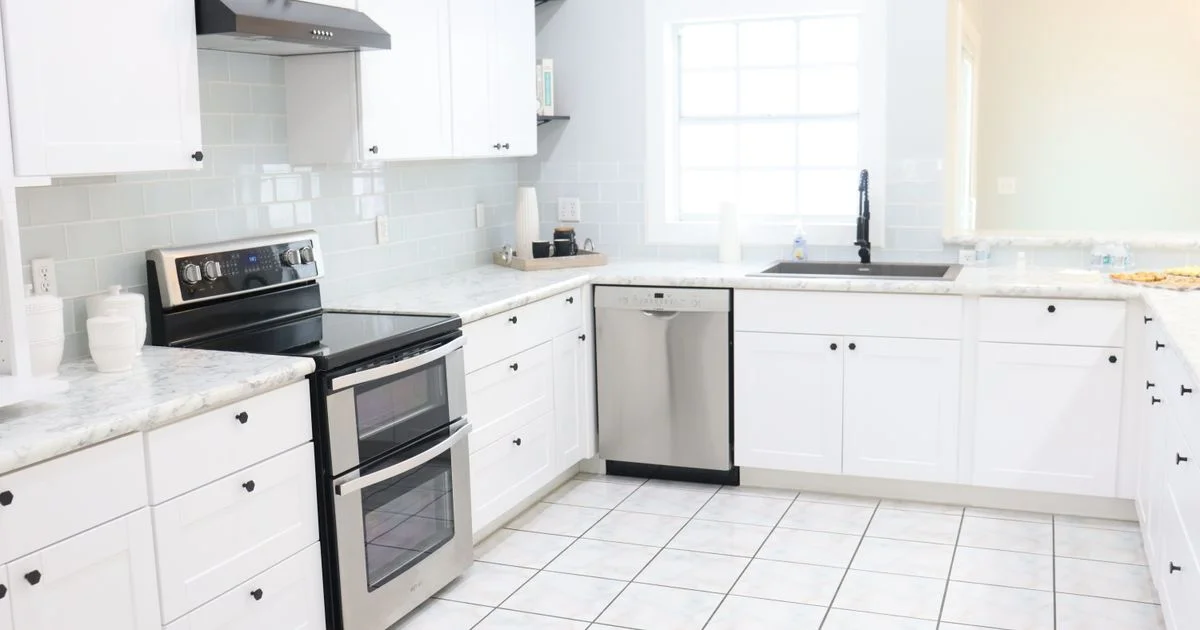
Half of every year’s home fires start at the stove, and the alarm that is supposed to notice is the same one you have been swatting with a dish towel since March. Fitting a smart smoke detector for the kitchen is mostly a geometry problem with a hearing problem behind it, and the phone notification everyone shops for is the third-most useful thing it does.
This article is general information about fire safety, not a substitute for your alarm’s own instructions or your local fire code. Hardwired alarms and branch-circuit work belong to a licensed electrician, and the manufacturer’s manual governs your specific unit.
Use case 1: siting a smart smoke detector for the kitchen so it stops crying wolf
The number that decides this is ten feet. NFPA 72, the National Fire Alarm and Signaling Code, states that smoke alarms should sit at least ten feet from cooking appliances to keep nuisance alarms down, and the same figure is built into how alarms are now tested.
UL Standards & Engagement describes the cooking nuisance smoke test added in the eighth edition of UL 217, the safety standard for smoke alarms. During the test, “smoke alarms are mounted 10 feet away from an electric range, which is turned to full power with frozen hamburger patties cooking inside on a broiler tray underneath electric broiler coils.” To pass, “the alarms must not go off while the patties are cooking prior to the smoke reaching a certain obscuration (OBS) level and/or measuring ionization chamber (MIC) value.”
Read that as a promise with a distance attached. An alarm certified against that test was proven to ignore a broiling burger from ten feet. Hang it six feet from the range and you are outside the conditions it was proven under, whatever the box says.
The reason this matters more than it sounds is what the U.S. Fire Administration finds in the fire data. Across 2017 to 2019, cooking “was, by far, the leading cause of all residential building fires and accounted for 51% of all residential building fires.” Ninety-three percent of those were confined fires, meaning the fire stayed inside the pan. And in the ones that did spread, “the leading specific factor contributing to ignition in nonconfined cooking fires in residential buildings was unattended equipment (37%).”
That is the whole argument for a smart alarm in one line. The fires that hurt people are the ones nobody was standing over, and a notification on a phone is the only part of a smoke alarm that reaches a room you are not in.
Before you buy anything, walk the kitchen:
- Measure from the edge of the range or cooktop to the nearest existing alarm. If it is under ten feet, you have found the reason for the false alarms.
- Find the spot ten feet out that still has a clear line to the hallway and the bedrooms.
- Check whether that spot has a ceiling box already. If it does not, the unit you want is a battery or sealed-cell alarm, not a hardwired one.
- Note what you cook. A household that broils and sears has a different tolerance than one that boils and steams.
Use case 2: a smart smoke detector for apartments, where you own none of the wiring
Renters hit a wall immediately. A smart smoke detector for apartments usually cannot replace the landlord’s hardwired, interconnected unit, and in a galley kitchen there may be no point on the ceiling that is ten feet from the range at all.
What is actually available to a tenant is narrower and worth naming honestly:
- A listed, self-contained alarm added alongside the existing one, placed where the geometry works rather than where the wiring already is.
- A sealed ten-year cell, so there is no annual battery negotiation and no temptation to pull one out during dinner.
- A unit whose silencing function is reachable from the floor, because an alarm you can only quiet with a broom handle is an alarm that gets disabled.
Apartments have also been moving in the tenant’s favor on the audible side. The 2021 International Building Code extended the low-frequency signal requirement described below to sleeping rooms in Group R-1 and R-2 occupancies, which covers hotels, motels, apartments and condominiums served by a fire alarm system. That is a code change, not a product feature, and it applies to new construction rather than the building you already live in. It is still worth knowing what it is when you read a listing.
Use case 3: a smart smoke detector for large homes, and the closed bedroom door
A smart smoke detector for large homes is not primarily about square footage. It is about doors.
The CPSC measured this directly in three homes between 1,120 and 3,371 square feet, built between 1960 and 1989. At the alarm itself the readings were loud: 104 dBA in one hallway, 102 in another, 96 in a family room. With bedroom doors closed, the same alarms arrived in the master bedroom at 77 dBA in the first house, 55 in the second and 61 to 67 in the third. An alarm in the basement reached the master bedroom at 45 dBA in one home and 34 dBA in another.
The study’s general finding is the one to carry around: “Closing a lightweight door attenuates a smoke alarm signal traveling from one room to another room between 10 to 20 dBA.” Against that, it puts the level needed to wake a sleeping adult at a minimum of 70 dBA, noting that levels as low as 55 to 60 dBA can wake some adults when the room is quiet.
Line those numbers up and a 34 dBA reading is not a quiet alarm. It is an alarm that is not going to wake anybody. The report concludes that interconnected alarms improve audibility compared with single-station units, which is the same conclusion the arithmetic forces.

For a big house the practical reading is that the kitchen alarm’s job is not to be heard in the far bedroom. Its job is to tell the other alarms, and to tell your phone. If you are drilling into a ceiling to add one, our notes on what an old wall or ceiling does to an anchor will save you a second trip.
Use case 4: a smart smoke detector for elderly parents, where the pitch is the point
The case for a smart smoke detector for elderly parents is usually made as remote monitoring: you get an alert on your phone from three states away. That is real, and it is the smaller half.
The larger half is the sound. The 2010 edition of NFPA 72 introduced a low-frequency public-mode audible alarm signal for sleeping areas, with a fundamental frequency of 520 Hz plus or minus 10 percent. It was written for dwelling units designed for people with mild to severe hearing loss, and the reason is that the standard high-pitched alarm tone sits exactly in the range that age-related hearing loss takes away first. Fire protection engineers who work with the requirement report that the low-frequency signal is substantially better at waking older adults and people who are hard of hearing than a conventional alarm.
Combine that with the door arithmetic in use case 3 and the shopping list for a parent’s house changes shape. What matters, in order:
- An alarm signal your parent can actually hear through a closed bedroom door, which may mean a low-frequency unit or an add-on bed shaker rather than a smarter app.
- Alarms that trigger each other, so the kitchen at 2 a.m. reaches the bedroom.
- Remote notification, so somebody who is not in the building knows too.
- A ten-year sealed cell, so nobody is on a step stool with a nine-volt battery.
One honest limitation is worth saying out loud: a notification on your phone is not a response. It tells you to call somebody who is closer.
Side-by-side by situation
| Your situation | What it needs | The trap |
|---|---|---|
| Small kitchen, constant false alarms | Ten feet from the range, UL 217 cooking nuisance testing | Moving the alarm closer to the hallway instead of farther from the stove |
| Rented apartment, hardwired unit you cannot touch | A listed self-contained alarm placed by geometry, sealed cell | Disabling the landlord’s alarm to stop the noise |
| Large or multi-level house | Alarms that trigger each other, plus phone notification | Assuming a loud alarm downstairs is audible upstairs |
| Older parent living alone | A 520 Hz low-frequency signal, interconnection, remote alerts | Buying the app and ignoring the pitch |
| You cook hot and fast | A silencing function you can reach from the floor | Removing the battery during dinner and forgetting |
| Basement laundry or utility room | Its own alarm, tied to the rest | Relying on a basement alarm to be heard on the top floor |
Related Articles
- Walmart Air Fryer for Small Kitchens: One Outlet, a Crowd, or a Dorm
- Top 5 Air Purifiers for Allergies Under 150: A Buyer’s Guide
- Humidifier for Bedrooms: Dry Heat, a Nursery, or an Old House
Frequently Asked Questions
These come up once the tape measure is out and the ceiling turns out to be the wrong shape.
My kitchen is too small for ten feet. What then?
Take the greatest distance the room allows, choose a unit tested against the UL 217 cooking nuisance test, and make sure the silencing function is reachable without a chair. The distance is guidance against nuisance alarms, not a license to leave the kitchen uncovered.
Does a smart alarm replace a regular one?
Only if it is a listed smoke alarm in its own right. A sensor that sends a phone alert but is not a listed alarm is an accessory, and it does not satisfy anything.
Is the phone notification worth paying for?
It is worth exactly what being away from the house is worth to you. With unattended equipment behind 37 percent of the cooking fires that spread, an alert that travels beyond the building is the feature doing work the siren cannot.
Why is my alarm loud in the hall and inaudible in the bedroom?
Because the door is doing its job. The CPSC measured 10 to 20 dBA of loss from a single lightweight door, which is enough to drop a 96 dBA alarm below the level that reliably wakes a sleeping adult.
Conclusion
Get the distance right first, because an alarm that is quiet because it was disabled protects nobody. Then work outward from the kitchen to the bedrooms and ask whether the signal will actually arrive through a closed door, at a pitch the person sleeping behind it can still hear.


