

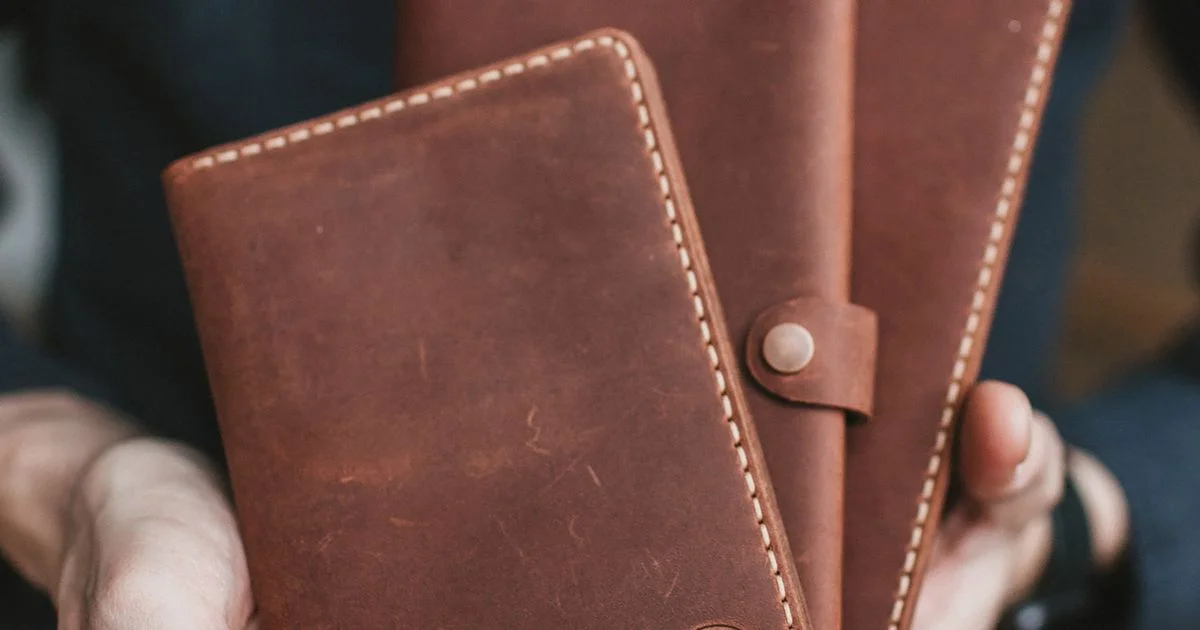
The useful question about a wallet is not how thin it gets. It is what happens in the twenty minutes after you notice it is gone. A smart wallet for men answers part of that question with a Bluetooth chirp, and leaves the rest to a phone number that is already printed on paperwork you own. Which version suits you depends entirely on the day you are having.
Use case 1: what a smart wallet for men has to carry on an ordinary day
Count the cards you used in the last month, not the ones you own. For a commute, a coffee, a grocery run and an office door, the honest total is usually four items: one payment card, a driver’s license, a transit or building card, and a little cash. Everything beyond that is being carried in case of an event that has not happened.
Two items belong nowhere near a daily carry. The FTC’s guidance on lost and stolen cards is blunt about the first: “Carry only the cards you’ll need. Don’t carry the PIN for your ATM or debit card in your wallet, purse, or pocket,” and it adds, “Never write your PIN on the card itself, or on any piece of paper that you could lose or someone could see.”
The second is the Social Security card. The Social Security Administration states that “Your Social Security card is not an identification document and, in many situations, you only need to know your Social Security number (you do not need to show the physical card).” It notes that for filing taxes, “You do not need your Social Security card, you only need to know your Social Security number,” and that driver’s licensing is the narrow exception, where it names Pennsylvania as the only state requiring the physical card.
Use case 2: a smart wallet for travel and the cards you should leave home
Travel is where capacity and loss risk pull in opposite directions. A smart wallet for travel has to survive being taken out and put back perhaps thirty times in a day, which is why a snap or an elastic band matters more than the card count. A wallet that opens in a security tray is a wallet that empties itself.
Split the contents before you leave. One card and the license travel in the wallet; a backup card and any loyalty cards travel in the bag, in a different pocket from the wallet. That single habit turns a lost wallet on day one from a ruined trip into an irritating afternoon.
There is also a document you already own and probably have not read. Federal rules require your card issuer to have “provided adequate notice of the cardholder’s maximum potential liability and of means by which the card issuer may be notified of loss or theft of the card,” at 12 CFR 1026.12(b)(2)(ii). That notice lives in your cardholder agreement, and it carries the number you will want at an airport. Save it to your phone before you fly.

Use case 3: a smart wallet for minimalists and the two-card problem
A smart wallet for minimalists usually means a metal or single-layer card holder, and the trade it makes is real. Cash becomes awkward, receipts have nowhere to go, and the card you use least ends up on a shelf at home. For a lot of people that is exactly right, and for anyone who still needs a parking stub or a folded bill it is a daily annoyance.
Run a two-week trial before committing. Move to your intended minimum card count in the wallet you already own, and note every time the missing item costs you something. If the count is zero after two weeks, the slim wallet will work. If you had to go back to the car twice, it will not.
Habits that make the small format survivable:
- Put the one card you tap in the outermost slot, so nothing else comes out with it.
- Photograph the front of your insurance and membership cards and leave the plastic at home.
- Keep a single folded bill behind the card stack rather than loose.
- Give parking and transit a phone app where the city offers one.
Use case 4: a smart wallet for tracking lost items, and the clock that starts first
The tracker is the headline feature, and it is worth being precise about what it does. A smart wallet for tracking lost items tells you where the wallet last was, which solves the sofa, the car seat and the coat pocket. It does not solve a wallet that left in someone else’s hand, and it is not the thing that limits what a stolen card can cost you.
That limit comes from the rules governing the card itself. For a credit card, 12 CFR 1026.12(b)(1)(ii) provides that “The liability of a cardholder for unauthorized use of a credit card shall not exceed the lesser of $50 or the amount of money, property, labor, or services obtained by the unauthorized use.” The same section defines unauthorized use as “the use of a credit card by a person, other than the cardholder, who does not have actual, implied, or apparent authority for such use, and from which the cardholder receives no benefit.” Debit cards sit under a different rule with a different and less forgiving timetable, which is a reason to keep the debit card at home on a day out.
The FTC’s sequence is the one worth memorizing:
- Report the loss to the issuer first. The FTC says to “report the loss or theft to the bank or credit union that issued the card as soon as possible.”
- Follow up in writing with “your account number, the date and time when you noticed your card was missing, and when you first reported the loss.”
- “Keep a copy of your letter and your notes from calls with the bank or credit union.”
- “Keep checking your account statements and call to report fraudulent charges ASAP.”
Read in that order, the tracker is a convenience feature and the phone call is the protection. A wallet that does both is fine. A wallet sold as if the chirp were the safeguard is selling the smaller half.
Side-by-side by situation
| Your situation | What that situation actually needs | The feature that earns its place |
|---|---|---|
| Same commute, same four cards | Fast access and a fixed card order | A slim bifold; a tracker is optional |
| Frequent flyer, wallet out constantly | A closure that holds and a split backup | A snap or strap, plus the issuer’s number saved |
| Cutting down to the minimum | Proof the minimum works in real weeks | A card holder, after a two-week trial |
| Loses things around the house | Last-known-location, not security | A Bluetooth tracker with a loud ringer |
| Carries cash and receipts daily | A bill compartment you will actually use | A traditional bifold, tracker pocket optional |
Related Articles
- Smart Backpack for Travel: Airport Days, Campus, or Commute
- Cheapest Smart Luggage for International Travel
- Top 7 Desk Accessories for Productivity Worth Buying
Frequently Asked Questions
These come up once the shortlist is down to two or three wallets. The answers stick to published federal rules and to what the products can honestly do.
Does a tracker stop someone using my cards?
No. It reports a location and makes a noise. What limits your exposure on a credit card is federal law and a prompt phone call to the issuer, not the wallet.
How much can an unauthorized credit card charge cost me?
Federal rules cap cardholder liability for unauthorized credit card use at the lesser of $50 or the value obtained, provided the issuer met its own notice and identification conditions. Debit cards follow a separate rule, so check your own agreement.
Is a metal card holder worth it?
It is, if your real card count is three or four and you rarely handle cash. Run the two-week trial described above before you buy, because the switch is easy to regret and hard to reverse.
Should I carry my Social Security card?
The SSA says the card is not an identification document and that in many situations you only need to know the number. Keep the card somewhere secure at home.
Conclusion
Buy for the day you actually have. A commuter with four cards, a traveler who takes the wallet out thirty times, a minimalist mid-experiment and someone who mislays things at home all want different objects, and only one of them needs a tracker. Whichever you pick, save your card issuer’s loss line to your phone tonight.


