

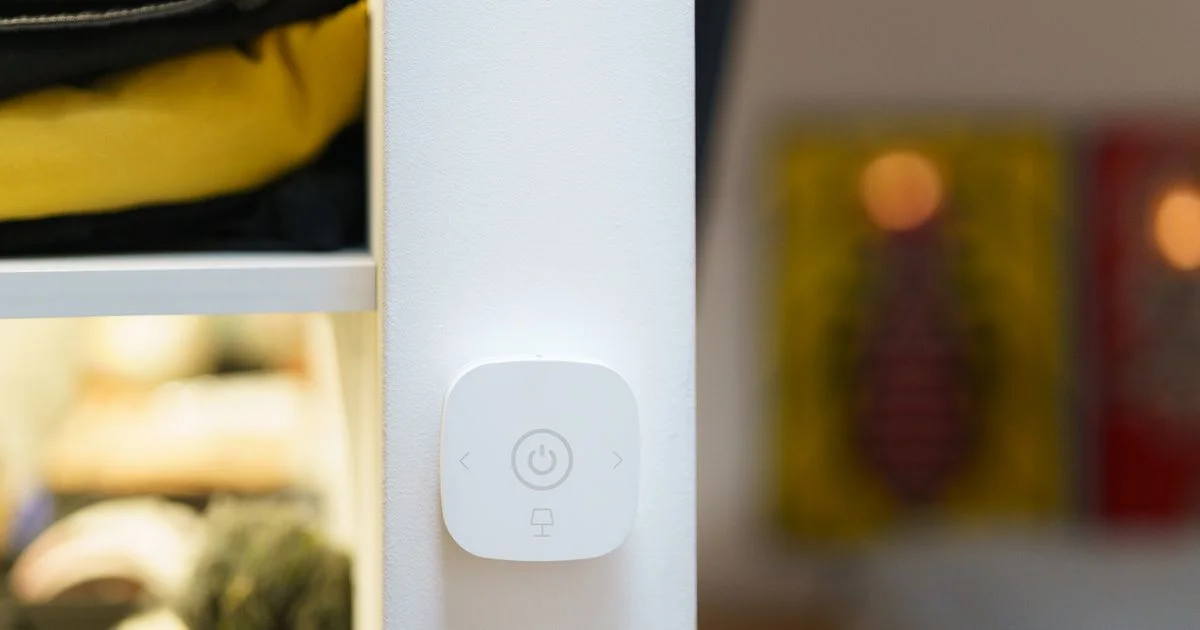
The lamp is by the couch, the switch is by the door, and at 11 p.m. somebody has to get up. That is the everyday annoyance a smart light switch for the living room is bought to end — and unlike a bulb or a plug, it replaces a piece of your home’s wiring, which is why the right answer depends far more on the room and the building than on the product.
Working inside a switch box means working on household mains wiring. Turn the breaker off and test that the circuit is dead before touching anything, and hire a licensed electrician if you are unsure or if your area requires a permit. Code references here are to the National Electrical Code and are general information, not a substitute for local rules.
Use case 1: one room, two doorways
Living rooms are the hardest room in the house for this, because they are usually the room with two entrances. A light controlled from two places runs on what electricians call a three-way circuit: two single-pole, double-throw switches, joined by a pair of wires called travelers, with the power feeding the common terminal of one switch and the light connected to the common terminal of the other. Flipping either one changes the state of the light.
That arrangement is what makes the upgrade awkward. Most smart switches expect to be the brain of the circuit, so a two-location room needs either a matched pair sold together or a main switch plus a companion device that reports back to it rather than switching the load itself. Buying one smart switch and leaving a conventional one at the other door usually produces a room where the automation works only when somebody remembers which doorway to use.
Before you buy anything, stand in the room and count the switch plates that control the same light. That number, not the brand, is the specification you are shopping against.
Use case 2: a house wired before 2011, and what that means for a smart light switch for the living room
The age of the building decides more here than anything on the packaging. Electronic switches need a small amount of standing power to keep their radios and sensors alive, and that power has to come from somewhere.
The 2011 edition of the National Electrical Code added Section 404.2(C), which requires a grounded conductor — the neutral — at switch locations controlling lighting loads on grounded general-purpose branch circuits. It was written specifically because the new generation of electronic controls needed standby current, and installers had been taking it from the equipment grounding conductor instead, which put unwanted current on the grounding system. The 2017 edition tightened the wording so that the conductor must be connected rather than merely present, and added Section 404.22, effective January 1, 2020, requiring that listed electronic switches “shall not introduce current on the equipment grounding conductor during normal operation.”
Two practical consequences follow. First, a home wired to the 2011 code or later is far more likely to have what a smart switch wants, and an older one may not. Second — and this one catches people in exactly the room we are talking about — the code’s own exceptions state that where a light is switched from more than one location, the neutral is only required at one of them. A newer house can therefore have a neutral at one living-room doorway and nothing at the other.
Use case 3: renting, where the wiring is not yours
Shopping for a smart light switch for renters runs into a wall that has nothing to do with electricity: the wiring belongs to the landlord, most leases treat altering it as a no, and a switch left behind at move-out is a switch you paid for and gave away.
The reversible options, in the order most renters should consider them:
- Smart bulbs in the lamps you actually use. Nothing is altered, they come with you, and they are the only option that also gives color and brightness control.
- A smart plug between a floor lamp and the outlet. Cheap, invisible, and it turns a dumb lamp into a scheduled one.
- A battery-powered wireless remote or wall button stuck beside the existing switch. It talks to the bulbs rather than the wiring, and it removes with adhesive.
- Asking, in writing, before doing anything permanent. Some landlords say yes; the ones who say no would rather be asked than discover it.
The compromise worth naming: a bulb-based setup leaves the wall switch as a trap. Anyone who flips it kills power to the bulbs, and the app can no longer reach them.

Use case 4: voice control, and the evening the internet drops
A smart light switch for voice control is the version of this product the advertising leads with, and it is also where the failure modes live. The chain is longer than it looks: your voice reaches a speaker, the speaker reaches a service, the service reaches the manufacturer, and the manufacturer reaches the switch. Any broken link in that chain and the room stays dark until somebody walks to the wall.
Two things separate a setup that survives a bad evening from one that does not:
- Local control. A switch that can be commanded on the home network, without a round trip to the internet, keeps working when the connection does not.
- A working manual paddle. A smart switch should still be a switch. If the physical control depends on the electronics being awake, a firmware problem becomes a room you cannot light.
There is a quieter benefit to the switch approach over bulbs here. Because the switch controls the circuit, guests, babysitters and visiting relatives can operate the light without an app, an account or an explanation.
Use case 5: the energy question, answered honestly
A smart light switch for energy saving is the claim that needs the most scrutiny, because the arithmetic is publicly available and it is modest. The Department of Energy’s Energy Saver guidance states that “lighting accounts for around 15% of an average home’s electricity use,” and that LEDs “use up to 90% less energy and last up to 25 times longer than traditional incandescent bulbs.”
Put those together. If your living room is already on LEDs, you are automating a slice of a category that is itself about a sixth of the bill, and the lights in question draw a few watts each. Scheduling and motion control genuinely cut waste — the Department of Energy lists timers and dimmers among the controls that reduce lighting energy — but they cut waste from a number that is already small. The switch itself also draws a little standby power continuously to stay reachable, which offsets part of the gain.
The honest framing is that these are convenience devices with a modest efficiency side effect. If the goal is a lower bill, heating, cooling and hot water are where the money is, and a smart thermostat is the device in this category with real savings behind it.
Side-by-side by situation
| Your situation | What that situation needs | What to avoid |
|---|---|---|
| One doorway, house wired after 2011 | A standard single-pole smart switch | Assuming the neutral is there without looking |
| Two doorways | A matched pair, or a main switch plus companion | One smart switch and one ordinary one |
| Older home, no neutral at the box | Bulbs or plugs, or an electrician’s opinion first | Improvising a neutral from the ground wire |
| Renting | Smart bulbs, a smart plug, a stick-on remote | Anything that alters the landlord’s wiring |
| Guests and family use the room | Switch control, so the wall still works for everyone | A bulb-only setup with a switch people can kill |
| Chasing a lower electricity bill | Heating and cooling, not lighting | Expecting a meaningful return from lights alone |
Related Articles
- Best Smart Plug for Home Automation: A Buyer’s Guide
- Best Smart Camera for Google Home for the Front Door, Nursery, or Pets
- Best Smart Doorbell Camera Buying Guide for 2026
Frequently Asked Questions
The questions below are the ones that decide whether this is a half-hour project or one you should not start at all.
How do I know whether my switch box has a neutral?
The reliable answer is to have an electrician look, and in many places the work requires one anyway. As a rough guide, homes wired to the 2011 National Electrical Code or later are likely to have one at switch locations controlling lighting, while older wiring often does not — and even in a newer home, a light switched from two doorways may only have a neutral at one of them.
Should I get smart bulbs or a smart switch?
Choose bulbs when you rent, when you want color and dimming from the bulb itself, or when the fixture is a lamp you plug in. Choose the switch when the light is hardwired, when other people use the room, or when you want the wall control to keep working for everybody.
What happens to my smart bulbs if someone flips the wall switch?
They lose power entirely and drop off the network until the switch is flipped back. This is the single most common frustration with a bulb-based setup, and it is why some households tape the switch or fit a blanking cover over it.
Do these work if the internet goes out?
It depends on the system. Setups that keep control on your local network continue to respond to a hub or an app on the same network, while cloud-dependent ones stop taking commands until the connection returns. In every case the physical paddle should still control the light, which is worth confirming before you commit to a product.
Conclusion
This is one of the few smart home purchases where the building has a bigger vote than you do: the number of doorways, the age of the wiring, and whether your name is on the deed will each rule options in or out before a product is chosen. Work through those three questions first, treat the energy-saving claims as a small bonus rather than the reason, and get a licensed electrician involved the moment the answer stops being obvious.


2 Comments
Comments are closed.