

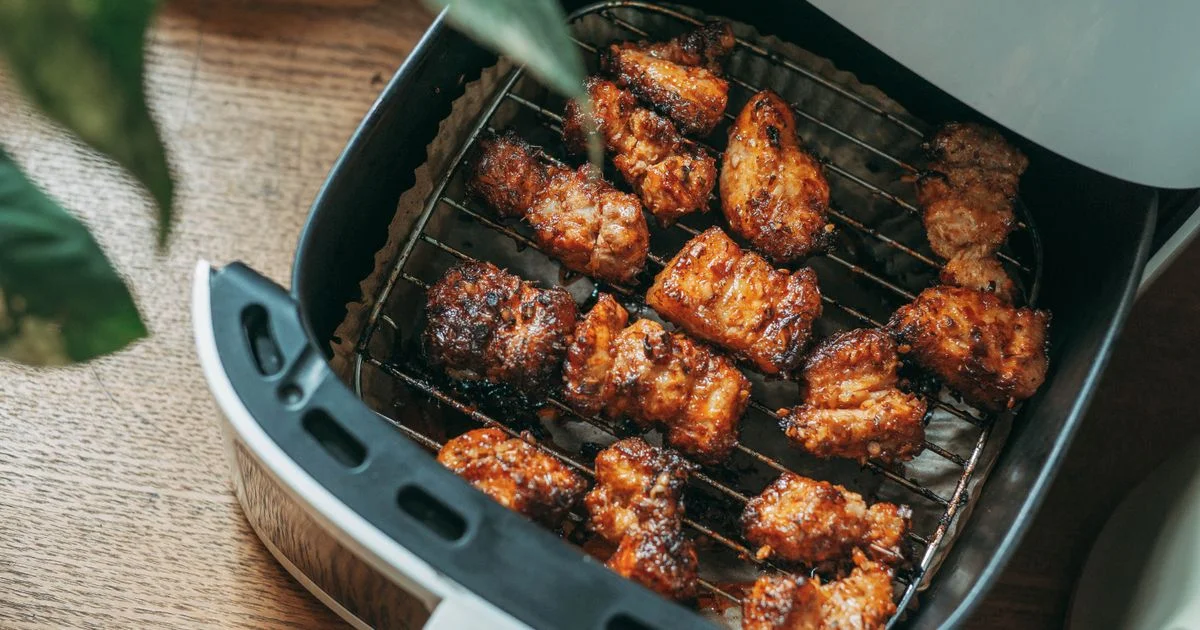
An air fryer is sold by how much food it holds and bought by how much counter it covers. Those two numbers appear in different places on the listing, and only one of them is in the headline. Anyone shopping for a Walmart air fryer for small kitchens is really solving a space-and-power problem with a cooking appliance attached, which is why capacity comparisons are the least useful part of the aisle.
We are not affiliated with any brand mentioned, and no brand reviewed or approved this article.
Safety and scope: an air fryer runs at oven temperatures on a countertop, and its basket and housing get hot enough to burn. The USDA, FDA and CPSC material below is general information; your own unit’s manual governs your unit, and its clearance, placement and cleaning instructions are worth reading before the first use.
Use case 1: the counter, the outlet, and what a Walmart air fryer for small kitchens has to fit
Measure before you shop, and measure three things rather than one:
- The footprint. Width and depth of the machine itself, on the stretch of counter it will actually occupy.
- The height under the upper cabinets. Measure it with the lid or drawer open, not closed.
- The clearance the manual asks for. This is the one that surprises people. These machines exhaust hot air, and a unit pushed against a backsplash to save four inches is being run outside its own instructions.
Then look at where it will plug in. Under the National Electrical Code, a dwelling kitchen is required to have “a minimum of two 20-amp small appliance branch circuits” serving the countertop receptacles. That sounds generous until you count what is already on them — a microwave, a toaster, a kettle, a coffee maker, all drawing heavily and all on the same two circuits. An air fryer is another high-draw heating appliance joining that queue. If your breaker already trips when the microwave and the kettle overlap, adding a third heating element to the same run is how you find out which circuit is which.
Practical rules for a tight kitchen, roughly in order of how often they get ignored:
- Give it its own outlet, and do not run it through a power strip or an extension cord
- Leave the manufacturer’s rear and side clearance even when the counter is full
- Decide where it lives when it is not cooking — a unit that gets put away every time gets used half as often
- Remember that the basket needs a heatproof landing spot within arm’s reach

Use case 2: cooking for one or two, on a weeknight
This is the scenario the category is genuinely good at, and the one where a small basket beats a large one. A Walmart air fryer for quick meals earns its counter space by skipping a preheat that a full-sized oven cannot skip, and by not heating a whole kitchen in August to cook two pieces of chicken.
The trade-off is that a small basket only works in a single layer. Crowd it and you are steaming rather than crisping, and the fix — cooking in two batches — quietly doubles the time advantage away. For one or two people that is rarely a problem. For four, it is the whole problem, which is the next section.
Use case 3: feeding a family out of one basket
Here the honest answer is arithmetic. A Walmart air fryer for families has to either be large enough to cook a meal in one go or fast enough that two batches still beat the oven, and for four people the second is rarely true. Batch two comes out while batch one is going cold, and somebody eats reheated food.
The more important family issue is doneness, because batches and crowding both create uneven cooking. The USDA is unambiguous that appearance is the wrong instrument: “Appearance and color are not reliable indicators of safety or doneness,” and ground beef in particular “may turn brown before it has reached a temperature at which bacteria are destroyed.” Its conclusion is that “only a food thermometer can be relied upon to accurately ensure bacterial destruction,” and the agency notes that “only about 15% of people consistently use a food thermometer.”
The numbers themselves are short. Whole poultry goes to a safe minimum internal temperature of 165 °F. Beef, pork, lamb and veal go to 145 °F, with a rest of at least three minutes before carving. Ground meat goes to 160 °F, and ground poultry to 165 °F. Combination dishes go to 165 °F. A browned, blistered surface produced by fast-moving hot air says nothing at all about the middle of the thickest piece — which makes a cheap probe thermometer the most valuable thing you can buy alongside the machine.
Use case 4: the healthy-cooking claim, read carefully
The oil reduction is real: you are circulating hot air rather than submerging food, so the fat you add is the fat you choose. But the case for a Walmart air fryer for healthy cooking gets overstated in one specific way, and the FDA’s acrylamide material is where to check it.
Acrylamide “forms from natural sugars and the amino acid asparagine in foods” during “high-temperature cooking, such as frying, roasting, and baking.” Frying produces the highest levels, and roasting and baking produce it too — an air fryer is doing the second of those at speed. Boiling potatoes and microwaving whole potatoes with the skin on, by contrast, do not produce it. The agency’s practical advice is about color: cooking cut potato products “to a golden yellow color rather than a brown color helps reduce acrylamide formation,” and toasting bread “to a light brown color, rather than a dark brown color, lowers the amount of acrylamide.” It also advises storing potatoes “outside the refrigerator, preferably in a dark, cool place, such as a closet or a pantry,” because refrigeration raises acrylamide during later cooking.
None of that is a reason to avoid the food or the appliance. The FDA does not recommend eliminating these foods, and says plainly that it “does not recommend reducing intake of healthful grain products.” It is a reason to stop pushing the timer for a darker finish, which is exactly what the crisping feature invites you to do. Swapping deep frying for air frying cuts oil; it does not cut browning chemistry, and the two claims get sold as one. If the goal is genuinely dietary rather than culinary, our piece on diabetic diet foods for breakfast is a useful reminder that the appliance matters far less than what goes in it.
Use case 5: a dorm room, where the rules are not yours
Students are a large part of this market and the constraint is different: it is contractual rather than physical. Housing agreements routinely restrict or ban open-element and high-wattage cooking appliances in rooms, and the list varies by school and sometimes by building. A kettle may be allowed where an air fryer is not, and a shared kitchenette may be the only legal place for either.
The document that decides this is one you already have. Find the housing contract or the residence-life appliance list, search it for “appliance” and for the wattage limit, and check before the box arrives rather than after an RA sees it. It is a two-minute read that no product page can do for you, and it is the only spec on this page that can get the machine confiscated.
Use case 6: check the model against the recall list before you pay
This category has a recall history, and checking it is free. In 2023 the CPSC announced a recall of about 2 million COSORI air fryers because “a wire connection in the air fryers can overheat, posing fire and burn hazards”; the firm had received “205 reports of the air fryers catching fire, burning, melting, overheating and smoking,” including 10 reports of minor burn injuries and 23 of minor property damage. Those units had been sold between June 2018 and December 2022 through a long list of retailers, Walmart.com among them.
In 2024 Best Buy recalled roughly 187,400 Insignia air fryers and air fryer ovens in the United States: the units “can overheat, causing the handles to melt or break,” and on the oven models “the glass on the door can shatter,” with 24 reports including six fires. The remedy was a refund.
Two things follow from that. First, a recalled model can sit unsold or resold long after the notice, so searching the CPSC recall list for the exact model number takes less time than reading a single review. Second, register the unit when you buy it — that is how a notice reaches you rather than passing you by.
Side-by-side by situation
| Your situation | What it actually needs | The thing to check first |
|---|---|---|
| Galley kitchen, every outlet in use | A small footprint and a free receptacle | Clearance at the back, and what shares the circuit |
| Cooking for one or two on weeknights | Fast preheat and easy cleaning, not capacity | Whether a single layer feeds you |
| Four people, one meal, one sitting | Real capacity or a second basket | Whether batch two ruins batch one |
| Meat, poultry, or anything ground | An instant-read thermometer | 165 °F, 160 °F, or 145 °F plus a three-minute rest |
| Buying it for health reasons | Less oil, and a lighter finish on starchy food | Golden yellow rather than brown |
| Dorm or rented room | Permission before hardware | The housing contract’s appliance clause |
| Any model, any price | A clean safety record | The model number against the CPSC recall list |
Related Articles
- Steam Mop for Hardwood Floors: What Your Floor Actually Is
- Humidifier for Bedrooms: Dry Heat, a Nursery, or an Old House
- Best Smart Plug for Home Automation: A Buyer’s Guide
Frequently Asked Questions
The questions that decide the purchase, rather than the ones the feature list answers.
How much counter space does one actually take?
More than the footprint, because of the clearance the manual requires and the space the basket needs when it comes out. Measure the appliance, add the stated rear and side gaps, and then find somewhere heatproof within reach for the basket. If those three do not fit together, the capacity is irrelevant.
Can it replace an oven?
For small batches of things you want crisp, largely yes, and it will do it without heating the room. For a sheet pan of vegetables for four, a roast, or anything that needs a single even layer bigger than the basket, no. Households that keep both use the oven less rather than never.
Is air-fried food genuinely healthier?
Less added oil than deep frying, certainly. But the browning chemistry is the same family as roasting and baking, so the FDA’s golden-yellow-not-brown advice for starchy foods applies here as much as anywhere. The appliance changes the fat, not the color rule.
Does the wattage matter for a small kitchen?
It matters for the circuit rather than for the cooking. These are high-draw heating appliances sharing the two small-appliance circuits your kitchen is required to have, and the practical question is what else is running at the same time. Give it its own receptacle and avoid extension cords, and the number on the label stops being your problem.
Conclusion
The useful specification in this aisle is not basket volume — it is the counter, the clearance, the outlet, and how many people are eating. Get those four right and almost any competent unit will do the job; get them wrong and the best-reviewed machine in the store becomes the one living in a cupboard. Then spend the twelve dollars on a probe thermometer, because that is the accessory that makes the cooking safe rather than merely fast.


1 Comment
Comments are closed.