

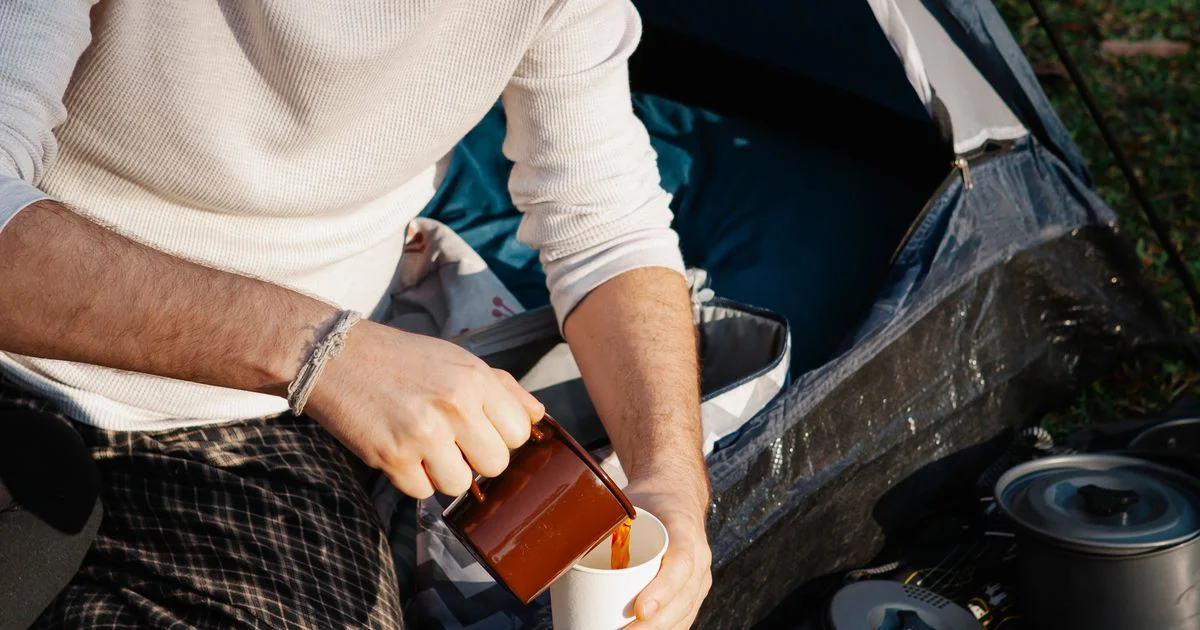
Camp coffee gets decided at 6 a.m., in the cold, by whatever is already in the bag. That is the honest test for a portable espresso maker for travel: not whether it can pull a good shot on a kitchen counter, but whether you will still bother with it on the third morning of a trip. The devices differ far less than the situations they get used in.
This is an independent editorial comparison. We are not affiliated with Wacaco, and no brand reviewed or approved this article.
Use case 1: A campsite with no power, where a portable espresso maker for travel lives or dies
A portable espresso maker for camping is usually a hand-pumped device, and the thing worth understanding first is that it does not heat anything. Wacaco says of its own hand-powered unit that “for a proper extraction it is best to heat up the water.” The maker supplies pressure; you supply hot water.
That means the real question at a campsite is not which maker to buy but what is boiling the water — and if you are already carrying a stove and a pot, you have most of a coffee setup regardless. The maker adds a small, strong cup to a kit you were bringing anyway.
A workable campsite routine looks like this:
- Boil water on the stove you already packed, and let it settle for a moment off the flame.
- Dose the basket with finely ground coffee and tamp it firmly — the published figure for one popular hand unit is roughly 8 grams, about a quarter ounce.
- Fill the water chamber. On that same unit the chamber takes about 80 milliliters, close to 2.7 fluid ounces.
- Pump steadily rather than frantically. The shot should take something like half a minute, not five seconds.
- Rinse the basket immediately, while the grounds are still wet and before they dry into the screen.
Cold mornings punish the last step most. Grounds left to dry in a basket overnight are the single most common reason a camping coffee habit lasts one trip.
Use case 2: An office kitchen, where cleanup decides everything
A portable espresso maker for the office has the easiest brewing conditions of any situation here — there is a kettle, a sink, and a bin within ten feet. What kills the habit is the two minutes of cleanup, done standing up, in a shared kitchen, four days a week.
Wacaco’s own support notes are candid about the maintenance this involves: clean the rim of the nozzle with the supplied brush, and periodically remove the seal, because grounds build up underneath and cause pressure to leak. A device that is not cleaned does not merely get dirty — it stops making good coffee, which is the part people misdiagnose as the device being bad.
The office test is therefore a simple one. Can you knock out the puck, rinse the parts, and dry them in under two minutes at a sink you share? If the answer is no, a capsule-based version of the same idea is the more honest purchase, because it trades some quality for a puck that lifts out in one piece.
Use case 3: A road trip, a 12-volt socket, and a device that heats its own water
The self-heating category exists mainly for cars. A portable espresso maker for road trips plugs into the vehicle’s 12-volt socket and boils its own water, which removes the stove from the equation entirely.
The trade-off is time. A vehicle socket supplies far less power than a household outlet, so heating enough water for a single cup takes minutes rather than seconds — which is fine at a rest stop and useless in a drive-through line. Two practical rules follow from that:
- Brew parked. A device full of near-boiling water, on the move, in a footwell, is not a thing to operate while driving.
- Run it with the engine on. Heating elements draw meaningfully on a socket that is often powered from the same battery you need to start the car.

Use case 4: A hotel room, where the kettle is already provided
In a hotel the constraints invert. There is hot water on the nightstand, no stove to carry, and no sink issue worth worrying about, but there is also very little space and a housekeeping staff who would rather you did not grind coffee on the desk.
This is the situation where pre-ground coffee or capsules make the most sense, and where the case matters more than the device. Coffee grounds loose in a suitcase are memorable in the wrong way. If the trip involves flights, note that the hand-pumped units have no battery in them at all, which makes them considerably simpler to pack than most travel gadgets.
Use case 5: What “18 bar” on the box actually tells you
Nearly every portable maker advertises a pressure figure, usually somewhere between 15 and 20 bar. It is worth knowing what the reference point is.
The Italian Espresso National Institute, which certifies espresso to a published specification, puts the entry water pressure at 9 bar, plus or minus 1. The rest of its certified figures are equally specific: roughly 7 grams of ground coffee (about a quarter ounce), water leaving the unit at 88 °C ± 2 (190 °F ± 4), percolation of 25 seconds ± 5, and 25 milliliters in the cup including the froth — a little under an ounce.
So 18 bar is double the certified figure, and that is not a mark of quality. A number like that describes what the pump can generate against a blocked outlet, not the pressure at the coffee during a real extraction. A grind that is too coarse lets water rush through at almost no pressure whatever the box claims; a grind that is too fine chokes the device entirely. The number on the packaging is the least useful specification in the category.
Use case 6: Grind, which is the thing that actually ruins it
If a portable maker disappoints, grind is the first suspect and the box is usually the last. Hand-pumped devices want a fine, espresso-grade grind, tamped hard. Supermarket pre-ground coffee is typically cut for drip machines, which is coarser, and it produces a thin, sour cup through a pressure device no matter how hard you pump.
That leaves a choice nobody puts on the packaging: carry a small hand grinder and grind on the trip, or buy coffee ground to espresso on the way out and accept that it will fade over a week. For a weekend, the second is fine. For two weeks at altitude, the grinder earns its space.
Side-by-side by situation
| Your situation | What it needs | What to skip |
|---|---|---|
| Campsite, no power | A hand-pumped maker and the stove you were already carrying | Anything that needs an outlet or a socket you will not have |
| Office kitchen | Parts you can rinse and dry in two minutes at a shared sink | A device whose cleanup routine you will quietly abandon |
| Road trip with a 12-volt socket | A self-heating unit, used parked, with the engine running | Expecting it to be quick — it heats slowly by design |
| Hotel room with a kettle | Pre-ground coffee or capsules, and a case that contains the mess | Packing a grinder for two nights |
| Chasing cafe quality anywhere | Fine grind, firm tamp, and a shot that takes about half a minute | Choosing between devices on the advertised bar figure |
Related Articles
- Cheapest Smart Luggage for International Travel: A Buyer’s Guide
- Smart Backpack for Travel: Airport Days, Campus, or Commute
Frequently Asked Questions
These are the questions that come up after the first few uses, once the novelty has worn off and the results have started to vary.
Is a moka pot the same thing as a portable espresso maker?
No. A stovetop moka pot brews at a small fraction of the pressure a certified espresso calls for, which is why it produces a strong, concentrated coffee without the crema and body of an espresso. It is an excellent camping brewer and a fine thing to own — it is simply answering a different question.
Can I use cold water if I have no way to heat any?
You can, and the manufacturer of one popular hand unit says as much, but the result is not espresso in any meaningful sense. Extraction depends on temperature as well as pressure, and the certified specification puts the water leaving the unit at about 190 °F. Cold water gives you a weak, sour cup with a deceptive layer of foam on top.
How much coffee does one of these actually make?
A single shot. The certified Italian figure is 25 milliliters in the cup, a little under an ounce, and portable devices are built around roughly that. If what you want is a mug of coffee at a campsite, a pour-over cone or a press weighs less, costs less, and does the job better.
Do I need to buy the brand’s own capsules?
Not necessarily — many hand units take both ground coffee and a capsule adapter, so you can switch depending on the trip. Ground coffee gives you a better cup and a worse cleanup; capsules reverse both. Choosing per trip rather than once is the reason to buy a device that accepts both.
Conclusion
The device matters less than the situation you are carrying it into: a stove decides the campsite, a sink decides the office, and a socket decides the car. Pick for the constraint you cannot change, grind finer than you think you should, and ignore the bar number on the box entirely.


1 Comment
Comments are closed.