

Hanging a row of shelves with a spirit level means measuring, marking, checking, and discovering at the end that the whole run drifts. The best laser level for home projects replaces all of that with a line you can see across the room — and for most DIY work, a modest one is genuinely all you need.
Key Takeaways
- Green beams are far easier to see than red, especially in daylight — and cost more.
- Self-leveling is the feature to insist on. Manual bubble-vial models waste the time you bought the tool to save.
- A cross line laser handles almost all household jobs. Rotary lasers are for outdoors and large sites.
- Accuracy specs are quoted at distance — irrelevant differences at the range of a normal room.
- A magnetic bracket or small tripod matters more day to day than any spec on the box.
What Makes the Best Laser Level for Home Projects
The short answer: the best laser level for home projects is a self-leveling cross line model with a green beam and a decent mount. That combination covers shelves, cabinets, tiling, picture walls, wainscoting and flooring, which is essentially the whole DIY range.
Beyond that, extra money buys features aimed at trades — outdoor range, receiver compatibility, multiple planes, dust and water sealing. They are real capabilities and they are wasted on a spare bedroom.
Beam Color Is the Biggest Practical Difference
The human eye is far more sensitive to green than to red at the same power, so a green line looks dramatically brighter and stays usable in bright rooms and near windows where a red line washes out and leaves you squinting.
The trade-offs: green units cost more, draw more power so batteries run down faster, and some struggle in freezing temperatures. For indoor DIY, green is still the easier recommendation — a line you cannot see is a tool you will not use.
Self Leveling Laser Review: The Feature Worth Paying For
Any honest self leveling laser review lands in the same place: this is the difference between a tool that saves time and one that does not.
A self-leveling unit uses an internal pendulum to find true level and plumb on its own, typically correcting for a tilt of a few degrees in any direction. Set it down roughly straight, let it settle for a second, and the line is right. Set it beyond its range and it warns you — usually by flashing the beam or beeping — instead of quietly projecting a crooked line.
That warning is the safety net. A manual-leveling laser has no way to tell you it is wrong, so an error at the wall becomes an error along the whole run.

Lock the Pendulum for Transport
Most self-leveling models have a transport lock that immobilizes the pendulum. Use it every time you put the tool away. A loose pendulum bouncing around a toolbox is the most common way these get knocked out of calibration, and recalibration usually means sending it back.
Cross Line Laser vs the Alternatives
A cross line laser projects one horizontal and one vertical line that meet in a cross, and that covers the overwhelming majority of household tasks. Knowing what the other types do saves you from paying for capability you will never use.
| Type | Projects | Best for |
|---|---|---|
| Cross line | One horizontal + one vertical line | Almost all indoor DIY — the default buy |
| Line laser (single) | One line only | Simple shelf runs; usually not worth saving on |
| 3D / 360-degree | Lines wrapping all four walls | Whole-room tiling, flooring, wainscoting |
| Rotary | Spinning beam, needs a receiver | Outdoors, decks, groundwork, long runs |
| Dot / plumb | Reference points, not lines | Transferring a point floor to ceiling |
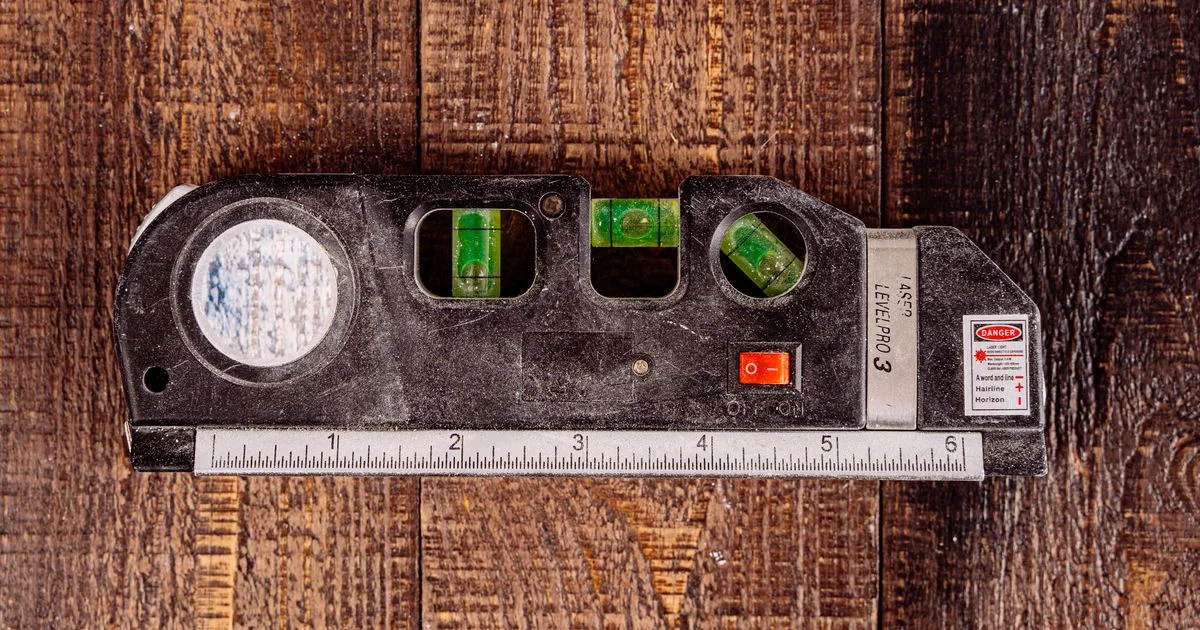
| Combination + tape | Short line plus a bubble vial | Picture hanging; limited beyond that |
Reading the Accuracy Spec
Accuracy is quoted as a deviation over a distance — something like a fraction of an inch at 30 feet. Two things follow. First, the error scales with distance, so at the ten or twelve feet of a typical room it is a fraction of the quoted figure. Second, the differences between consumer models at household range are usually smaller than the thickness of the laser line itself.
Which means accuracy is rarely the spec to choose on. Visibility and mounting are.
Best Laser Level for DIY: The Practical Extras
Picking the best laser level for DIY use comes down to the things you handle constantly rather than the things printed on the box.
- Get a magnetic pivot bracket. It sticks to a stud finder plate, a bracket or metal trim and adjusts by fine increments — often more useful than a tripod indoors.
- Check the tripod thread is the standard 1/4-20 size, so any camera tripod you already own will fit.
- Prefer AA batteries over a proprietary pack unless you already own that brand’s tool platform.
- Look for a pulse mode if you might ever work outdoors with a receiver.
- Check it can lock the horizontal line off, so you can project vertical only without a distracting cross.
- Test it on arrival — project a line, rotate the unit 180 degrees, and confirm the line lands in the same place.
- Store it locked and cushioned, ideally in the case it shipped in.
Laser Safety, Briefly
Consumer laser levels are low-powered, but they are still lasers. Do not look directly into the beam or point it at anyone’s face, and be careful at eye height in a room where children or pets are moving around. Check the class marking on the tool and follow the manufacturer’s guidance — and never use one where a reflection could send the beam somewhere you did not intend.
The Bottom Line
For household work, buy a self-leveling cross line laser with a green beam and a magnetic bracket, and stop there. Skip rotary units unless you are working outdoors, ignore small differences in quoted accuracy at room distances, and lock the pendulum every time you pack it away. Verify it with a 180-degree rotation the day it arrives, while you can still return it.
Related Articles
- Best Smart Doorbell Camera Buying Guide
- Best Wireless Mouse for Productivity
- Fitness Tracker Buying Guide
Frequently Asked Questions
These come up most from people buying their first laser level.
Is a green laser really worth the extra money?
Indoors, usually yes. A green line stays visible in bright rooms where red disappears, and visibility is what makes the tool faster than a spirit level. If you work mostly in dim interiors, red will do.
Do I need a tripod?
Not always. A magnetic pivot bracket is often more useful indoors because it grips brackets and trim at working height. A small tripod helps for floor-level work like tiling, and any standard camera tripod fits.
How do I know it is still accurate?
Project the line onto a wall and mark it, rotate the unit 180 degrees in place, and project again. If the two marks do not line up, the tool needs recalibration. Repeat this check after any hard knock.
Can I use one outside?
Only in low light, or with a laser receiver that detects the beam electronically. In daylight, no consumer laser line is visible at useful distance, which is what rotary lasers and receivers exist to solve.


